
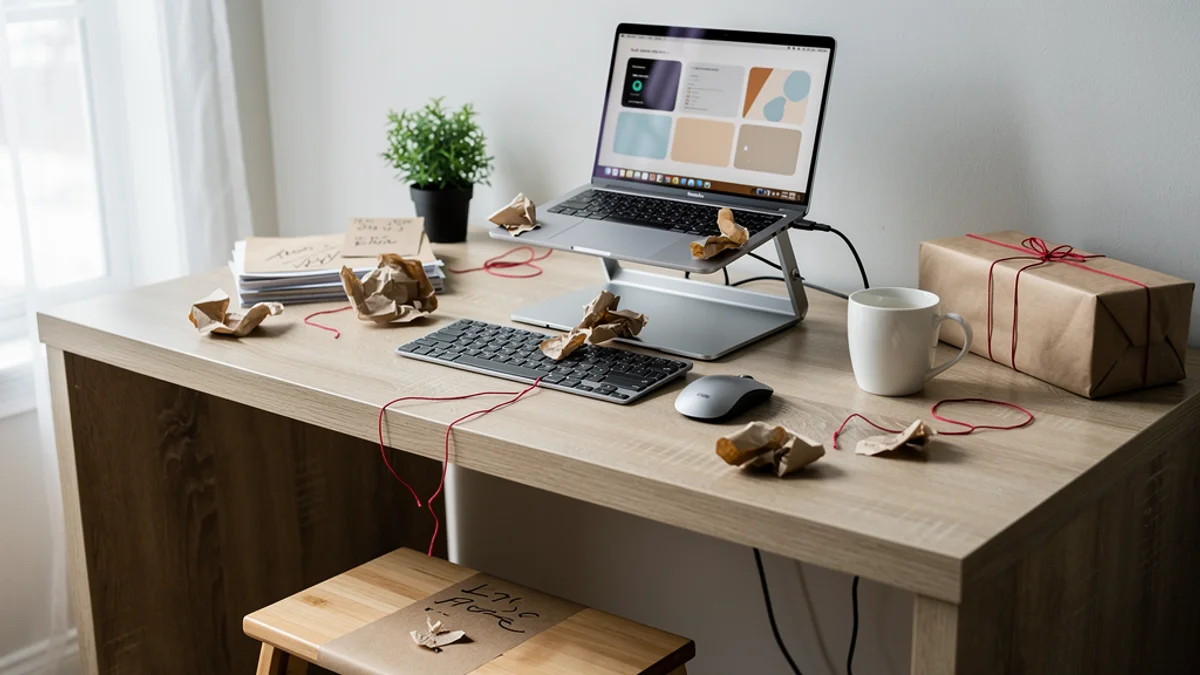
The ergonomic gifts for desk workers with the best evidence are plain, adjustable bits of kit: a laptop stand bought together with a separate keyboard and mouse, a monitor arm, a forearm support, a footrest, a sit-stand converter, or something that prompts short breaks. Blue-light glasses and balance-ball chairs are popular gifts with trials that found little or no benefit. A chair you pick for someone else is a guess about their body.
How to choose an ergonomic gift someone will use
Look at how they work before you buy. Someone on a laptop at the kitchen table needs a different gift from someone with two monitors and a proper office chair.
Then favour things that adjust. Bodies and desks vary, so a monitor arm or a footrest that can be set to the person beats a fixed-height gadget. Leave anything that has to fit them closely, like a chair or a split keyboard, to the person who’ll use it.
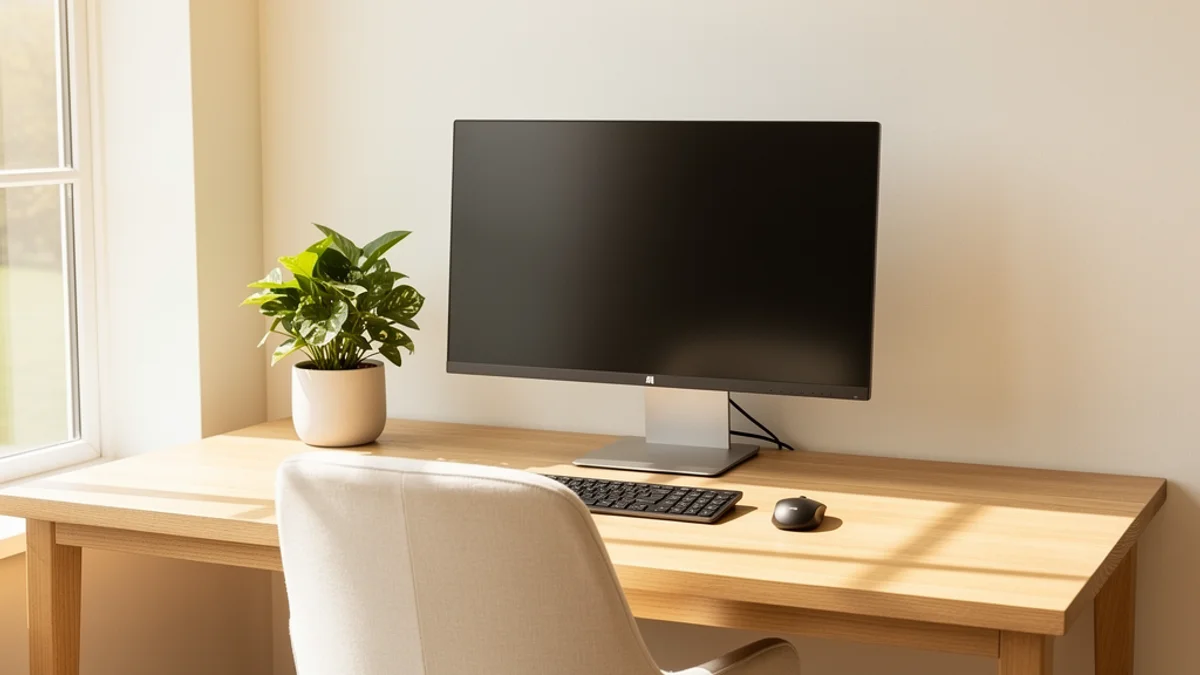
Ergonomic gifts for desk workers with evidence behind them
1. A laptop stand, bought with a keyboard and mouse
A stand on its own raises the screen and pushes the strain into the wrists. Researchers at the Harvard School of Public Health tested this with 15 people in Applied Ergonomics. Tilting a laptop up on 12° and 25° inclines reduced forward head tilt and neck flexion. It also increased wrist extension, and the steeper 25° incline got the lowest comfort ratings and the highest discomfort scores.
The UK Health and Safety Executive says to keep the keyboard and mouse separate from the laptop so the screen can go up on a riser. So buy the three together, or check they already own a keyboard and mouse. Our laptop stand guide covers what to look for.
2. A monitor arm or monitor riser
For anyone with a separate screen sitting too low, this is the equivalent gift. OSHA says the top of the monitor should be at or slightly below eye level, 20 to 40 inches (50 to 100 cm) from the eyes. The HSE puts the top of the screen level with the eyes, about an arm’s length away. OSHA and the HSE don’t quite agree, so an arm that lets them set the height themselves is the safer gift. More on that in monitor height and neck pain.
3. A forearm support
A forearm support board is the least exciting thing to unwrap here, and it has the strongest trial behind it. A one-year randomised trial of 182 call-centre operators, published in Occupational and Environmental Medicine, gave some of them a wide forearm support board along with ergonomics training. Compared with training alone, the board group had about half the rate of new neck and shoulder disorders (hazard ratio 0.49) and less neck, shoulder and right-arm pain.
A second trial in the same journal followed 206 engineers for a year. The forearm board reduced discomfort in the right arm and hand. An alternative mouse was tested too, and its protective trend wasn’t statistically significant. A vertical mouse is a fair gift for someone with wrist pain from typing, but this is weaker evidence than the board.
4. A footrest
A footrest needs no sizing. OSHA recommends one when lowering the chair would leave the keyboard or monitor too high, and says it may lift the knees slightly to take pressure off the back of the legs. Anyone shorter than their desk was designed for gets the most out of it. Our office chair guide explains how it fits in with seat height.
5. A sit-stand desk converter
A converter sits on an existing desk, so it’s an easier gift than a whole new desk. A Cochrane review of 34 studies found sit-stand desks cut sitting at work by about 100 minutes per workday over the first three months, and by about 57 minutes a day at three to 12 months. The evidence was rated low quality, and the review measured sitting time rather than pain or posture, which we cover in do standing desks fix posture.
6. Something that prompts short breaks
A kitchen timer counts. The same Cochrane review included one study where short breaks of one to two minutes every half hour cut sitting by about 40 minutes a day, compared with two 15-minute breaks. A meta-analysis in PLOS ONE pooled 22 study samples and found micro-breaks gave a small boost to vigour (d = 0.36) and a small drop in fatigue (d = 0.35). Their effect on overall work performance wasn’t significant.
If they’d rather have a nudge on screen, SitApp has a free plan with an hour of webcam posture monitoring a day, plus break reminders and Movement Breaks. We make it, so we’re hardly neutral.
Ergonomic gifts to skip
Blue-light glasses
A 2023 Cochrane review of 17 randomised trials found there may be no difference in eye strain between blue-light filtering lenses and ordinary lenses, over follow-ups of less than a week. The certainty was low. For tired eyes, the 20-20-20 rule is free.
A balance-ball chair
In a study of 14 people in Human Factors, an hour of computer work on a stability ball changed muscle activity and pelvic tilt only slightly compared with an office chair. People reported more discomfort on the ball.
A chair they haven’t sat in
Seat depth, lumbar height and armrest width all depend on the person. If you want to help with a chair, offer to put money towards one they choose. Our chair guide is a good place for them to start.
A posture brace is another common pick. We looked at the research in do posture correctors work before you spend money on one.
FAQ
What’s a good ergonomic gift for a coworker?
A footrest, a forearm pad or a laptop stand. None of them needs sizing, and they suit most desks.
Is a standing desk a good gift?
A converter is easier to give than a full desk. The research shows it reduces sitting time. It hasn’t shown less pain.
What should I buy a remote worker?
If they work on a laptop, a stand with a separate keyboard and mouse.
Are vertical mice worth buying as a gift?
They’re a reasonable option for someone with wrist or forearm discomfort. In the one year-long trial above, the alternative mouse’s benefit wasn’t statistically significant.
