
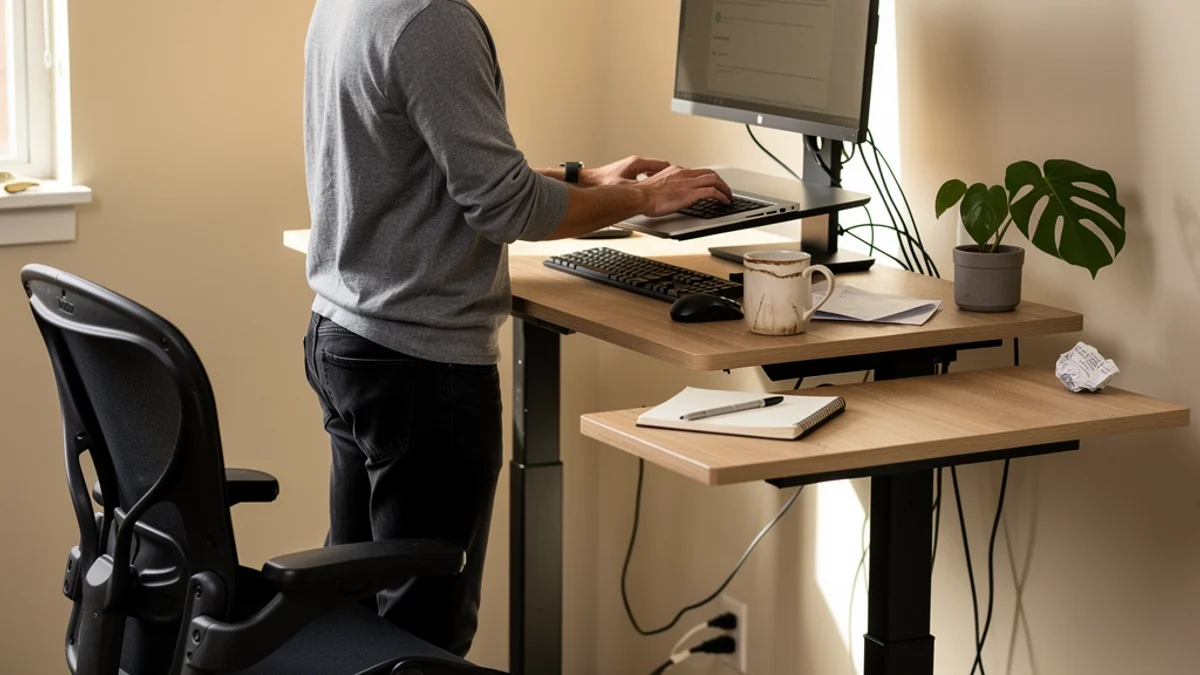
You bought the standing desk. Maybe you spent a weekend assembling it, or talked your manager into expensing one, and for the first few days it felt like a fresh start. Stand up, back straight, problem solved. Then a couple of weeks passed, and you caught your reflection in the dark monitor: chin poked forward, one hip cocked, forearm propped on the desktop like a bar stool. Standing, sure. But slouching all the same.
So do standing desks fix posture? The short answer is no, not on their own. A standing desk changes one thing about your day, and it’s a genuinely useful thing, but it isn’t the thing most people think they’re buying. The research on this is surprisingly clear, and it’s worth understanding before you decide the desk was a waste of money or a miracle cure. It’s neither.
Here’s what a standing desk actually does, what it can’t do, and how to set yours up so it earns its keep. If you’re still weighing the purchase, we’ve also compared standing versus sitting for posture in more depth.
What a Standing Desk Actually Changes
The one thing a standing desk reliably does is get you off your chair. That matters, because sitting for hours on end is its own health story. And the evidence backs it up, if modestly.
A Cochrane review of workplace sitting interventions pooled the trials and found that people using sit-stand desks sat somewhere between 30 minutes and two hours less per working day than people at conventional desks. Less sitting is a reasonable goal. Prolonged sitting is linked to a pile of metabolic and cardiovascular risks, and breaking it up is sensible.
But read the same review a little further and the caveats stack up fast. The quality of the evidence was rated low, the studies were small and often poorly designed, and the authors were blunt: there isn’t enough good evidence to say whether standing more at work repairs the harms of a sedentary lifestyle. Notice what that finding measures. Sitting time. The desk moves you from a chair to your feet, and that’s roughly where its job ends. What it can’t do is tell you what to do once you’re up there.
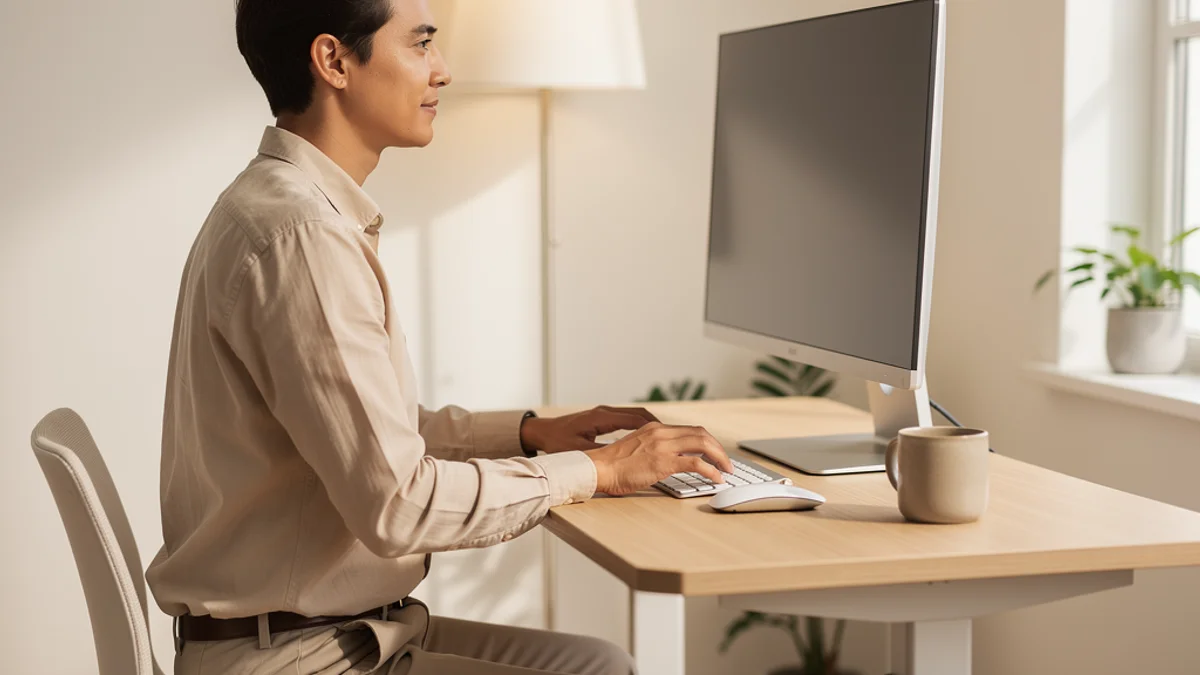
Standing Up Is Not the Same as Standing Well
This is where the “posture fix” idea quietly falls apart. Good posture isn’t a synonym for being vertical. You can hold a rounded, collapsed shape just as easily on your feet as in a chair, and plenty of people do.
Watch yourself at a standing desk for an afternoon and you’ll probably spot at least one of these:
- Forward head drift. The screen is a touch too low or too far, so your head creeps toward it. Standing does nothing to stop this. Your neck loads up exactly the way it does when you’re sitting and hunched over a laptop.
- The lean. One elbow or both forearms park on the desktop and take your weight. Now you’re standing, technically, while your spine curls and your shoulders round forward.
- The hip hitch. You shift all your weight onto one leg, pop the opposite hip, and settle in. It feels restful. It’s also an asymmetric load your lower back pays for over time.
To be fair, standing can help a little with one specific thing. One study of office workers with forward head posture found that using a standing desk nudged their craniovertebral angle in a better direction over a work session, where a traditional sitting desk let it drift the wrong way. Real, but small. We’re talking about a change of roughly one degree, and only while people were actually standing and set up properly. It’s a nudge that shows up when the screen is where it should be, and disappears when it isn’t.
Standing Too Long Has Its Own Bill
Here’s the part the standing-desk marketing skips. If sitting all day is bad, the fix is not standing all day. Standing brings its own set of problems, and they show up faster than you’d expect.
In one controlled study, researchers had pain-free volunteers stand for two hours. Thirteen of the sixteen developed low back discomfort in that single session. These were people who walked in with no back pain at all. Two hours of standing was enough to create it.
Zoom out to the working population and the pattern holds. A large analysis of the Fifth Korean Working Conditions Survey found a clear dose-response relationship: the more of the workday people spent on their feet, the higher their risk of musculoskeletal pain and physical fatigue, especially in the lower body. More standing was not automatically better. Past a point, it was worse.
None of this means standing is dangerous. It means “stand instead of sit” is the wrong mental model. Swapping a chair you never leave for a standing position you never leave just trades one static load for another.
So What Does the Research Actually Reward?
Movement. Variation. Changing position before your body starts complaining.
Physios have a line for this that’s worth stealing: your best posture is your next posture. Sitting was never the enemy, and neither was standing. What wears you down is holding any single shape for hours while your tissues quietly stiffen and load up in the same spots. A perfect ergonomic pose held for three straight hours still ends badly.
That reframes what a standing desk is for. It makes switching positions easy, and the switching is the healthy part. Used that way, alternating between sitting and standing through the day, it can genuinely help. Left in one position all day, sitting or standing, it does very little.
The trials hint at exactly this. A recent 6-month randomised trial of sit-stand desks in offices found that simply giving people the desks did not significantly cut their total sitting time compared to a control group. The furniture arrived. The habits mostly didn’t. Owning the desk and using it well are two very different things, and only the second one moves the needle.

Do Standing Desks Fix Posture? The Honest Verdict
So here’s the honest answer. A standing desk is a good tool and a poor cure. It hands you a lever and leaves the pulling to you. Whether it helps your posture comes down entirely to what you do with it, which is a slightly annoying answer if you were hoping the desk would do the work for you.
The people who benefit are the ones who use the desk to move more, alternate positions on a rhythm, and set their screen up properly. The people who don’t benefit are the ones who raise the desk, plant themselves, and lean on it for four hours the same way they used to melt into a chair. Same slouch, different altitude.
How to Actually Use a Standing Desk Well
If you’ve got one, or you’re about to buy one, here’s how to make it count. None of this is complicated, and it’s where the real posture payoff lives.
- Alternate on a timer, don’t tough it out. Rotate between sitting and standing every 30 to 45 minutes. Don’t chase a heroic all-day standing streak. The goal is frequent change, not maximum standing.
- Get the screen to eye level. Whether sitting or standing, the top of your monitor should sit around eye height so your head stays stacked over your shoulders. A standing desk with a low screen just makes you slouch on your feet. Our ergonomics guide for desk workers covers monitor and keyboard height in detail.
- Stop leaning. If you catch yourself propped on your forearms, reset. Weight through both feet, not the desktop.
- Add an anti-fatigue mat. Standing on a hard floor gets uncomfortable quickly, which pushes you into the hip-hitch lean. A cushioned mat makes standing sustainable enough that you’ll actually do it.
- Take real movement breaks. Every hour or so, walk somewhere. Standing still and walking are not the same input for your body, and the walk is the better one. It also helps with the afternoon energy dip that quietly wrecks posture later in the day.

Where Awareness Comes In
Every tip above has the same weak point: it relies on you noticing. And noticing is exactly the thing that fails when you’re two hours into a deep-work block. You don’t decide to slouch. You just look up eventually and realise you’ve been folded forward the whole time, standing desk and all.
That’s the gap a standing desk can’t close, because furniture has no idea what your body is doing. It’s also the gap we built SitApp to close. It uses your webcam and on-device AI to watch your actual posture, sitting or standing, and gives you a gentle nudge when you start to collapse. The video never leaves your computer, so the awareness costs you nothing in privacy. Think of it as the part of the setup that remembers to check on you when you’ve forgotten to check on yourself. The desk gives you the option to stand well. Something has to notice when you don’t.
FAQ
Do standing desks fix posture? No, not by themselves. A standing desk reduces the time you spend sitting, but you can slouch, lean, and poke your head forward just as easily standing as sitting. Posture improves when you change positions often and set your screen up correctly, not simply by owning the desk.
Are standing desks bad for you? Not inherently, but standing for long unbroken stretches has real downsides. Studies show prolonged standing can trigger low back discomfort and lower-body fatigue, even in people who started pain-free. The healthy pattern is alternating between sitting and standing, not standing all day.
How long should I stand at a standing desk? A common, sensible approach is to alternate roughly every 30 to 45 minutes rather than standing continuously. The exact ratio matters less than the change itself. Frequent switching between sitting and standing is what the evidence points toward.
Will a standing desk fix my back pain? It might help if back pain is worsened by prolonged sitting and you use the desk to break that up. But standing too long can cause its own back discomfort, so it’s not a guaranteed fix. If pain is persistent, see a physio or doctor rather than relying on furniture.
Is sitting or standing better for posture? Neither, held for hours. The best position is the one you’re about to switch to. A standing desk helps only because it makes switching easy. We go deeper on this in our standing desk versus sitting comparison.
The Takeaway
Do standing desks fix posture? A desk on its own doesn’t. What fixes posture is movement, variety, a screen at the right height, and enough awareness to catch yourself before a good setup turns into a slow slump.
This week: set a timer to switch between sitting and standing every 30 to 45 minutes, and raise your monitor to eye level.
This month: add a movement break every hour and pay attention to whether you’re standing well or just standing.
The standing desk is a good buy. Just don’t ask it to do a job it was never built for. Give it a way to actually watch your posture, and the two together get you a lot closer to sitting, and standing, a bit less terribly. You can try SitApp free and let it handle the noticing.
