
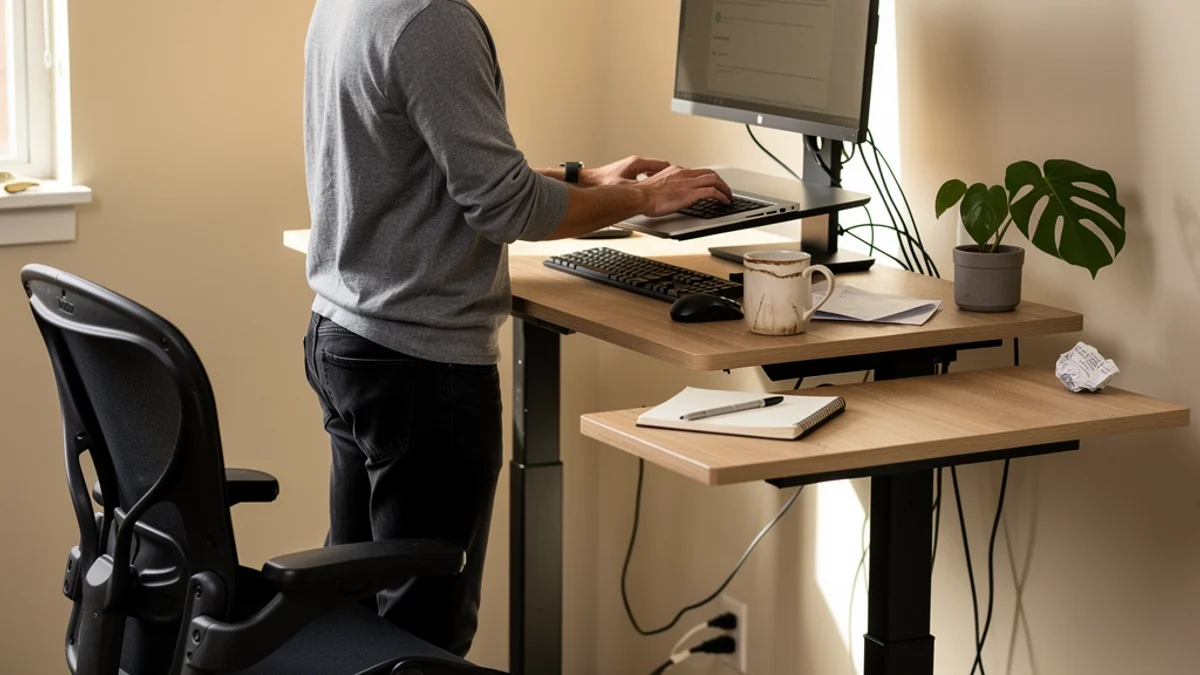
The standing desk industry wants you to believe sitting is killing you and standing will save you. The chair industry wants you to believe the opposite. The honest answer - the one backed by actual 2024 research - is that both camps are wrong.
If you’re trying to decide whether a standing desk will fix your posture, the research says you’re asking the wrong question. Staying still is the problem. Sitting still, standing still - both accumulate the same way.
This guide walks through what the latest studies actually found when comparing sitting and standing for posture, back pain, and long-term health - and what that means for your setup.
The Short Answer
Neither position is inherently better for posture. The spine is designed to move. Sitting with bad posture compresses your discs and rounds your shoulders. Standing with bad posture pinches nerves, fatigues your hip muscles, and loads your lumbar spine in a different way. The research keeps landing on the same conclusion: the best position is your next one.
The evidence does tip in one direction, though. Here’s the breakdown:
| Factor | Sitting | Standing |
|---|---|---|
| Spinal compression | Higher disc pressure, especially when slouched | Lower disc pressure with good alignment |
| Back pain risk (prolonged) | Chronic lower back pain common | ~40% develop back pain after 2 hours (Waterloo study) |
| Calorie burn per hour | ~80 kcal | ~88 kcal (Harvard) |
| Cardiovascular mortality risk | 34% higher for predominantly-sitting workers (JAMA 2024) | No cardiovascular protection over sitting; higher varicose vein risk (Sydney 2024) |
| Neck and shoulder pain | High if monitor placement is poor | Usually reduced with proper setup |
| Focus during deep work | Better for fine motor tasks, long writing | Better for calls, email, light tasks |
| Leg and foot fatigue | None | Significant after 1-2 hours without a mat |
Both positions carry costs when you stay in them too long. “Standing desk vs sitting” is the wrong frame for the actual question.
What the 2024 Research Actually Says
Two large studies published in 2024 should change how you think about this. If you’ve been told standing is the answer because “sitting is the new smoking,” this is where that narrative stops being accurate.
Sitting carries real mortality risk - but not how people think
A JAMA Network Open study followed 481,688 adults for an average of 12.85 years. People who predominantly sat at work had a 16% higher all-cause mortality risk and a 34% higher cardiovascular disease mortality risk compared to those who mostly didn’t sit.
But the fix wasn’t standing. Researchers found the risk was mitigated by 15-30 extra minutes of daily physical activity, or by alternating between sitting and non-sitting at work. The problem was staying put - not which piece of furniture you stayed put on.
Standing alone doesn’t offset the damage
The more interesting 2024 finding came from the University of Sydney’s International Journal of Epidemiology study. Researchers used accelerometer data from 83,013 UK adults over 6.9 years and concluded that standing more doesn’t reduce cardiovascular disease risk - and beyond about 2 hours of daily standing, it increases the risk of orthostatic circulatory diseases like varicose veins, chronic venous insufficiency, and venous ulcers.
Lead researcher Dr. Matthew Ahmadi put it bluntly: “Standing for too long will not offset an otherwise sedentary lifestyle and could be risky for some people in terms of circulatory health.”
Standing still creates its own back pain problem
A University of Waterloo study that standing desk advocates don’t love to cite: researchers tested 40 healthy adults with no previous back issues, and after just two hours of standing work, about 40% developed lower back pain. Not slight discomfort - actual pain. Lead author Daniel Viggiani’s summary: “The key take-away, regardless of whether you are sitting or standing at work, is to move around and shift your posture often.”
All three studies land on the same point: variability beats position. Whatever you’re doing right now, do something else soon.
The Real Posture Question
When people ask “is standing desk better than sitting for posture?” they usually mean one of three different things. Each has a different answer.
Q1: Does standing fix slouching?
No. Standing with bad posture is its own problem. Lean forward more than about 20 degrees and you load your lumbar spine harder than sitting upright would. Anyone who’s seen someone hunched over a standing desk, wrists angled up at a raised keyboard, chin jutting toward the monitor, knows the shape: standing slouch, just with tired legs.
Standing doesn’t teach you posture. It just changes which muscles get strained when your posture is wrong.
Q2: Does sitting cause slouching?
Chairs don’t make you slouch, but they make slouching easy. Without active engagement from your core and postural muscles, gravity and tired muscles will pull your shoulders forward and round your upper back within minutes. This is why proper desk posture has to be an active skill, not a passive starting position.
Q3: Is a sit-stand desk better than either alone?
Yes, when you actually alternate. A 2025 systematic review noted that workers using sit-stand desks decreased sitting time at work and reported reduced neck and shoulder pain, with increased vitality and self-rated work performance over four weeks - but only when they actually switched positions. Desks that became expensive shelves delivered nothing.
The hard part is that “actually alternate” bit.
Why Most Standing Desks Become Expensive Coat Racks
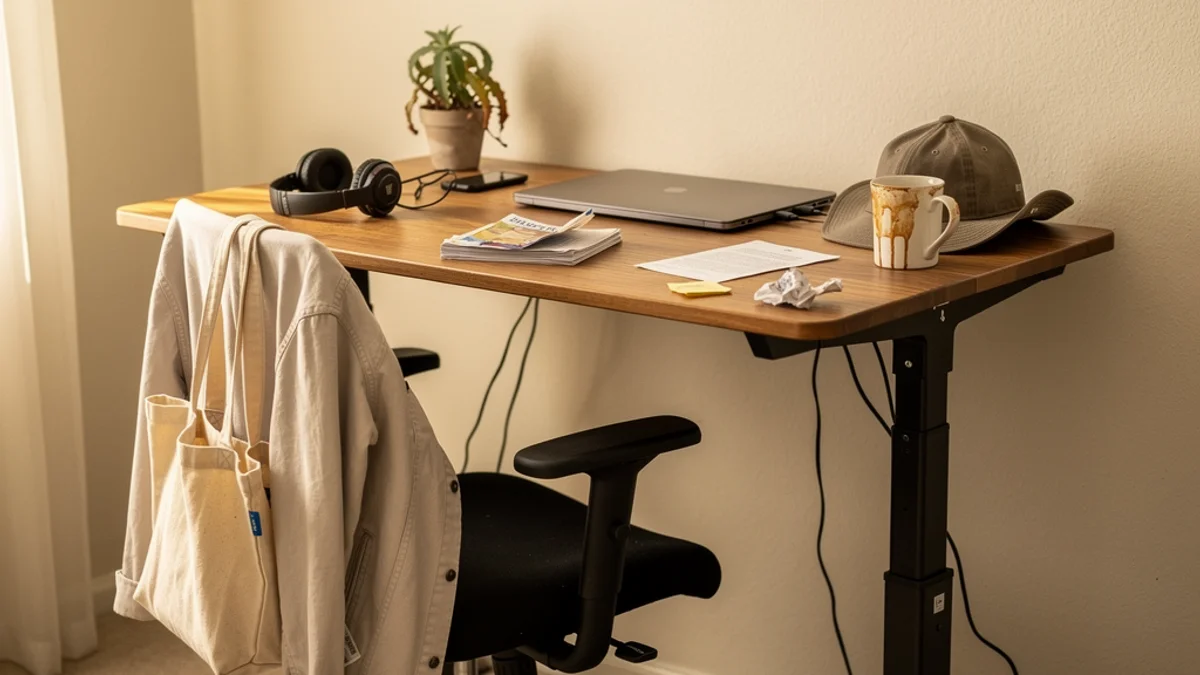
There’s a predictable pattern documented extensively across Reddit’s r/StandingDesk community and ergonomics research: person buys desk, uses it enthusiastically for 2-4 weeks, gradually sits more, eventually forgets to raise it, desk becomes a jacket holder.
A study on sit-stand desk compliance found that without automated reminders, the proportion of workers who never used the standing position barely changed over 12 months. With software prompts, it dropped from 26% to 9%.
The pattern from real long-term users (the ones on Reddit who’ll actually admit their desk became a shelf): they stopped standing because nobody told them when. The novelty wears off, the legs get tired, the task gets absorbing, and before you know it you’ve been sitting for three hours again. Willpower doesn’t hold. You need something external.
The Ratio That Actually Works
The best-supported sit-stand protocol is the 20-8-2 rule, developed by Alan Hedge at Cornell University. It breaks every 30 minutes into three parts:
- 20 minutes sitting with good posture
- 8 minutes standing
- 2 minutes moving (a quick walk, stretch, or water refill)
Over a 7.5-hour workday, that comes to roughly 5 hours sitting, 2 hours standing, and 30 minutes of accumulated movement - with about 16 position changes. The 2-minute movement piece is arguably the most important part; research from the CDC-funded Take-a-Stand Project found that reducing sitting time by just 66 minutes per day with regular breaks cut upper back and neck pain by 54%.
The specific ratio isn’t sacred. Some people do better at 30:10, others at 15:15. What the research actually supports is simple: don’t stay in any one position for more than 30 minutes. For a full breakdown of how to schedule this across a workday, see the 20-8-2 rule guide.
You Don’t Need a Standing Desk
This is the part the sit-stand industry won’t tell you. If you can’t afford a proper electric standing desk (they run £300-£600 for anything that isn’t wobbly), you’re not missing the main benefit.
The 2024 research is consistent on this: the health benefits come from movement, not from standing. You could skip the standing phase entirely and get 80% of the benefit just by taking a 2-minute walk every half hour.
Cheap alternatives that work:
- Walk during calls. Anything where you don’t need to type, do it standing or walking. Calls, podcasts, reading.
- Use a kitchen counter or high shelf for the 8-minute standing periods. Stack some books under your laptop.
- A $20 laptop stand on the kitchen counter is a functional standing desk.
- A sturdy cardboard box on your regular desk works in a pinch. This looks ridiculous but does the job.
- The 2-minute movement breaks are the real medicine. Water refill, bathroom, a lap around the flat. Do this every half hour and you’ve solved most of the problem without buying anything.
If you already have a standing desk, great. Use it. If you don’t, don’t feel pressured into spending the money. The research on improving posture while working from home consistently shows that movement frequency matters more than equipment.
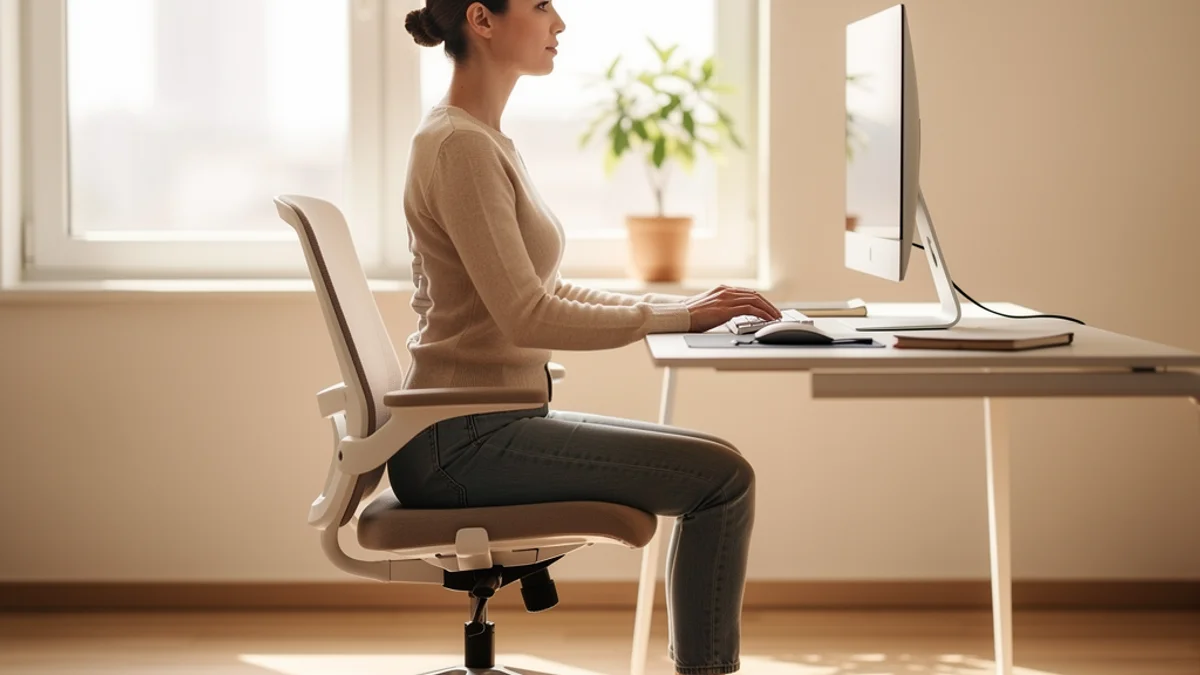
How to Set Up Either Position Properly
If you do have a sit-stand desk, the setup matters more than the switching. Bad ergonomics cancels any benefit from position variety.
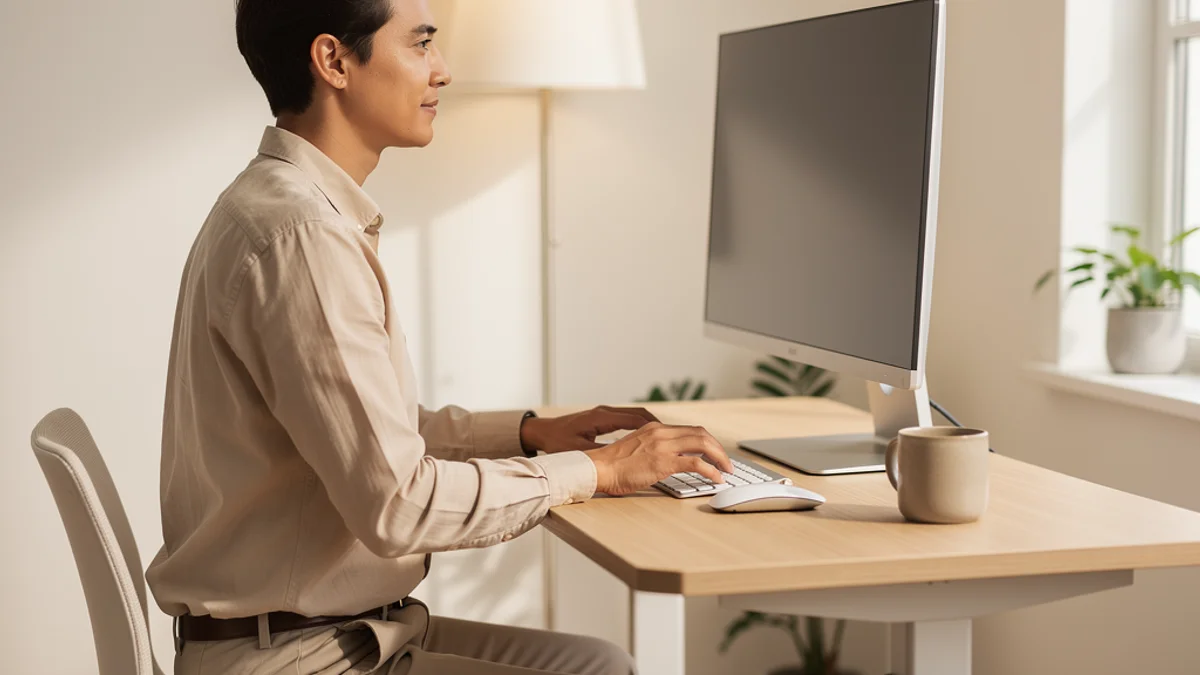
Sitting posture setup
- Feet flat on the floor. If they dangle, use a footrest (a shoebox or stack of books works fine).
- Knees at roughly 90 degrees, hips slightly higher than knees if possible.
- Back supported, lumbar curve preserved. A rolled-up towel works if your chair lacks support.
- Monitor at eye level. The top of the screen should be at or just below eye level. Laptop users almost always need a stand plus an external keyboard.
- Elbows at about 90 degrees when typing. Keyboard and mouse close to the body.
- Screen about an arm’s length away.
Standing posture setup
- Raise the desk so your elbows are at 90 degrees when typing. This is almost always higher than people set it initially.
- Monitor at eye level - same rule as sitting. If you don’t raise the monitor along with the desk, you’ve just created standing tech neck.
- Weight evenly distributed on both feet. Shift regularly. Don’t lock your knees.
- Use an anti-fatigue mat. This is the single upgrade long-term standers say made it sustainable. Hard floors destroy your feet after 30 minutes.
- Keep your core lightly engaged. Not braced, just active - don’t dump your weight into your lower back.
Both positions fail the same way: without active awareness of what your body is actually doing.
Where Posture Apps Fit In
Timers tell you when to switch positions. They don’t tell you how you’re sitting or standing in between. This is where most sit-stand routines break down - the 20 minutes of sitting is spent slouched, and the 8 minutes of standing is spent hunched forward.
This is what tools like SitApp are built for. It uses your webcam and on-device AI to watch your actual posture in real time - whether you’re sitting or standing. When you start slouching, it gives you a nudge. No images ever leave your device, nothing is sent to the cloud, and it runs quietly until you need it.
SitApp also includes a built-in Break Timer that prompts you to stand and move at whatever interval you choose. Set it to 20 minutes and you’ve got the time-based structure of the 20-8-2 rule running automatically, while the posture monitoring handles whether you’re actually doing it right.
For anyone who’s bought a standing desk and watched it become a shelf, this is the missing piece. The desk alone won’t change behaviour; the app makes the behaviour automatic.
Special Cases
If you have existing back pain
The research is split depending on where the pain is. Lower back pain from sitting often improves with more standing (start at 20-25% standing time, build up). Lower back pain from standing - often driven by hip abductor weakness, per the Waterloo study - can get worse with sit-stand transitions. If your pain intensifies within 10-15 minutes of switching positions, see a physio before making changes. Our guide on lower back pain from sitting covers position-specific triggers.
If you’re a developer or deep-focus worker
Sit for code. Stand for calls, email, Slack, and documentation review. This task-based switching tends to be more sustainable than clock-based switching because it ties to natural transitions. The deep work stays seated; the shallow work gets you on your feet. Our guide on posture for upper back pain from computer work goes deeper on the developer-specific setup.
If you’re pregnant
Standing tolerance decreases as pregnancy progresses, especially in the third trimester. Flip the ratio - favour sitting with good lumbar support, prioritise the 2-minute movement breaks over the 8-minute standing phase. Walk more, stand less.
If you have varicose veins
The 2024 Sydney study is particularly relevant here. Standing beyond about 2 hours daily increases circulatory issues. Keep standing short, move frequently, wear compression socks if your doctor recommends them.
FAQ
Is standing at a desk better than sitting for posture?
Not inherently. The 2024 research consistently shows that neither position is better in isolation - what matters is alternation and movement. Standing with bad posture loads your spine just as much as slouching in a chair. The best posture is the one you change regularly.
How long should I stand at a desk per day?
The University of Sydney’s 2024 study found that standing beyond about 2 hours daily can increase the risk of circulatory issues like varicose veins. The Cornell 20-8-2 rule suggests about 2 hours of standing spread across the workday in 8-minute intervals as a practical ceiling.
Does a standing desk fix bad posture?
No. Standing desks don’t teach posture - they just change which muscles tire when your posture is wrong. Fixing posture requires active awareness plus the right ergonomic setup. Tools like posture monitoring apps or working with a physio are what actually build the skill. The desk gives you the option to alternate; what you do with that option is on you.
Is standing better than sitting for back pain?
It depends on the source. People with chronic sitting-related back pain often improve with sit-stand alternation. But 40% of healthy people develop back pain after just 2 hours of continuous standing, per the Waterloo research. The answer is rarely “always stand” - it’s almost always “alternate and move.”
Do I really need a standing desk?
Probably not, if you’re on a budget. The main health benefit comes from breaking up sitting with movement, not from standing itself. A kitchen counter, a laptop stand on a high surface, or just walking for 2 minutes every half hour delivers most of the gain for zero cost.
Is sitting really “the new smoking”?
That claim is overblown. The 2024 JAMA study found a 16% higher all-cause mortality risk for predominantly-sitting workers - real but not remotely smoking-level. Smoking roughly doubles all-cause mortality. Prolonged sitting is a meaningful health risk; equating it to smoking isn’t supported by the evidence.
The Takeaway
Standing desk vs sitting for posture is mostly a marketing debate dressed up as a health question. The research is clear: neither position is inherently better, prolonged time in either causes problems, and the real variable is how often you change.
If you’ve been agonising over whether to buy a standing desk for posture reasons, here’s where things actually land:
- No standing desk? Save the money. Get a $20 laptop stand, set timers, and take 2-minute movement breaks every half hour.
- Have one already? Use it properly. Aim for roughly 2 hours of standing spread across the day, not in one block. Get an anti-fatigue mat.
- Whichever setup you’re running, the posture piece only works if something watches how you’re actually sitting or standing - something no desk can do on its own.
Want a tool that handles both the timing and the posture monitoring? SitApp watches your actual posture through your webcam, nudges you when you slouch (sitting or standing), and includes a built-in break timer for the movement side. All on-device, nothing uploaded, free tier gives you an hour a day - enough to build the awareness that makes the rest of your day better too.
Your body wasn’t designed for eight hours in any one position - that much the research agrees on. Sit well, stand well, and move between them.
