
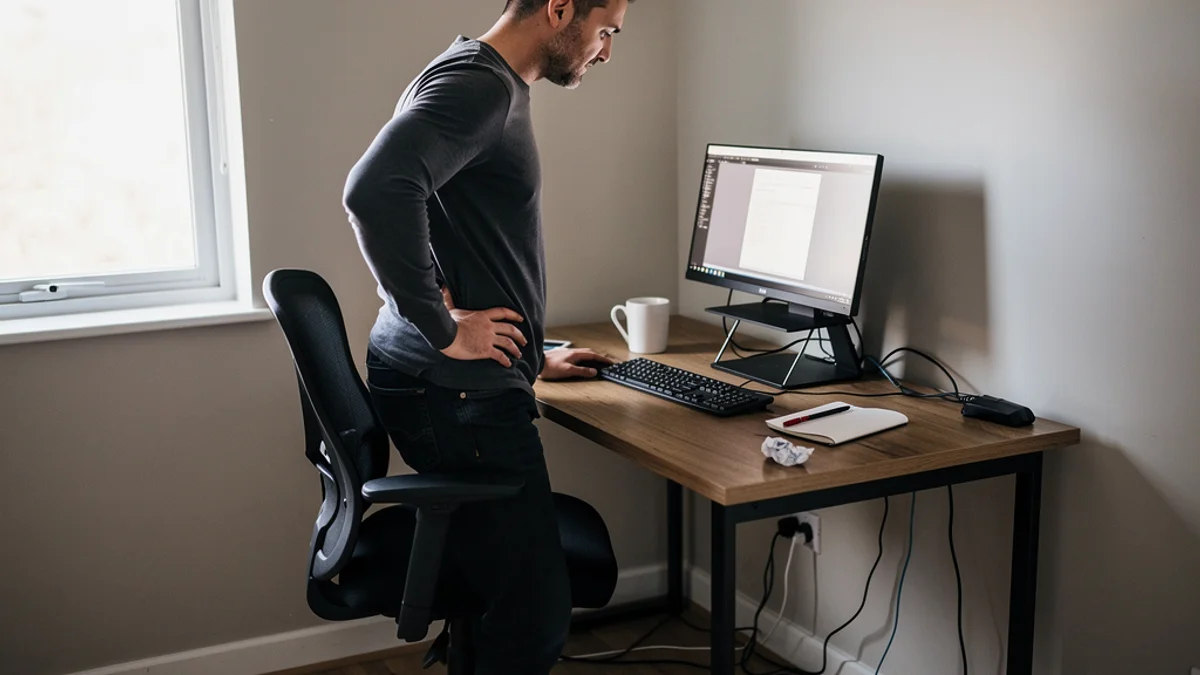
You stand up after a long session at the desk and the first four or five steps are not quite yours. There’s a band of tightness across the front of the hip, the stride is a bit short, and something in the lower back feels like it’s been holding a shape for too long. Walk to the kitchen and it fades. Sit back down for two hours and it’s waiting for you again.
Search for what’s going on and you’ll get the same answer everywhere. Sitting holds your hip flexors in a shortened position, they adapt, they get short, and now you need to stretch them. Harvard says it. Yoga Journal says it. Every physio blog on the first page of Google says it.
The odd thing is how little of that is ever referenced. It gets repeated as though it were settled anatomy. Go and read the research it rests on and you find one cross-sectional study, a modest effect size, and a set of authors being noticeably more careful than the people quoting them. That gap matters, because the version of the story you believe changes what you do at four in the afternoon.
Below: what these muscles are and which ones sitting can plausibly affect, what the evidence does and doesn’t show, a self-check with a real normal range attached to it, what genuinely improves hip extension, one very popular claim that a 2025 trial went looking for and failed to find, and the symptoms that mean this isn’t a desk problem at all.
What Your Hip Flexors Actually Are
“Hip flexor” is a group name, not a muscle. The main players are the iliopsoas and the rectus femoris, and the difference between those two is the part that most articles skip.
The iliopsoas is the deep one. StatPearls describes it as a unit made of the psoas major, the psoas minor and the iliacus. The psoas major runs down from the lumbar vertebrae, the iliacus fans out of the inside of the pelvis, and both converge onto the lesser trochanter, a small bump on the inside of the thigh bone. It is “the primary flexor of the thigh” and it also helps stabilise the hip. For our purposes the important bit is that it crosses the hip and nothing else.
The rectus femoris is different. It’s the middle of the four quadriceps, and StatPearls again puts it plainly: it “is responsible for thigh flexion at the hip and knee extension.” Two joints, one muscle. It starts on the pelvis and finishes at the kneecap.
Now picture yourself in a chair. The hip is bent to roughly ninety degrees, which brings the iliopsoas ends closer together. Fine, that part of the folk story holds up. But your knee is also bent to roughly ninety degrees, and knee flexion pulls the rectus femoris the other way. One end goes slack, the other end gets drawn out. Sitting does not put that muscle in a shortened position at all, at least not in any simple sense.
So when someone tells you eight hours of sitting is shortening “your hip flexors”, they’re describing something that could only be happening to one of them. This is why a hip flexor stretch that keeps the back knee bent feels completely different from one that lets it straighten, and why the two are worth telling apart before you pick one.
Does Sitting Really Shorten Them? The Honest Answer
Here’s where it gets thinner than you’d expect. There is one study people reach for, and it’s worth reading properly rather than through a headline.
Boukabache, Preece and Brookes published it in Musculoskeletal Science and Practice in 2021, and you can read the record on PubMed. They used the modified Thomas test to measure passive hip extension in 144 people, then sorted 98 of them into three groups using a questionnaire about activity and sitting. The cut-offs were 150 minutes of activity a week and either more than seven hours a day sitting or less than four.
The headline number is real. There was 6.1 degrees more passive hip extension in the high activity and minimal sitting group compared with the low activity and prolonged sitting group, and the difference across groups was significant at p < 0.001.
Read the design again though, because the group labels carry the point. The comparison that produced 6.1 degrees was not “sits a lot” against “sits a little”. It was “active and sits little” against “inactive and sits a lot”, which is two variables moving together. That’s why the researchers built a third group of people who were active and still sat for long stretches. Sitting and inactivity are not the same exposure, and the study was deliberately designed around that.
The authors are careful about what they’ve got. They call it the first demonstration of an association, say it’s “possible that these findings indicate a physiological adaptation in passive muscle stiffness”, and close by noting that further research is needed to know whether the adaptation has anything to do with pain at all.
Cross-sectional, association, possible, further research required. That’s a long way from the confident causal claim you’ll read on page one of Google, and it leaves a gap most articles fill with assertion.
Six degrees is also worth sizing up. It’s roughly the width of the minute hand moving one minute on a clock face. Measurable, genuinely there, and not the catastrophic seizing-up that the wellness framing implies.
Feeling Tight and Being Short Are Different Things
The sensation you get standing up from the chair is not a readout of muscle length. This sounds like semantics until you look at what happened when someone tested it directly.
Stanton and colleagues ran three experiments on back stiffness and published them in Scientific Reports in 2017. They measured how stiff people’s spines actually were with instrumentation, and asked the same people how stiff their backs felt. The two didn’t line up. They “found no significant relationships between perceived and actual stiffness at any applied force level”, and objective spinal stiffness did not differ between the people who reported feeling stiff and the people who didn’t.
What did differ was how those people processed sensation. The ones who felt stiff overestimated the force being applied to their spine, while simultaneously being better than everyone else at detecting changes in that force. The authors read this as a protective construct: a body flagging an area as needing care, not a strain gauge reporting on collagen.
That’s a back study, not a hip study, so don’t over-extend it. But it should change how much weight you put on the feeling. The tight band across the front of your hip at 4pm is information about your nervous system’s current opinion of that area. It is not a measurement. It eases within a minute of walking, and no tissue changes length in a minute.
This is the same trap as anterior pelvic tilt from sitting all day, where a normal anatomical variation gets read as damage because someone online said it was.
Signs You Actually Have Tight Hip Flexors
If you want to know rather than guess, there’s a test, and there’s a normal range to compare against. Most articles give you the first and skip the second, which makes the result useless.
The modified Thomas test works like this. Sit on the very end of a sturdy table or a firm bed, close enough to the edge that half your thigh is off it. Hug one knee firmly to your chest, then lie back so your back is flat. Let the other leg hang freely off the edge, completely relaxed. Now look at that hanging leg.
Roughly level with the table or dropping slightly below it is unremarkable. Hanging clearly above the line of the table, so the thigh is still pointing a little upward, suggests limited hip extension. If the knee also wants to straighten out as the thigh drops, that’s the rectus femoris rather than the iliopsoas, which tells you which stretch to reach for.
The important number is what counts as normal, and it’s humbling. A 2024 reliability study in the International Journal of Sports Physical Therapy measured 64 healthy adults with a mean age of 23.7 and found average hip extension of 5.43 ± 9.73 degrees. Look at that spread. The standard deviation is nearly twice the mean, which means perfectly healthy young people range from well past neutral to a fair way short of it, with nothing wrong with any of them.
So a leg that hangs a bit high is not a diagnosis. It’s one reading inside an enormous normal band. The same study found the test itself is reliable when pelvic tilt is controlled, with intra-rater agreement of 0.911 and inter-rater agreement of 0.851, so the measurement is trustworthy even when the interpretation people hang on it isn’t.
The signs worth taking seriously are functional. A stride that stays short after you’ve been walking a couple of minutes. Trouble getting the trailing leg behind you in a lunge without the lower back arching to make up the difference. Front-of-hip pinching when you sprint, cycle hard or squat deep. Any of those is worth acting on. A leg that hangs two degrees high on a kitchen table is not.

What Actually Changes Hip Extension
Here the evidence is in better shape than it is for the problem itself.
A randomised clinical trial in Physical Therapy took 33 patients with limited hip extension and assigned them to active or passive home stretching, measuring at baseline, three weeks and six weeks. Range of motion improved in both groups over time, with no difference between them. The PubMed record has the detail. A null result, and a genuinely useful one, because it means you can stop researching which variation is optimal and go and do one.
A 2025 cohort study in the International Journal of Sports Physical Therapy put a number on the dose. Twenty-three young adults with hip flexor tightness, twelve of them doing five minutes of a lunge-and-reach stretch daily for six weeks. The intervention group gained a mean 5.92 ± 3.73 degrees on the modified Thomas test, p = 0.01. Five minutes a day for six weeks bought back roughly what the Boukabache study found separated the most active from the least.
The lunge-and-reach itself is simple. Half-kneeling, back knee on something soft, front foot flat and forward. Tuck your tailbone under to flatten the arch in your lower back before you move an inch, then shift your weight gently forward until you feel a stretch in the front of the back hip. Reach the same-side arm up and slightly over. Hold for thirty seconds, five times each leg. That pelvic tuck at the start is the whole exercise. Without it you’ll just arch your lower back and feel a convincing stretch that isn’t happening at the hip.
One caveat on timing. A 2018 study in the same journal compared dynamic stretching against hold-relax PNF in 36 people with tight hip flexors, and found both improved hip extension immediately, with PNF ahead. But the follow-up measurement was taken five minutes later. Those are acute effects. A stretch before a gym session is a warm-up, and a warm-up does not accumulate, so don’t mistake the pleasant loose feeling afterwards for a lasting change. The 5.92 degrees took six weeks of showing up.
If you want a routine that covers more than the hips, the five-minute desk stretch routine and the posture exercises for desk workers are the places to start.
Stretching Is Only One Way to Get the Range
Almost no hip flexor article gets this far, which is a shame, because you can buy the same degrees with a barbell.
Afonso and colleagues pooled 11 randomised controlled trials covering 452 people in Healthcare and compared strength training against stretching for range of motion. The pooled effect was ES -0.22 with a confidence interval of -0.55 to 0.12, p = 0.206. Nothing between them.
A much larger 2023 meta-analysis in Sports Medicine pulled in 55 studies and reached the same place from a wider base. Resistance training improved range of motion against a control condition at ES 0.73, p < 0.001, and came out level with stretch training at ES 0.08, p = 0.79. Their closing line is blunt: stretching before or after resistance training “may not be necessary to enhance flexibility.”
Two things buried in that paper are worth more to a desk worker than the headline.
The subgroup analysis split people by activity level. Trained and active participants improved at ES 0.43. Untrained and sedentary participants improved at ES 1.042, and the gap between the groups hit significance at p = 0.005. Spend three years in a chair and you land in the group with roughly double the room to move.
The other finding will save you some wasted effort. Resistance training using only body mass produced no significant range of motion improvement at all. Air squats and bodyweight lunges did not do it. The gains came from external load.
So a set of split squats with dumbbells, taking the back hip into extension under weight, is doing the same job as the stretch and building something while it’s there. Reverse lunges, Bulgarian split squats and step-ups all put the trailing hip through range with load on it. If you already lift, you may not need a dedicated stretching habit at all.
The ATG split squat, and what’s actually behind it
If you’ve been anywhere near fitness content in the last few years you’ll have met this one already. Ben Patrick, who trains and publishes as Knees Over Toes Guy, built a large following on the idea that knees travelling past the toes is something to train rather than avoid, and his ATG split squat is the exercise most people know him for. Deep split squat, front knee sliding well forward over the foot, back leg trailing long behind you.
It is relevant here for a reason that has nothing to do with knees. At the bottom of that position the rear hip is in deep extension with bodyweight and often a load on top of it, which is the exact thing the meta-analyses above are describing. The front leg meanwhile is working through deep hip flexion. One movement, both halves of the hip flexor job.
The knees-past-toes half of his argument has a real biomechanical basis. Fry, Smith and Schilling put seven weight-trained men through barbell squats with and without a wooden barrier blocking the knees from travelling forward, and published the joint torques in the Journal of Strength and Conditioning Research. Blocking the knees dropped knee torque from 150.1 to 117.3 newton metres. It sent hip torque from 28.2 to 302.7. The load did not disappear, it moved, and the authors concluded that appropriate joint loading “may require the knees to move slightly past the toes.”
Hold that one loosely. Seven participants, a barbell back squat rather than a split squat, and a 2003 paper. It supports the principle without validating any particular programme built on top of it.
Which is the honest position on the rest of it. Search PubMed for the ATG split squat and you get nothing, because nobody has run a trial on it. What exists is a coach with a large body of case reports and a lot of people who say it helped them, and that is a different category of thing from the 55-study meta-analysis two paragraphs up. The movement is a sensible application of well-supported principles. It is not itself a tested intervention, and anyone telling you otherwise is doing the thing this whole article is about.
Practically: it asks a lot of ankle and knee range before you can even reach the bottom position, which is why most people should start shallow and earn the depth over months. A plain loaded split squat through whatever range you currently own puts the trailing hip into extension just fine, and that’s the part your hip flexors care about.
Worth being honest about the limits of this. Both meta-analyses measured range of motion across many joints and populations, and neither ran a loaded hip flexor programme against a hip flexor stretch with the Thomas test as the outcome. Nobody has done that trial. What the evidence supports is the general principle, which is strong and consistent, rather than a hip-specific prescription.
Training the flexors themselves is a separate job again, and a reasonable one if your self-check showed a short hanging leg. Hanging knee raises, standing band-resisted hip flexion held at the top, slow leg lowers. These train the muscle in the range it actually has to work in, which matters because tightness at end range is sometimes just an absence of strength there, and no amount of stretching will supply that.
The Glute Claim You Can Drop
Somewhere in the last decade “tight hip flexors switch off your glutes” became something everyone knows. Reciprocal inhibition, dormant butt syndrome, the whole vocabulary. It sounds mechanically plausible, which is how most of these things get their staying power.
The 2025 lunge-and-reach study went looking for it. Alongside the Thomas test they measured glute strength with a handheld dynamometer, glute endurance with a single-leg bridge held to failure, and glute power with a single-leg broad jump. If tight hip flexors were suppressing the glutes, six weeks of stretching that visibly lengthened the hip flexors should have freed them up.
Hip flexor length improved by 5.92 degrees. Glute strength did not change, p = 0.23. Glute endurance did not change, p = 0.26. Broad jump distance did improve, by 12.39 cm, which the authors put down to the mechanics of the jump rather than a sleeping muscle waking up.
So the stretch worked and the glutes stayed exactly as strong as they were. If your glutes are weak, the fix is loading them. Bridges, hip thrusts, step-ups, walking up hills. Stretching the front of the hip is a fine thing to do and it is not glute training.
Prevention: The Part That Actually Beats Stretching
Go back to the Boukabache design for a second. The biggest measured gap was between people who were active and sat little, and people who were inactive and sat a lot. Total sitting hours were only half of that comparison.
Which lines up with how the day actually feels. The tightness that arrives at 3pm did not come from a muscle changing length between lunch and mid-afternoon. It came from holding one hip angle for ninety minutes without interruption. The variable you can move cheaply is not how many hours you sit. It’s how long the unbroken stretches are.
Sit-stand desks are the well-studied version of this. A randomised controlled trial in BMC Public Health gave 26 office workers a sit-stand workstation for eight weeks against 21 controls, and found a reduction of 80.2 minutes of sitting per eight-hour workday (95% CI -129.0 to -31.4, p = 0.002). No harmful changes in musculoskeletal discomfort, and total cholesterol came down too. Worth knowing before you buy one: standing desks help by adding variety, not by being a better posture.
You don’t need the hardware. Objective measurement with activity monitors found office workers sedentary for 5.69 hours of an 8.5-hour workday, around two thirds of it. Breaking that into shorter blocks costs nothing. The 20-8-2 rule is one workable pattern, and standing up to take calls is another. Three minutes of walking an hour puts the hip through full extension dozens of times, which is more total range of motion than any stretch session you’ll realistically do.
In order of what it will get you: interrupt the long blocks, then stretch daily if your test flagged something, and put worrying about the number itself a long way last.
This is the problem SitApp exists to solve, though not from the hip end. The Droid watches your posture through the webcam and nudges you when you’ve drifted, and one thing it makes visible is how long your unbroken sitting blocks really are. Most people guess forty minutes and are closer to two hours. SitApp is free to try, it runs entirely on your machine, and no video ever leaves your computer.
When It Isn’t Just Tightness
Front-of-hip discomfort from desk work is usually mechanical and usually boring. Some of it isn’t, and tightness is a cheap explanation that can cover something that needs looking at.
The NHS hip pain page sets out when to see a GP: “hip pain is stopping you doing normal activities or affecting your sleep”, “the pain is getting worse or keeps coming back”, “the pain has not improved after treating it at home for 2 weeks”, and “you have hip stiffness for more than 30 minutes after waking up”.
That last one deserves attention, because it looks exactly like the thing this article is about. Desk-related hip tightness turns up after sitting and clears within a minute or two of moving. Stiffness that is waiting for you when you wake up and takes more than half an hour to shift is a different pattern and belongs in front of a doctor.
Get urgent advice for severe hip pain that started suddenly without a fall or injury, a hip that is swollen and hot, skin around the hip that has changed colour, or hip pain with feeling generally unwell and a high temperature.
Worth separating this from its neighbours too. Pain that travels down the back of the leg is more likely sciatica from sitting. Pain that stays in the lower back is lower back pain from sitting at a desk. A deep ache around the hip joint itself, rather than a band across the front, is covered in hip pain from sitting all day.
FAQ
Can sitting all day permanently shorten your hip flexors?
No evidence supports permanent shortening. The strongest available study found a 6.1 degree difference in passive hip extension between active low-sitters and inactive high-sitters, and six weeks of daily stretching has been shown to recover around 5.92 degrees. The gap is small and it moves.
How long does it take to fix tight hip flexors?
Six weeks of five minutes a day produced a measurable change in the trial evidence. Expect the sensation of tightness to ease much sooner than the measurement does, since the two are only loosely related.
Is the couch stretch better than a standard lunge stretch?
Putting the back foot up behind you adds knee flexion, which biases the stretch toward the rectus femoris. A flat-footed half-kneeling lunge targets the iliopsoas more. Which is better depends on which one your Thomas test flagged.
Do tight hip flexors cause lower back pain?
The link is assumed more than demonstrated. The authors of the main sitting study explicitly said further research was required to know whether the adaptation they measured plays any role in musculoskeletal pain. Treat the connection as plausible, not established.
Should I stretch my hip flexors every day?
Daily is what the six-week study tested and it worked. There’s no evidence that more than five minutes a day adds anything, and no evidence that stretching prevents injury on its own.
Is stretching or strengthening better for tight hip flexors?
Two meta-analyses found no difference between them for range of motion. Sedentary people gained more than twice as much as active people from resistance training, so if you sit all day and already lift, loaded split squats may be all you need. Bodyweight versions did not work.
Do ATG split squats fix tight hip flexors?
The position puts the rear hip into loaded deep extension, which is a sound application of what the range-of-motion research supports. No trial has tested the exercise itself. Start with a shallow loaded split squat and work into depth rather than chasing the full version early.
The Short Version
Sitting probably does reduce hip extension a little, and the honest size of the effect is a few degrees rather than a crisis. Feeling tight and being short are separate things, and the feeling that clears after sixty seconds of walking was never about tissue length. Normal hip extension covers such a wide range that a single self-test result tells you less than you’d hope.
Three things to do with that:
This week, run the modified Thomas test once so you have a baseline, and stop reading the 3pm tightness as damage.
This month, pick one of the two routes that work equally well. Five minutes of half-kneeling lunge-and-reach a day, or loaded split squats taking the back hip into extension. Load your glutes separately either way, because neither route will do it for you.
Ongoing, break the long sitting blocks. It costs almost nothing, it’s the variable with the most room to move, and it’s the one that changes how 4pm feels.
If the stiffness is there before you’ve sat down, lasts more than half an hour after waking, or keeps getting worse, stop self-managing it and see a GP.
