

You’ve read a desk stretch article before. Probably several. There was a list of thirteen moves grouped by body part, a photo of somebody in a blazer doing a triceps stretch, and a closing line about how your body will thank you.
You did them twice. Maybe three times. Then Thursday happened.
Blaming the stretches misses it. Nearly every list out there describes the same sound, safe movements, and they mostly work. What sinks you is that a list of thirteen options at 3pm is a decision, and a decision is exactly what you can’t spare when you’re halfway through something difficult.
So this guide does it the other way round. One fixed sequence of five desk stretches, roughly 90 seconds, done from your chair without standing up. Same five every time. No choosing.
The 90-Second Desk Stretch Routine
Here’s the whole thing. Read it once and you shouldn’t need to come back.
- Chin tucks - 15 seconds
- Shoulder rolls - 15 seconds
- Seated chest opener - 20 seconds
- Seated spinal twist - 20 seconds, both sides
- Wrist and forearm stretch - 20 seconds, both hands
That’s it. Five moves, in that order, from your chair. You can run the whole sequence with a headset on and a call in your ear, which is a bigger deal than it sounds when most of your day is meetings.
The order is deliberate. It runs top to bottom so you’re not bouncing around your body, and it finishes at the wrists, which is where a lot of desk workers actually hurt even though most stretch guides treat forearms as an afterthought.
How to Do Each One
The instructions below take longer to read than to perform. Aim for slow and boring. No bouncing, no forcing, and nothing should hurt.
Hold each position for a reasonable stretch rather than a heroic one. The Canadian Centre for Occupational Health and Safety suggests you hold a stretch for 10 to 20 seconds, which is the range this routine uses.
1. Chin Tucks (15 seconds)
Sit tall. Without tipping your head down, draw your chin straight back toward your throat, as though someone is gently pushing your forehead. You’re aiming for a stretch at the base of your skull and a mild double chin, and yes, the double chin means you’re doing it right.
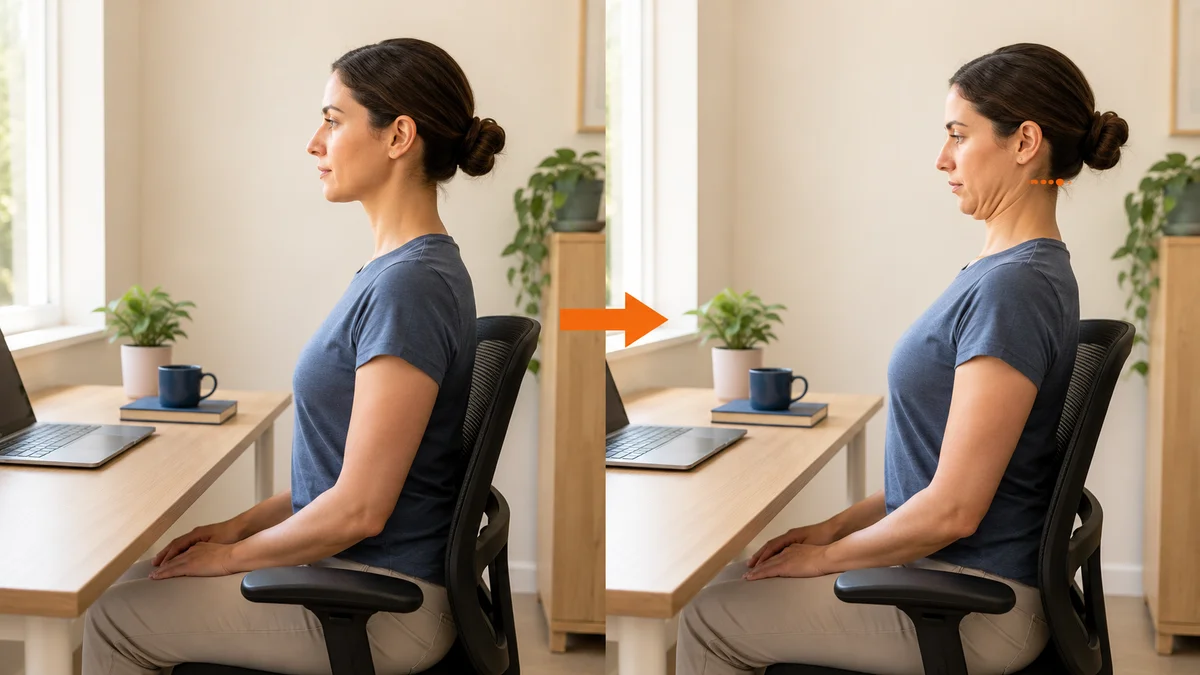
Hold for 5 seconds, release, repeat three times.
This one counters the forward head drift that builds up over a morning of screen work. If your neck is the part that complains loudest, our guide to neck pain from desk work goes deeper on why.
2. Shoulder Rolls (15 seconds)
Lift both shoulders up toward your ears, roll them back, then let them drop. Slowly. Five rolls backward is plenty.
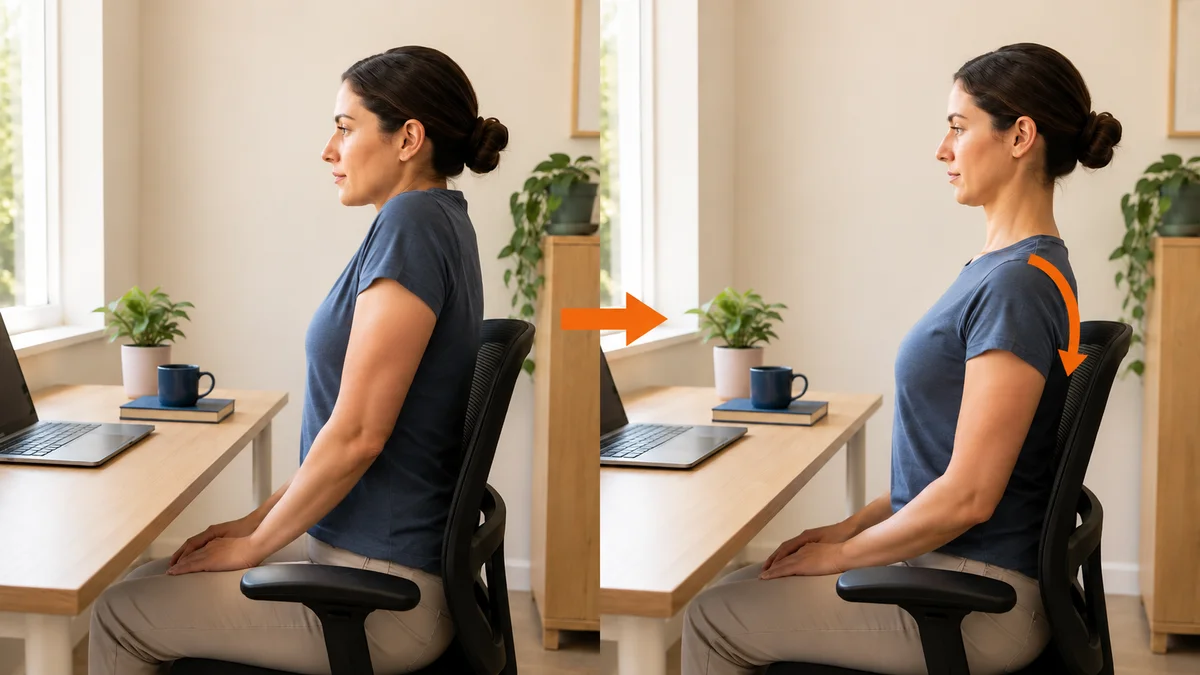
Most people do this one too fast and turn it into a shrug. Let the drop happen under gravity rather than pulling your shoulders down.
3. Seated Chest Opener (20 seconds)
Clasp your hands behind your head, elbows wide. Gently draw your elbows back and lift your breastbone. Breathe in as your chest opens.
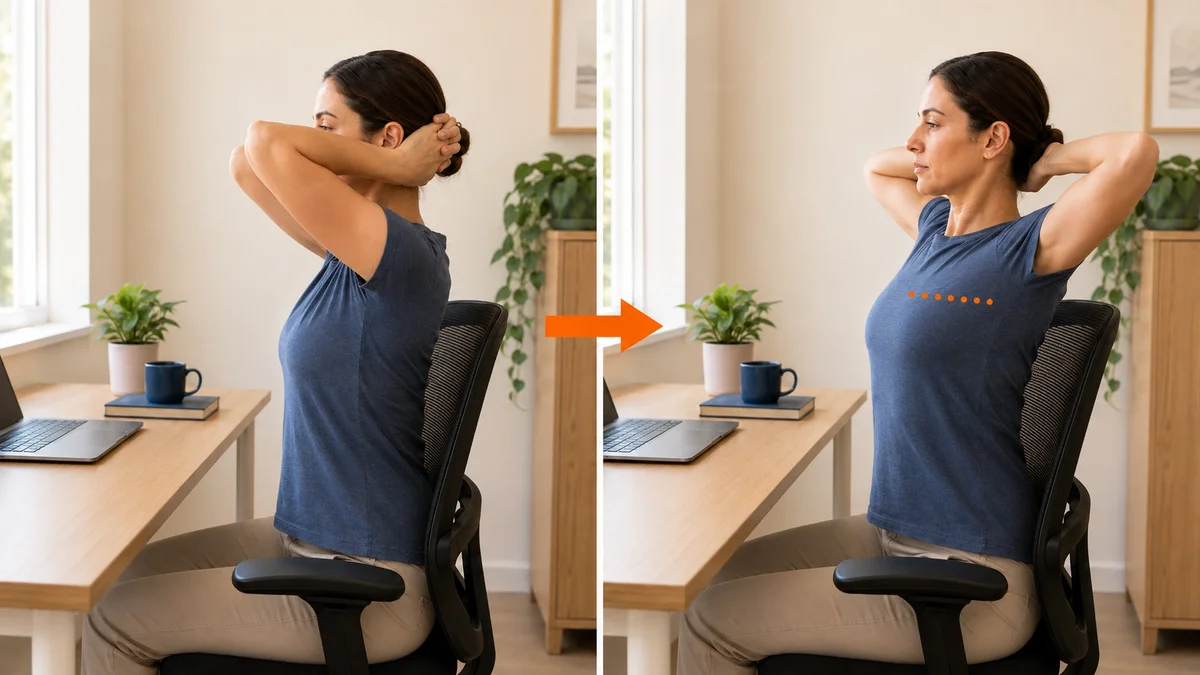
If clasping behind your head feels awkward in an open office, take your hands behind the chair back instead and interlace your fingers there. Same effect, and it reads as a normal post-meeting stretch to anyone glancing over.
This is the one that counteracts hours of typing with your arms out in front of you, and it pairs with the work in our guide on how to fix rounded shoulders.
4. Seated Spinal Twist (20 seconds)
Sit tall with feet flat on the floor. Place your right hand on the outside of your left thigh, left hand on the chair back or armrest, and rotate gently to the left. Turn from the ribs rather than yanking with your arms. Hold 10 seconds, then swap.
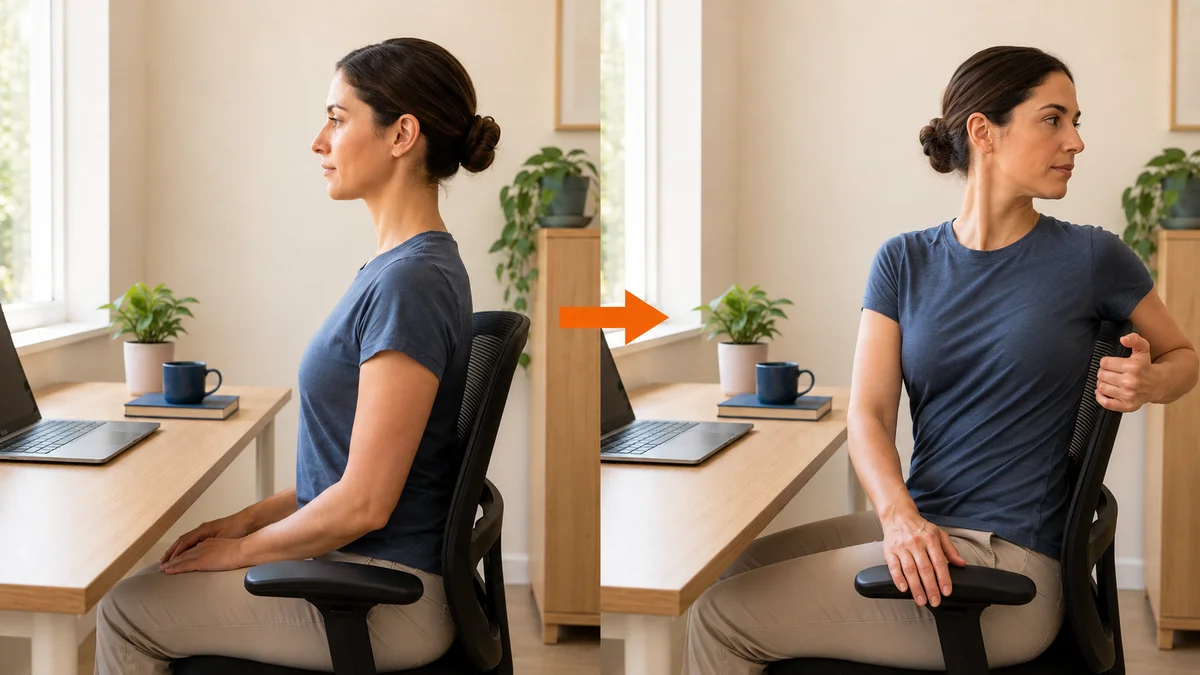
Keep both hips planted. The moment one hip lifts, you’re twisting the chair instead of your spine.
5. Wrist and Forearm Stretch (20 seconds)
Extend one arm straight out at shoulder height, palm facing down, elbow straight. Let the hand drop so the fingers point at the floor, then use your other hand to gently pull the back of that hand toward you. You’ll feel it along the top of your forearm. Hold 10 seconds.
Then reverse it. Keep the arm out and pull the fingers up and back so they point at the ceiling, which lands on the underside instead.
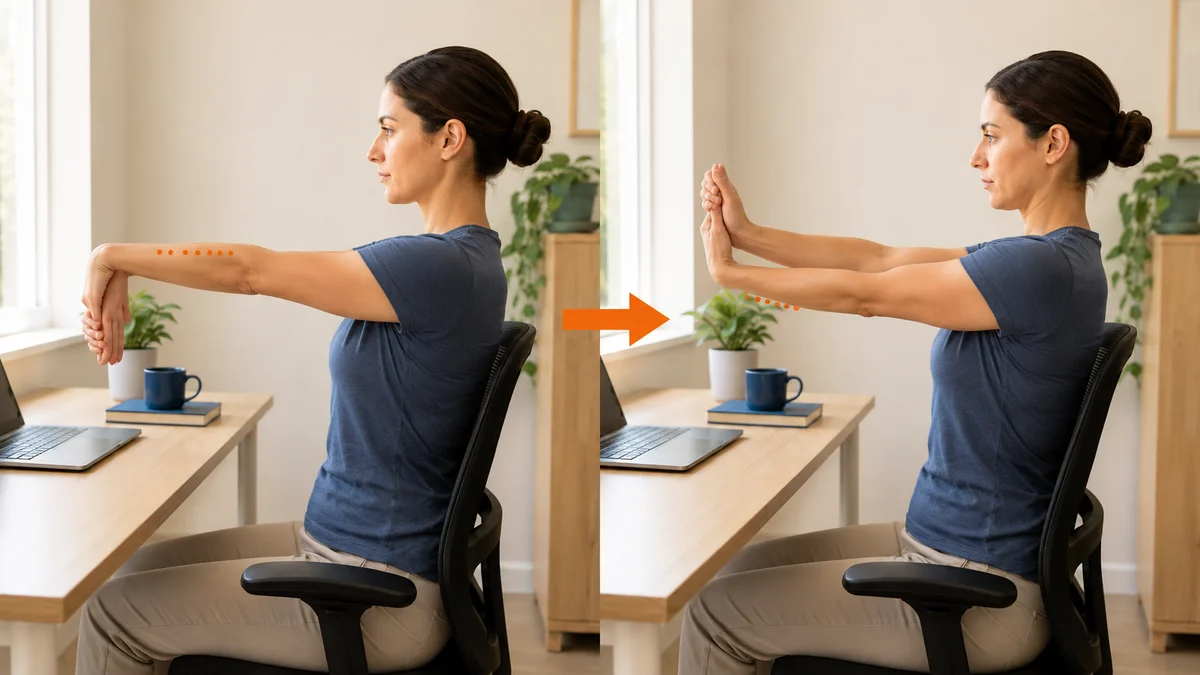
Swap hands.
Forearms get skipped constantly in desk stretch lists, which is odd given how much of the discomfort people describe in developer and writer communities is wrist and forearm rather than neck. If you type for a living, don’t drop this one when you’re in a hurry.
Why Every Hour, Rather Than Once a Day
Most advice lands somewhere between “every 30 minutes” and “a few times a day,” usually with nothing behind it. The exact number is less settled than confident blog posts imply, but the direction of the evidence is clear enough to act on.
The CCOHS recommendation is the most concrete of the official ones: “a person break for 5-10 minutes for every hour spent at a workstation.” That’s a full break rather than a stretch routine, but it sets the hourly rhythm.
WHO guidance is broader and points the same way. Adults should “limit the amount of time spent being sedentary,” and replacing sedentary time with activity of any intensity, including light intensity, provides health benefits. Light intensity is doing a lot of work in that sentence. The bar is genuinely low.
The NHS puts numbers on the scale of the problem: many adults in the UK spend around 9 hours a day sitting, and the guidance is to break up long periods of sitting with at least light activity.
Against nine hours, a once-daily five-minute routine is a rounding error. Eight rounds of 90 seconds comes to about twelve minutes across the day, and it interrupts your sitting eight separate times, which is where most of the benefit lives. Changing position often does more for you than holding any single position well, which is also why the perfect chair won’t save you if you sit perfectly still in it for four hours.
If you want a fuller framework for structuring the whole day rather than just the stretches, the 20-8-2 rule is a good next step.

What Desk Stretches Actually Do (And What They Don’t)
Workplace stretching has real trial evidence behind it. A randomised controlled trial of office workers published in the Brazilian Journal of Physical Therapy tested a stretching programme against a control group over six months and found meaningful reductions in discomfort: neck (MD -10.55; 95%CI -14.36 to -6.74), right shoulder (MD -12.17), left shoulder (MD -11.1) and lower back (MD -7.8).
One detail from that trial is worth more than the effect sizes. “The significant improvement from month 4 to 6, was only seen in exercise group.” The gains kept accumulating for the people who kept going, which is the entire reason this routine is 90 seconds instead of 15 minutes. Short enough to survive month five beats thorough enough to quit in week two.
Now the caveats, because they’re real.
A meta-analysis of micro-breaks in PLOS ONE, pooling 22 study samples and 2,335 participants, found that short breaks of under ten minutes produced statistically significant but small effects: vigor (d = .36) and fatigue (d = .35). The effect on overall performance wasn’t statistically significant. Stretch breaks will probably leave you feeling better, and you should be sceptical of anyone promising they’ll transform your output.
Worth knowing what underperforms its reputation, too. The Cochrane review on workplace interventions for reducing sitting found only very low quality evidence that sit-stand desks decrease workplace sitting by thirty minutes to two hours a day, and concluded that they “did not have a considerable effect on work performance, musculoskeletal symptoms or sick leave.” Buying furniture is easier than changing behaviour, which is presumably why it stays popular. We covered this in more detail in do standing desks fix posture.
Stretching won’t cure an injury, either. Persistent numbness, tingling, or pain that wakes you up is a reason to see a physio or GP rather than to hold a chin tuck for longer.
Why Desk Stretch Routines Die
Routines rarely fail because people forget the moves. They fail for three fairly specific reasons, and none of them is laziness.
Breaking flow costs too much. When you’re deep in something, the interruption is expensive in a way a stretch reminder never accounts for. Developers describe exactly this on forums like Hacker News: the timer goes off, you’re mid-thought, and ignoring it is obviously the right call in the moment. Do that eight times and the timer becomes wallpaper.
The routine is too long. A ten-minute routine has to compete with your actual work, and it loses. Ninety seconds barely registers as a decision, which is the whole design goal.
It depends on you remembering. Anything needing an active choice every single hour will eventually lose to a busy Thursday. The habits that survive get built into the setup rather than into willpower.
Asking a tired brain to make the same small decision eight times a day has a predictable outcome, and you’re living it.
How to Actually Remember
A few things that help, in rough order of how well they hold up.
Attach it to something that already happens. The end of a meeting, waiting for a build, the kettle boiling, sending a message you know needs a reply. Those cues arrive on their own schedule rather than yours, so they’re hard to quietly skip.
Do it badly rather than not at all. Three of the five moves counts. Skipping the whole thing because you can’t do the full sequence is how routines quietly end.
Let the reminder be interruptible. A nudge you’re allowed to ignore twice and still act on the third time survives far longer than one demanding compliance.
Use something that watches posture rather than the clock. A timer fires whether you need it or not, so it eventually becomes wallpaper. SitApp works the other way round. The Droid uses on-device AI and your webcam to spot the moment you’ve actually started slouching, and nudges you then. No video ever leaves your machine, and no image data is stored or uploaded. A nudge that lands because your shoulders genuinely rounded is much harder to tune out than one that lands because sixty minutes elapsed.
If you’d rather see the wider set of options first, we keep an honest roundup of the best posture apps.
When You Want Something Longer
Some days 90 seconds won’t cut it. If your back has properly seized up, or you want a dedicated daily block on top of the hourly top-up, our 5-minute posture exercise routine for desk workers covers eight moves including strengthening work that the hourly routine deliberately leaves out.
They do different jobs. Hourly stretching stops you stiffening up between tasks, while the longer daily block builds the strength that makes sitting upright feel like less of an effort in the first place.
Frequently Asked Questions
How often should I do desk stretches?
Once an hour is a sensible default. CCOHS recommends a 5 to 10 minute break for every hour at a workstation, and the 90-second routine fits inside that. Eight rounds across a working day interrupts your sitting eight times, and those interruptions matter more than the total minutes stretched.
How long should I hold each desk stretch?
Between 10 and 20 seconds per position, per CCOHS guidance. Longer holds are not better for this purpose. Breathe normally, avoid bouncing, and stop if anything hurts.
Can I do these stretches without standing up?
All five work seated, in a normal office chair, without leaving your desk. The chest opener has a lower-key variation with your hands behind the chair back if you’d rather not clasp behind your head in an open-plan office.
Do desk stretches actually fix back and neck pain?
They reduce discomfort rather than cure it. A six-month randomised controlled trial found meaningful reductions in neck, shoulder and lower back discomfort in the exercise group, with benefits still growing between months four and six. Ongoing or severe pain needs a clinician, not a stretch routine.
Are desk stretches better than a standing desk?
They address different things, and the standing desk evidence is weaker than its reputation. The Cochrane review found only very low quality evidence for sit-stand desks reducing sitting, and no considerable effect on musculoskeletal symptoms. Changing position often beats owning the equipment to change position.
What if I keep forgetting to do them?
Forgetting is the normal outcome rather than a personal failing. Attach the routine to events that already happen in your day rather than to a time of day, keep it short enough that skipping feels sillier than doing it, and consider a tool that nudges based on your actual posture rather than a fixed timer.
Start With One Hour
Don’t commit to eight rounds tomorrow. Pick a single trigger, something that happens a few times a day anyway, and run the 90 seconds when it fires. That’s the whole first week.
The trial evidence points the same direction every time: the people who benefit are the ones still doing it in month five. The moves are easy. Remembering them at 3pm on a Thursday, eight hours into a bad week, is the part that beats people.
If that’s the part you keep losing, it’s the specific problem SitApp was built to solve. It watches your posture on-device, spots the slouch before you do, and nudges you at the moment a stretch would actually help. Free to try, and no video ever leaves your computer.
