
It’s 3pm. You’ve been “sitting up straight” since morning, but somewhere between the second meeting and the third coffee, you melted. Your shoulders are hunched. Your chin is jutting forward. Your lower back has completely given up on the chair behind it. You look - and feel - like a human question mark.
Sound familiar? It should. Research published in Scientific Reports found that 58.6% of office workers experience neck pain, with shoulder, lower back and upper back pain close behind. The culprit isn’t laziness or a bad chair. It’s the simple reality that our bodies weren’t built to hold the same position for eight hours straight.
A systematic review of workplace stretching programmes found that targeted posture exercises can reduce musculoskeletal pain by up to 72%. You don’t need an hour at the gym. Five focused minutes and the right exercises. This guide gives you both - a complete 5-minute posture routine you can do at your desk, plus the strengthening work that makes the results stick.
Why Desk Workers Need Specific Posture Exercises
Generic fitness advice doesn’t cut it here. Desk work creates a very specific pattern of muscle imbalances, and you need posture exercises that target those exact imbalances.
Eight hours of sitting does the same thing to almost everyone:
The front tightens. Your chest muscles (pectorals) and hip flexors shorten from hours in a closed, forward-leaning position. This pulls your shoulders forward and tilts your pelvis, creating a chain reaction up your entire spine.
The back weakens. The muscles between your shoulder blades (rhomboids and mid-trapezius), your deep neck flexors, and your glutes slowly disengage. They’re not being asked to work, so they stop contributing. Over time, they lose the endurance to hold you upright even when you try.
Your head drifts forward. Your 10 to 12-pound head shifts ahead of your shoulders, and the muscles at the back of your neck have to work overtime to keep it from dropping further. At just a 45-degree forward tilt, the effective load on your neck muscles is nearly 50 pounds.
The result? That familiar ache between your shoulder blades. The tight neck. The lower back that screams by Friday afternoon. And research links poor workplace posture to increased musculoskeletal pain, reduced productivity, and worse mood over the working day.
The right posture exercises for desk workers reverse this pattern: opening the front, strengthening the back, and retraining the position of your head over your spine.
What Good Desk Posture Actually Looks Like
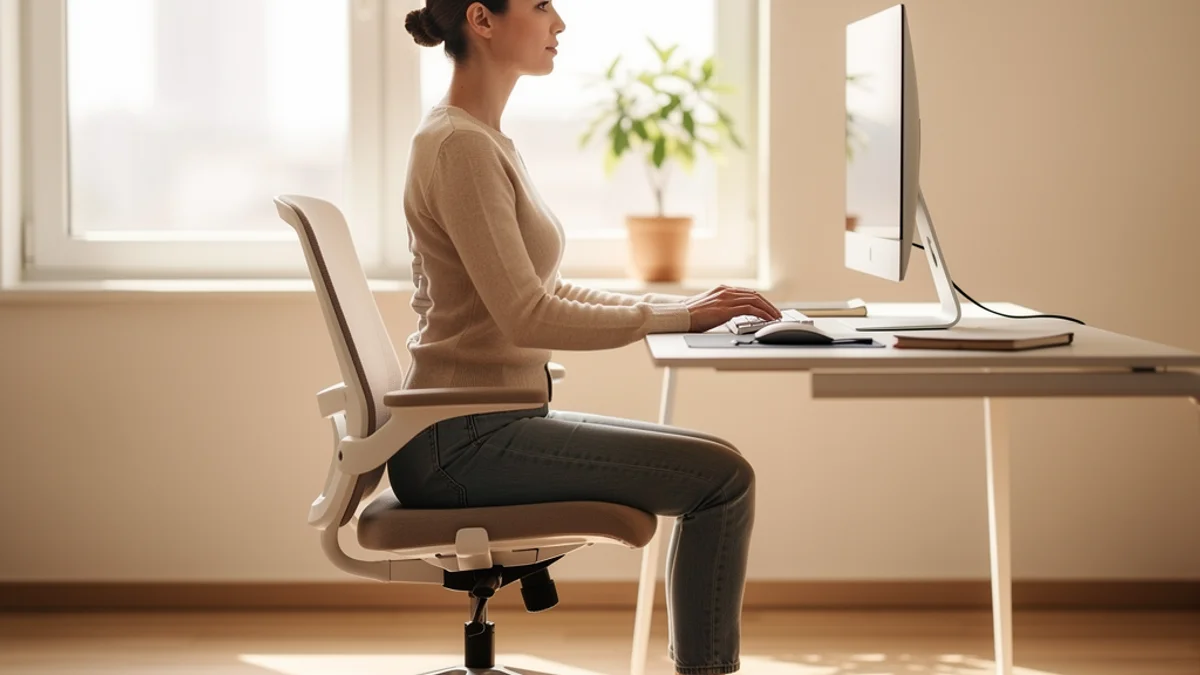
Before jumping into exercises, it helps to know what you’re working toward. Good desk posture isn’t military-rigid “sit up straight.” It’s a relaxed, aligned position your body can sustain without effort.
Quick checklist (for a deeper dive, see our full guide to proper desk posture):
- Feet: Flat on the floor, knees at roughly 90 degrees
- Hips: Pushed to the back of the chair, slight recline (25-30 degrees is ideal - not bolt upright)
- Shoulders: Relaxed and pulled slightly back, not hunched toward your ears
- Head: Ears directly above shoulders, chin level (not jutting forward)
- Screen: Top of monitor at eye level, arm’s length away
- Arms: Elbows at 90 degrees, wrists neutral on keyboard
If this feels impossible right now, that’s exactly why the exercises below exist. Your muscles need to be flexible enough and strong enough to hold this position without thinking about it. Tools like SitApp can help by monitoring your posture through your webcam and nudging you when you drift - but first, let’s build the foundation.

The 5-Minute Posture Reset: Your Daily Desk Routine
This is the core routine. Eight posture exercises for desk workers, sequenced to open what’s tight and activate what’s weak, all in five minutes. Do it once in the morning, once after lunch, and you’ll notice a difference within two weeks.
Every exercise can be done at or near your desk. No equipment needed except a wall for the last one.
1. Chin Tucks (30 seconds)
The single most effective desk posture exercise, according to physiotherapists.
- Sit tall. Without tilting your head up or down, pull your chin straight back - like you’re making a double chin.
- Hold for three seconds. Release.
- Repeat 8 to 10 times.
Why it works: Directly reverses the forward head position that causes neck pain and tension headaches. Activates the deep cervical flexors that keep your head properly stacked over your spine.
2. Neck Tilts (30 seconds)
- Gently tilt your right ear toward your right shoulder. Hold for five seconds.
- Return to centre. Tilt left ear toward left shoulder. Hold for five seconds.
- Repeat three times per side.
Why it works: Releases the upper trapezius muscles that tighten when your shoulders creep up toward your ears during focused work.
3. Shoulder Rolls (30 seconds)
- Roll both shoulders forward in large circles, 10 times.
- Reverse direction, rolling backward 10 times.
Why it works: Restores circulation to the shoulder girdle and breaks the “frozen” position that desk work creates. The backward rolls actively pull your shoulders into a better position.
4. Seated Chest Opener (40 seconds)
- Sit on the edge of your chair. Clasp your hands behind your back.
- Straighten your arms and gently lift your hands while squeezing your shoulder blades together.
- Open your chest wide and hold for 20 seconds. Release and repeat.
Why it works: Stretches the pectoral muscles that shorten from hunching. This is the direct antidote to rounded shoulders.
5. Seated Cat-Cow (40 seconds)
- Sit with feet flat on the floor, hands on your knees.
- Cow: Inhale, arch your back, lift your chest, look slightly upward.
- Cat: Exhale, round your spine, tuck your chin to your chest, pull your belly in.
- Flow between the two positions for five to six cycles.
Why it works: Mobilises the entire spine through flexion and extension. Desk work locks your thoracic spine (mid-back) in a forward curve - cat-cow breaks it free.
6. Shoulder Blade Squeezes (40 seconds)
- Sit or stand with arms at your sides, palms forward.
- Squeeze your shoulder blades together as if holding a pencil between them.
- Hold for five seconds. Release.
- Repeat 10 times.
Why it works: Activates the rhomboids and mid-trapezius - the muscles that pull your shoulders back and counteract the desk-worker hunch. This is as much a strengthening exercise as a stretch.
7. Seated Spinal Twist (40 seconds)
- Sit tall with feet flat on the floor.
- Place your right hand on the back of your chair or on your left knee.
- Twist your torso gently to the right, looking over your right shoulder. Hold for 10 seconds.
- Return to centre and repeat on the left side.
Why it works: Desk work is entirely forward-facing. Twists counter this by rotating the spine through a range of motion it doesn’t get during the working day. Releases tension in the obliques and lower back.
8. Wall Angels (30 seconds)
- Stand with your back flat against a wall, feet six inches out. Press your head, shoulder blades, and the backs of your arms against the wall.
- Slowly slide your arms up overhead (like a snow angel) and back down.
- Repeat five times.
Why it works: The ultimate desk-posture diagnostic. If you can’t keep your head, shoulders, and arms against the wall, that’s a clear indicator of how tight and weak your postural muscles have become. It gets easier every week as your body adapts.
Total time: ~5 minutes. Set a calendar reminder for 10am and 2pm, and you’ve built the habit.
Strengthening Exercises for Long-Term Posture Correction
The 5-minute routine above provides immediate relief and mobility. But if you want posture that holds without constant effort, you need to strengthen the muscles that keep you upright. Stretching alone isn’t enough.
Physiotherapists often describe seeing people who do desk stretches religiously and find the pain eases for an hour before returning. Stretching addresses the tight muscles - the symptom - not the weak muscles behind the posture. Adding a handful of strengthening exercises each week tends to turn that temporary relief into a stable change in resting posture.
Add these two to three times per week, outside your desk routine:
Resistance Band Pull-Aparts
- Hold a resistance band at chest height, arms straight, hands shoulder-width apart.
- Pull the band apart by squeezing your shoulder blades together until the band touches your chest.
- Slowly return. 3 sets of 15 repetitions.
Targets: Rear deltoids, rhomboids, mid-trapezius - the exact muscles that weaken from desk work.
Y-Raises
- Stand with arms at your sides holding light dumbbells (or water bottles).
- Raise both arms up and outward in a Y shape, thumbs pointing toward the ceiling.
- Hold at the top for two seconds. Lower slowly. 3 sets of 12 repetitions.
Targets: Lower trapezius and rotator cuff - critical for pulling shoulders down and back.
Plank With Shoulder Taps
- Start in a push-up position (or from your knees).
- Keeping your hips still, tap your right hand to your left shoulder. Then left hand to right shoulder.
- Alternate for 30 seconds. Repeat 3 times.
Targets: Deep core muscles that stabilise your spine and pelvis - the foundation that holds everything else in alignment.
When and How Often to Do These Posture Exercises
Frequency matters more than duration. A practical schedule that actually holds:
Morning (at your desk): Run through the 5-minute posture reset before your first task. This sets your posture baseline for the day when your muscles are fresh.
After lunch (at your desk): Do the 5-minute routine again. This is when most people’s posture deteriorates - energy dips, focus shifts entirely to work, and your body starts to fold forward.
End of day (optional, 2 minutes): At minimum, do chin tucks (30 seconds) and a chest opener (30 seconds) to undo the day’s damage before your commute or evening.
Two to three times per week (home or gym): Add the strengthening exercises from the section above. These don’t need to happen at your desk - do them whenever you exercise.
Worth knowing: A workplace intervention study comparing stretching-only with a combined stretching plus ergonomic adjustment programme found the combined approach produced better reductions in pain. Exercises alone rarely fix what’s also a setup problem.

The Missing Piece: Posture Awareness Between Exercises
Posture exercises cover 10 minutes of your day. The other seven hours and 50 minutes are where it falls apart.
You can have the perfect routine and the strongest upper back in the office, but if you spend the rest of the day slouching without realising it, your muscles are fighting a losing battle. Exercises build capacity, but awareness is what actually changes your posture throughout the day.
This is the gap most advice ignores. “Do these exercises” doesn’t address the fact that you’ll be hunched over again 20 minutes later, completely absorbed in a spreadsheet. Two things actually help:
The timer method: Set a reminder every 30 minutes to check your posture. When it goes off, do a quick chin tuck, roll your shoulders back, and reset. Takes 10 seconds. The problem? Most people start snoozing the reminder within a week. (For more strategies that work without constant willpower, see our guide on how to stop slouching at your desk.)
Posture monitoring: This is where SitApp fills the gap. It uses your webcam and on-device AI to watch your posture in real-time and gives you a gentle nudge only when you actually start to slouch. No images are stored, no data leaves your computer - the AI runs entirely on your device. The free plan gives you one hour of daily monitoring, which is enough to pair with your exercise routine and build genuine awareness between sessions.
Exercises build capacity. The Droid is what keeps that capacity from leaking away between sessions.
Frequently Asked Questions
Can 5 Minutes of Posture Exercises Really Make a Difference?
Yes - and the research backs it. A systematic review found that workplace stretching programmes reduce musculoskeletal pain by up to 72%. The key isn’t duration but consistency and targeting the right muscles. Five minutes twice daily (10 minutes total) hits the sweet spot for desk workers who won’t sustain longer routines.
Should I Stretch or Strengthen for Better Posture?
Both, but strengthening has a larger long-term impact. Stretching provides immediate relief and restores range of motion. Strengthening builds the muscular endurance that holds you upright without conscious effort. The ideal approach combines the daily 5-minute stretch routine with strengthening exercises two to three times per week.
How Long Before I Notice Posture Improvement?
Most desk workers notice reduced pain and stiffness within two weeks of consistent daily exercises. Visible postural changes - shoulders sitting further back, less forward head lean - start showing up around four to six weeks. Strengthening exercises get you there faster.
Can I Do These Exercises in an Open Office Without Looking Weird?
Every exercise in the 5-minute routine can be done seated at your desk (except wall angels, which you can do near any wall). Chin tucks, shoulder rolls, and seated cat-cow are subtle enough that colleagues won’t notice. The chest opener and spinal twist look like normal stretching. Save the wall angels for a break near a corridor wall.
Build Better Posture Starting Today
You don’t need a gym membership, a personal trainer, or even 20 spare minutes. You need the right exercises, done consistently, targeting the exact muscles that desk work breaks down.
Start here:
- This week: Try the 5-minute posture reset once a day. Set a reminder for 2pm - that’s when most desk workers need it most.
- Next week: Add the morning session. Two resets per day, 10 minutes total.
- Week three: Introduce one or two strengthening exercises on days you already work out (or three standalone sessions per week).
For the hours between exercises, download SitApp free to keep your posture in check with real-time AI monitoring that’s 100% private - nothing leaves your computer. The combination of targeted exercises and ongoing awareness is what separates desk workers who fix their posture from those who keep meaning to.
Five minutes, twice a day. Your back and neck will start noticing the difference before you consciously do.
