
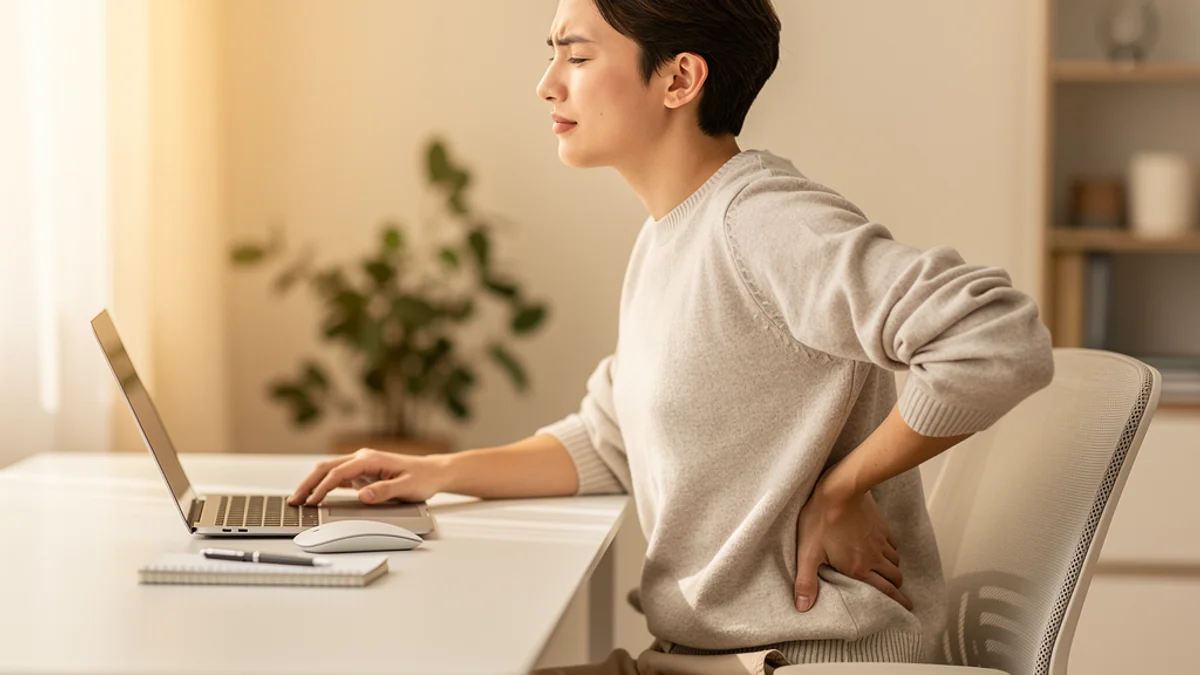
Stand sideways to a full-length mirror, relax, and look at the line of your lower back and your belt. In a lot of people who sit all day, the front of the pelvis has rotated down and forward: the lower back arches more than it needs to, the belly pushes out at the bottom even when there’s no extra weight there, and the backside sits a little further back than the line of the spine would suggest. That forward rotation of the pelvis is anterior pelvic tilt, and if you have spent any time online looking at posture content, you have probably been told it is a problem you urgently need to fix.
What most articles leave out: anterior pelvic tilt is the normal resting position of the pelvis for the majority of adults, including people with no pain and no problem at all. Knowing that tells you when to bother and when to leave it alone - which is what the “ten exercises to fix your tilt” version never gets around to.
This guide covers what anterior pelvic tilt is, why it is so common, how to tell whether yours is worth paying attention to, why sitting gets blamed for it, and what the controlled trials actually show about correcting it - plus a practical approach built around how your back and hips feel rather than chasing a number on a side-view photo.
What Anterior Pelvic Tilt Is
The pelvis sits at the base of the spine like a bowl, and it can rotate forward or backward over the hip joints. When the front rim of the bowl drops down and forward, that is anterior pelvic tilt. When the back rim drops, that is posterior tilt. A small amount of forward tilt is built into normal human anatomy - it is part of what gives the lower back its gentle inward curve, the lumbar lordosis.
The popular explanation for why some people sit in more tilt than others is a muscle-imbalance model that physiotherapist Vladimir Janda named lower crossed syndrome. The idea is that two groups of muscles get short and overactive while their opposites get long and underactive. A 2024 study of lower cross syndrome describes the pattern as tightness in the “hip flexor muscle groups” and “lumbar extensors,” paired with “weakness in the abdominal muscles, gluteus maximus, and gluteus medius,” and notes that this imbalance is associated with “anterior pelvic tilt, increased lumbar lordosis, and lower back pain,” per the study of lower cross syndrome in housemaids hosted by the National Library of Medicine. Picture the front of the hips and the muscles of the lower back pulling the pelvis into a forward tilt, while the abs and glutes that would pull it back the other way sit quiet and undertrained.
It is a tidy model, and it lines up with what desk work does to the body. The honest caveat is that the model is more popular than it is proven - the specific pattern of imbalance Janda described has not been strongly validated in the research, and plenty of people with classic “tight hip flexor, weak glute” lives have perfectly happy backs. Lower crossed syndrome is a useful framework for choosing what to stretch and strengthen, not a formal diagnosis.
How Common It Is - And Why That Matters
Most people without any symptoms have an anterior tilt. It is the default, not the exception - and that single fact changes how you should read everything else here.
The measurement data backs this up. A review of clinical measures of pelvic tilt in the International Journal of Sports Physical Therapy gathered normative data from several studies and found the “majority of asymptomatic individuals presenting with some degree of anterior pelvic tilt.” The average values across those studies cluster around 8 to 13 degrees of forward tilt in people with no complaints: one radiographic study found an “average of 13 (+/- 6) degrees of anterior pelvic tilt with range of -4.5 - 27 degrees,” while caliper-based studies put healthy men around 8.6 to 9.6 degrees and healthy women around 11.7 to 12.2 degrees.
A couple of things stand out in those numbers. Women naturally carry a few degrees more anterior tilt than men in pain-free populations - so a deeper curve in the lower back is not automatically a fault. And the range in healthy people is enormous: from a slight backward tilt all the way out past 25 degrees forward, with no symptoms attached. There is no single “correct” pelvic angle to aim for.
Seeing anterior tilt in your own side-profile photo tells you almost nothing on its own. You almost certainly have some, like most people. The question worth asking is whether it is causing you a problem - and the rest of this guide is built around that.
How to Tell Whether Yours Is Worth Paying Attention To
Because tilt by itself is so common, the useful home checks are less about measuring the angle and more about whether the surrounding muscles are tight and whether you have symptoms. Three are worth doing.
1. The side photo. Stand naturally side-on to a camera at hip height, arms relaxed, and take one photo without posing. Look at the lower back and the front of the pelvis. A pronounced forward tilt shows up as a deep arch in the lower back, a belly that tips forward at the bottom, and a backside that sticks out behind the line of the spine. This is worth taking, but read it the right way: a visible tilt is normal. Use the photo to track yourself over time, not to diagnose yourself against an imaginary ideal.
2. The Thomas test. This is the test clinicians use to check whether the hip flexors at the front of the hip are genuinely short, and it is the most informative thing you can do at home. Sit on the very edge of a sturdy table or firm bed, pull one knee firmly to your chest, and roll slowly onto your back, letting the other leg hang off the edge. Per the reliability study of the modified Thomas test in the National Library of Medicine, hip flexors are considered tight when “the thigh [is] above 0 degrees of hip extension” - in plain terms, if the hanging leg’s thigh floats up above parallel with the table instead of dropping to flat, the hip flexors on that side are short. The Healthline guide to anterior pelvic tilt names this same test as the standard at-home check. Tight hip flexors are the most fixable contributor to a tilt that bothers you, so this test points you at something actionable.
3. The symptom check. Honestly ask: do you have lower back ache that builds through a day of standing or sitting, hip pinching at the front of the hip when you squat or sit deeply, or a back that feels relieved when you tuck your pelvis under? If the answer is no - if your back and hips feel fine and you only noticed the tilt in a photo - the most evidence-based thing you can do is nothing. A tilt without symptoms is a variation, not an injury.
No single check tells the whole story, but taken together they point clearly at one of two situations: a common, harmless tilt that needs no intervention, or a tilt accompanied by tight hip flexors and symptoms that is worth working on.
Why Sitting Gets Blamed for It
The mechanism people describe for desk-work tilt is plausible and lines up with how muscles adapt. Sit in a chair and your hips are held in flexion - bent - for most of the day. The hip flexors that cross the front of the hip, chiefly the iliopsoas, spend hours in a shortened position, and like any muscle held short for long enough, they can adapt to that shorter length and stop extending fully. The Healthline guide puts the everyday version simply: “excessive sitting without enough exercise and stretching often causes it,” and notes that with a tilt “the muscles in the front of your pelvis and thighs are tight, while the ones in the back are weak.”
At the same time, the glutes get almost no work while you sit on them, and the deep abdominal muscles that would help hold the pelvis level are rarely challenged by a day at a desk. Short, tight muscles at the front of the hip pulling the pelvis into tilt, with weak glutes and abs failing to pull it back - that is the lower crossed syndrome picture, mapped onto a workday. It is the same logic as the chest-tight, upper-back-weak pattern behind kyphosis from sitting, just one storey down the body.
Two caveats. The causal evidence that sitting creates a measurable tilt over time is far weaker than the confident tone of most posture content implies - much of the story is reasonable inference from how tissue adapts, not from long-term studies tracking desk workers’ pelvic angles. And sitting is not the only contributor: pregnancy shifts the pelvis forward as load moves to the front, and habitually wearing high heels tips the body’s weight forward in a way that encourages the same compensation. The desk is the most common everyday dose, but not the whole picture.
What the Research Actually Says About Fixing It
The controlled evidence here is genuinely different from what most posture articles will tell you.
A 2020 systematic review in EFORT Open Reviews, hosted by the National Library of Medicine, set out to answer exactly this question - do non-surgical treatments actually reduce excessive anterior pelvic tilt - and pooled every controlled study it could find. That turned out to be only four studies covering 95 people in total. The headline conclusion, quoted verbatim, was blunt: “Due to limited literature and in general low-quality designs no overall evidence for the effect of non-surgical treatment in reducing excessive anterior pelvic tilt and potentially related symptoms was found.” The authors graded the overall quality of evidence as “very low.”
The specifics are illuminating. The one study that tested the intervention most people reach for - abdominal strengthening - found that even though abdominal strength improved significantly, there was “no relationship to a mean reduction of 0.5 degrees” of anterior pelvic tilt. Half a degree, and not statistically significant. The interventions that moved the angle more were the passive ones: soft-tissue manipulation produced a 1.7-degree immediate reduction, taping the pelvis produced 5.1 degrees, and a manipulation-plus-muscle-activation protocol produced 5.8 degrees. But these were immediate, short-term measurements in tiny samples, not evidence of a lasting change you can train into your pelvis with home exercises.
So the strong version of “do these five exercises and fix your tilt in eight weeks” is not supported by the controlled evidence. Stretching and strengthening are not pointless - their value is in how your hips and back feel and function, not in permanently re-angling a bone structure. If your hip flexors are genuinely tight on the Thomas test, stretching them gives you back range of motion and usually eases the front-of-hip pinch, regardless of what the protractor says afterward. Weak glutes, once strengthened, make you move better and support your lower back. Those are real, worthwhile outcomes. A smaller number on a side photo is a different goal, and the evidence says it is probably not achievable through home exercise anyway.
When Anterior Pelvic Tilt Actually Matters
For most people, an anterior tilt is a harmless variation that needs no intervention. There are a few situations where it is worth taking more seriously.
The clearest is when tilt travels with a specific hip condition. A 2025 cross-sectional study of femoroacetabular impingement syndrome, hosted by the National Library of Medicine, compared 69 patients with the condition against 69 healthy controls and found that “participants with FAIS exhibited greater pelvic tilt” along with lower trunk-muscle endurance. Femoroacetabular impingement is premature contact between the ball and socket of the hip, and the authors suggested that addressing pelvic tilt and strengthening the trunk “might be considered as a potential means to improve these physical impairments.” In a hip that is already pinching, the pelvic angle is part of the picture worth managing - though notably the difference between the groups was small (a mean of about 1.6 degrees), which again argues against treating the raw angle as the villain.
Beyond that, the tilt is worth attention when it comes with persistent lower back ache, especially the kind that builds through a day of sitting and eases when you tuck your pelvis or lie down. The lumbar lordosis that deepens with a forward tilt loads the small joints at the back of the spine, and for some people that is a genuine source of discomfort - which is the overlap with lower back pain from sitting at a desk. The thing to treat there is the pain and the function, using tilt as one lever among several, not the tilt as an end in itself.
If you have back or hip pain that is sharp, radiating into the leg, waking you at night, or steadily worsening over weeks, that is a reason to see a physiotherapist or doctor rather than to start a home stretching routine. Pain with those features is not a posture problem to self-manage.
A Practical Approach That’s Worth the Effort
If you have tight hip flexors on the Thomas test, or symptoms that ease when you level your pelvis, the following is worth doing. The goal is mobility, strength, and relief - not a better number on a side photo. If you have no symptoms and only a photo, skip the whole thing.
Open the front of the hips. The half-kneeling hip flexor stretch is the most direct fix for the genuinely short iliopsoas the Thomas test reveals. Kneel on one knee, the other foot flat in front, squeeze the glute on the kneeling side, and gently shift your weight forward until you feel a stretch across the front of the back hip - not in the lower back. Hold 30 seconds, both sides, a couple of times a day. Start here - tight hip flexors are the most reliably fixable contributor to a symptomatic tilt, and this stretch addresses them directly. The Healthline guide leads with this stretch for the same reason.
Wake up the glutes. Glute bridges are the staple: lie on your back, knees bent, feet flat, and lift your hips by squeezing your glutes hard at the top rather than arching your lower back. The squeeze matters more than the height. A few sets of 10 to 15, a few times a week. Squats and hip thrusts do the same job with more load once bridges feel easy.
Train the deep abs to hold the pelvis level. The posterior pelvic tilt - lying on your back and gently flattening your lower back into the floor by drawing the front of the pelvis up - teaches the abs to counter the forward pull. The dead bug builds on it: lie on your back, arms reaching to the ceiling, knees bent at 90 degrees, then slowly lower one arm overhead and the opposite leg toward the floor while keeping your lower back pressed flat. The moment your back lifts off the floor, you have gone too far. These are about control, not crunches.
Stop sitting in one shape all day. No stretch undoes ten hours of held hip flexion if you go straight back to it. Set your chair so your hips are level with or slightly above your knees, which reduces how deeply the hips are flexed while you sit, and get up to move every half hour or so. A simple standing reset - stand, squeeze the glutes, gently tuck the pelvis under for a few seconds - does more for a tilt-prone resting posture than any single floor exercise, because it interrupts the position dozens of times a day. Our guides to proper desk posture and the 20-8-2 rule for desk work cover the workday side of this in more depth, and posture exercises for desk workers collects the movements above into a routine.
The sticking point, and it applies to every posture pattern, is remembering to interrupt the position while you are absorbed in work. When deep focus takes over, no amount of intending to sit better actually changes how you sit. That gap is the reason we built SitApp. The Droid lives in your menu bar, watches your posture markers locally through your webcam, and gives you a quiet nudge when you have settled into a slump for too long - the cue to stand, reset the pelvis, and move before the position consolidates into another hour. All of the inference runs on-device; no images or video data ever leave your machine, and the model learns what a good resting posture looks like for you specifically rather than enforcing a generic ideal. Any tool that interrupts a long-held position does the same job; the point is the interruption.
FAQ
Is anterior pelvic tilt actually bad for you? Usually not. The majority of pain-free adults have some degree of anterior pelvic tilt - the review of clinical pelvic-tilt measures notes that most asymptomatic people present with one, and healthy values range from a slight backward tilt out past 25 degrees forward. A tilt only warrants attention when it comes with symptoms: lower back ache, front-of-hip pinching, or a related hip condition. If your back and hips feel fine and you only spotted the tilt in a photo, it is a normal variation, not a problem to fix.
Can you actually fix anterior pelvic tilt with exercises? Hip flexor length, glute strength, abdominal control - you can reliably improve all of those, and for many people that eases symptoms. Permanently re-angling the pelvis by a meaningful amount through home exercise is a different claim, and the evidence does not back it up. The 2020 systematic review found no overall evidence that non-surgical treatment reduces excessive tilt, and the one trial testing abdominal strengthening found a non-significant half-degree change despite real strength gains. Aim for how your hips and back feel and function, not for a number on a side photo.
How long does it take to fix anterior pelvic tilt? For most people, the angle is not the right target - but if you have tight hip flexors and symptoms, daily hip flexor stretching often eases the front-of-hip tightness within a couple of weeks, and glute and core work builds over 6 to 12 weeks like any strength work. The controlled evidence does not support durable change to the pelvic angle itself on that timeline. Mobility, strength, and comfort are what actually shift - and those are worth tracking.
How is anterior pelvic tilt different from lordosis or lower crossed syndrome? They describe overlapping parts of the same picture. Anterior pelvic tilt is the forward rotation of the pelvis itself. Lumbar lordosis is the inward curve of the lower back, which deepens as the pelvis tilts forward. Lower crossed syndrome is Janda’s name for the muscle-imbalance pattern - tight hip flexors and lower-back muscles, weak abs and glutes - thought to drive both. The syndrome is a useful framework for choosing what to stretch and strengthen, but it is more popular than it is validated, so treat it as a guide rather than a label.
Will sitting with my hips higher than my knees fix it? It helps the contributing factor, not the angle. Setting your seat so your hips sit level with or slightly above your knees reduces how deeply your hip flexors are held in flexion while you sit, which gives them less time to adapt short. Combined with getting up to move every half hour, that is a sensible setup change. On its own it will not transform your standing posture - it is one useful piece, not a cure.
The Honest Summary
Anterior pelvic tilt is the most over-diagnosed posture problem on the internet. The majority of people without any pain have a forward-tilted pelvis; women naturally have a few degrees more than men; and the healthy range is wide enough that there is no single correct angle to aim for. The controlled evidence that you can permanently correct an excessive tilt with home exercise is, to put it plainly, very weak.
If the Thomas test shows your hip flexors are genuinely tight, or if you have lower back ache or front-of-hip pinching that eases when you level your pelvis, then stretching the front of the hips, strengthening the glutes and deep abs, and interrupting long stretches of sitting will likely make you move better and feel better. Do those things for the mobility and the comfort. Not for the protractor.
If you have no symptoms and only noticed your tilt because a video told you to check for it, leave it alone. Stand up now and then, keep your hips and glutes strong because that is good for you anyway, and stop staring at your side profile. A pelvis that tilts forward a bit is one of the most ordinary things a human body does.
