

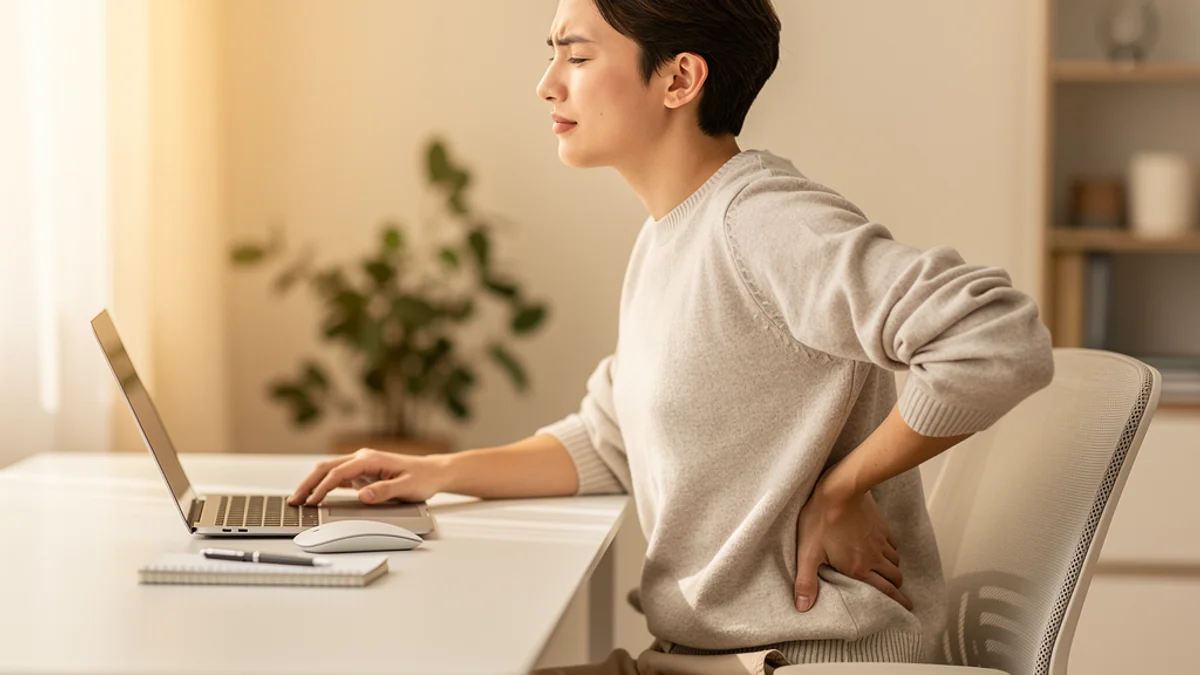
You feel it most when you stand up. You’ve been locked into the chair since the morning standup, you finally get up to refill your coffee, and there it is - a deep stiffness in the front of your hip, or a dull ache off to one side, or a tight band across the crease where your thigh meets your pelvis. The first few steps are stiff and slightly hobbled. Thirty seconds of walking and it loosens off. Then you sit back down for another two hours and the whole thing resets.
Hip pain from sitting all day is one of the most predictable consequences of a desk job, and one of the least talked about. We obsess over necks and lower backs, but the hip is arguably where sitting does its most direct damage - because sitting is, mechanically, just holding your hips bent at 90 degrees for eight hours straight. A 2018 study in the International Journal of Environmental Research and Public Health tracked discomfort during two hours of uninterrupted office computer work and found that hip, thigh, and buttock discomfort climbed to a clinically meaningful level after just 90 minutes - earlier than the lower back. The body starts complaining about the hips first.
The good news is the same as it is for most desk-related pain: this is overwhelmingly mechanical, not degenerative. The position created it, and a different position plus a short, targeted routine fixes it. This guide covers exactly what’s happening at the hip when you sit all day, how to read where your pain shows up, the desk geometry that’s quietly making it worse, and a five-minute reset for the specific muscles involved.
Why Sitting All Day Causes Hip Pain
Your hip is a deep ball-and-socket joint wrapped in some of the biggest, most powerful muscles in your body. It’s built to move through a wide range - to extend behind you when you walk, to flex in front of you when you climb, to rotate when you change direction. Sitting asks it to do none of that. It asks the hip to stay folded at the same angle for hours, and the tissues quietly adapt to the position they’re held in most.
That adaptation happens in two connected ways.
Your hip flexors shorten and tighten. The hip flexors - mainly the iliopsoas, which runs from your lower spine and pelvis to the top of your thigh bone - are the muscles that bend your hip. When you sit, they’re held in a shortened position the entire time. Hold any muscle short for long enough, often enough, and it adapts to that length. A 2021 study in Musculoskeletal Science and Practice measured this directly: people who were highly active with minimal sitting had 6.1 degrees more passive hip extension than people with low activity and prolonged sitting. The sitters had literally lost range at the hip. That’s why standing up feels stiff - you’re asking flexors that have set themselves to “seated” to suddenly let the hip open up, and they resist. Harvard Health puts it plainly: “Sitting for long periods of time causes the hip flexors to tighten and shorten, and that can lead to stiffness and discomfort.”
Your glutes switch off. While the flexors are shortening on the front, the muscles on the back - your glutes - are doing the opposite. They’re held long, squashed under your body weight, and given nothing to do for hours. Over time they get sluggish about firing at all, a pattern physios informally call “gluteal amnesia” or “dead butt syndrome.” Healthline’s clinical explainer, medically reviewed by physical therapist Courtney L. Gilbert, describes how “not getting enough movement, including if you spend hours sitting or lying down, can cause the gluteal muscles to lengthen and the hip flexors, or hip muscles, to tighten” - to the point where the glutes essentially forget “their main purpose: supporting the pelvis and keeping your body in proper alignment.”
Put those together and you get the classic desk-worker hip setup: tight, dominant flexors on the front, lazy under-firing glutes on the back. The conventional model says this imbalance pulls the pelvis into an anterior tilt - tipped forward, like pouring water out of a bowl - which then overloads the hip joint and the lower back. That tilt-and-overload chain is the standard textbook explanation, though researchers still debate exactly how tightly pelvic tilt tracks with muscle imbalance. The part nobody disputes is what you actually feel: shortened flexors, reduced hip extension, and glutes that have gone quiet. If your pain comes with a lower-back ache too, the anterior pelvic tilt from sitting guide covers that shared mechanism in detail.
Where the Pain Actually Shows Up
Hip pain from sitting isn’t one single sensation. Where you feel it tells you a lot about which tissue is unhappy, and that changes what you do about it.
-
Front of the hip or deep in the groin. This is hip-flexor territory - the iliopsoas pulling on its attachments after hours in a shortened position. It can also signal femoroacetabular impingement (FAI), where the ball and socket pinch at the front of the joint. Yale Medicine notes that FAI pain is “usually in the groin or hip” and specifically “can also develop while sitting with the hips flexed at a 90-degree angle for prolonged periods of time.” If sitting itself - especially in a low or deep chair - reproduces a sharp front-of-hip pinch, this is the likely culprit.
-
The outer side of the hip. A burning or aching pain on the bony point of the hip, often worse when you lie on that side at night, points to greater trochanteric pain syndrome (GTPS) - the modern name for what used to be called trochanteric bursitis. It’s notably more common in women: a 2007 study in Archives of Physical Medicine and Rehabilitation found unilateral GTPS in 15.0% of women versus 6.6% of men. If your “hip pain” is really on the outside and flares at night, this is the pattern.
-
In the buttock, sometimes shooting down the leg. Deep buttock pain that radiates down the back of the thigh, especially after long sitting stretches, often involves the piriformis - a small muscle deep in the glute that can irritate the sciatic nerve. Cleveland Clinic lists “sitting for long periods of time (for example, people who sit a lot on the job)” as both a cause and an aggravator, and notes the pain “can feel a lot like sciatica but in a more specific area.”
-
A vague, deep stiffness that eases once you walk. This is the everyday version - tight flexors and a stiff joint capsule that gel up during sitting and loosen with movement. No single dramatic structure, just the cumulative cost of the position.
If your hip pain comes with numbness running down the leg, gives way or feels unstable, wakes you repeatedly at night, or follows a specific injury or fall, that’s worth getting checked rather than self-treating - more on that below. For the everyday mechanical version, which is the large majority of desk-related hip pain, the fixes that follow target the whole cluster.
Fix the Setup First
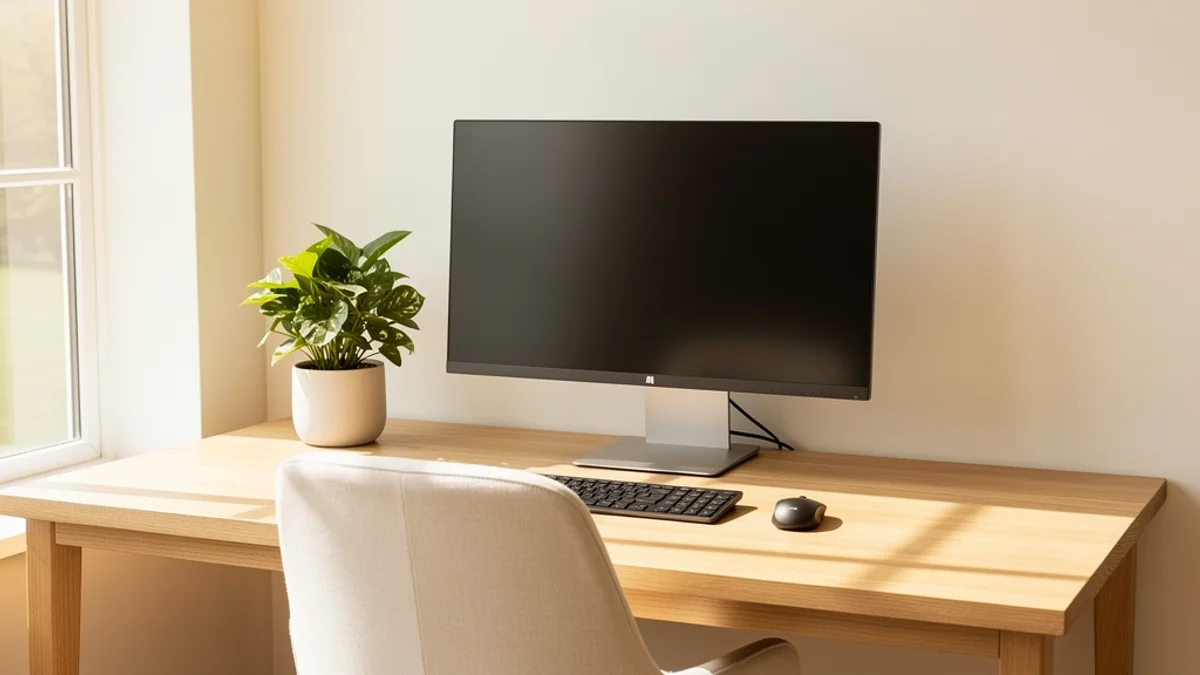
Stretching won’t outrun a chair that’s actively loading your hips wrong for eight hours a day. Sort the geometry before you sort the routine.
Get the Chair Height and Depth Right
The single biggest ergonomic lever for hips is how you sit, not what you sit on. The goal is a hip angle that’s open and supported rather than crammed shut.
- Set the seat so your hips are level with or very slightly above your knees. When knees ride higher than hips - the position cheap or too-low chairs force - the hip is jammed into deeper flexion all day, which is exactly what shortens the flexors and aggravates impingement.
- Sit all the way back so the backrest supports you, then check there’s a small gap (roughly two fingers) between the seat edge and the back of your knees. A seat pan that’s too deep makes you perch or slump.
- Keep your feet flat on the floor (or a footrest), thighs roughly parallel to the ground.
- The NHS guidance on hip pain is blunt about the worst offender: “do not sit in low chairs - this can put extra pressure on your hips.” If you have a choice of seats, skip the soft low sofa-style ones for work.
For a full walkthrough of the rest of the workstation, our proper desk posture guide and work from home ergonomics guide cover monitor, keyboard, and chair together.
Break Up the Sitting
No chair setup survives ninety unbroken minutes, which is exactly when the 2018 study saw hip discomfort cross into clinically meaningful territory. Staying mobile is the fix, not a better static position.
- Stand up and move at least every 30 minutes. Even a 30-second standing break resets the hip angle.
- A sit-stand desk makes this effortless rather than something you have to remember. If you’re weighing one up, our standing desk vs sitting guide covers the trade-offs honestly - standing all day isn’t the answer either; alternating is.
- The 20-8-2 rule - twenty minutes sitting, eight standing, two moving per half hour - is a solid framework for what “enough movement” actually looks like.
The same studies that show sitting shortens the flexors show that activity protects hip extension. Stretching alone won’t keep pace if you keep re-creating the problem every half hour.
A 5-Minute Routine for Hip Pain From Sitting
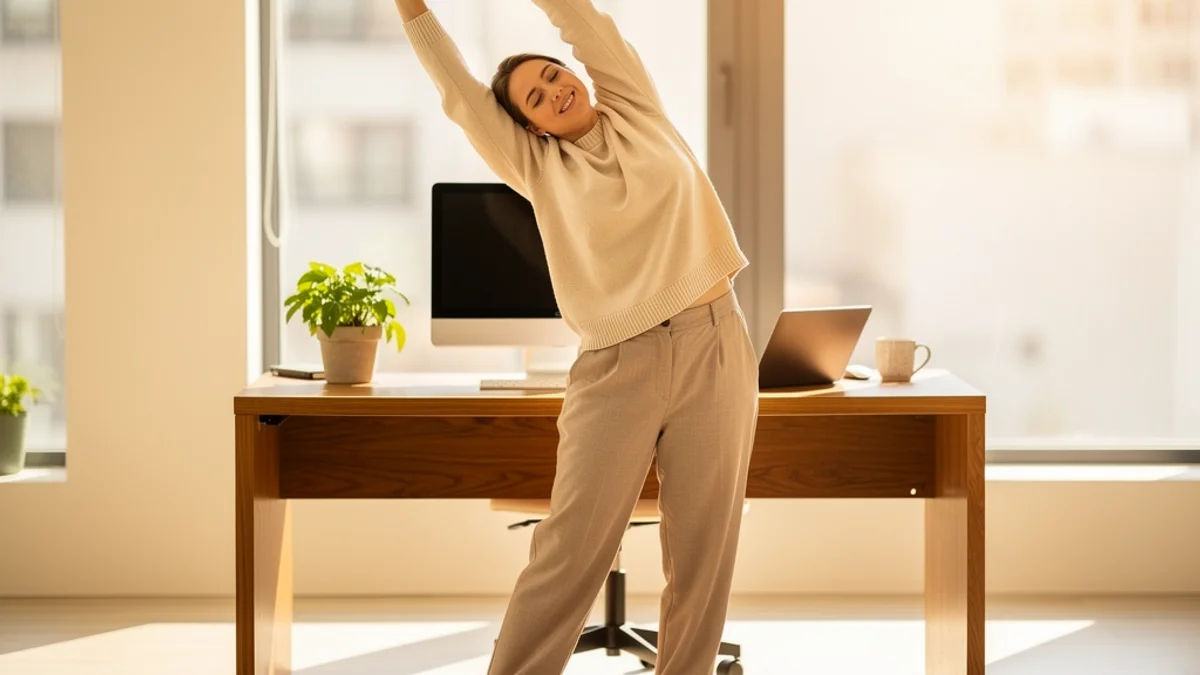
With the setup sorted, here’s a short routine targeting the muscles sitting actually affects: lengthen the tight flexors, wake up the quiet glutes. Run it once or twice during the workday, ideally after a long focus block. No equipment needed.
1. Kneeling Hip Flexor Stretch (2 minutes, 1 minute per side)
The single most direct fix for the shortened iliopsoas. This is the stretch Harvard Health recommends specifically for people who sit all day.
- Kneel on one knee, the other foot flat on the floor in front of you, like a proposal pose
- Tuck your pelvis under slightly (think: pull your belt buckle up toward your chin) - this is what actually targets the flexor
- Gently push your hips forward until you feel a stretch across the front of the kneeling-leg hip
- Hold for around 60 seconds per side, breathing slowly. Don’t bounce
2. Glute Bridges (1 minute)
Reactivates the glutes that have gone dormant from sitting on them all day. This is the “wake up the dead butt” move.
- Lie on your back, knees bent, feet flat on the floor
- Squeeze your glutes and lift your hips until your body forms a straight line from shoulders to knees
- The lift should come from your glutes, not your lower back - squeeze at the top
- Hold 2 seconds, lower slowly. 12-15 reps
3. Seated Figure-Four Stretch (1 minute, 30 seconds per side)
Opens the deep glute and piriformis - the buttock-and-radiating-pain pattern.
- Sitting (or lying), cross one ankle over the opposite knee so your legs make a “4”
- Gently lean forward (or pull the lower thigh toward you) until you feel a stretch deep in the crossed-leg buttock
- Hold 30 seconds per side
4. Standing Hip Circles (1 minute)
Restores the rotational range the joint loses from being held still.
- Stand tall, hands on hips
- Slowly circle one hip as if drawing a big circle with your knee - 5 each direction, then switch legs
- Keep it slow and controlled, exploring the range rather than forcing it
For a longer daily set, our posture exercises for desk workers layers more movements on top of this. And if your hip pain comes packaged with lower-back ache - it very often does - the routine in our lower back pain from sitting guide pairs naturally with this one.
The Awareness Piece (Why Setup Alone Isn’t Enough)
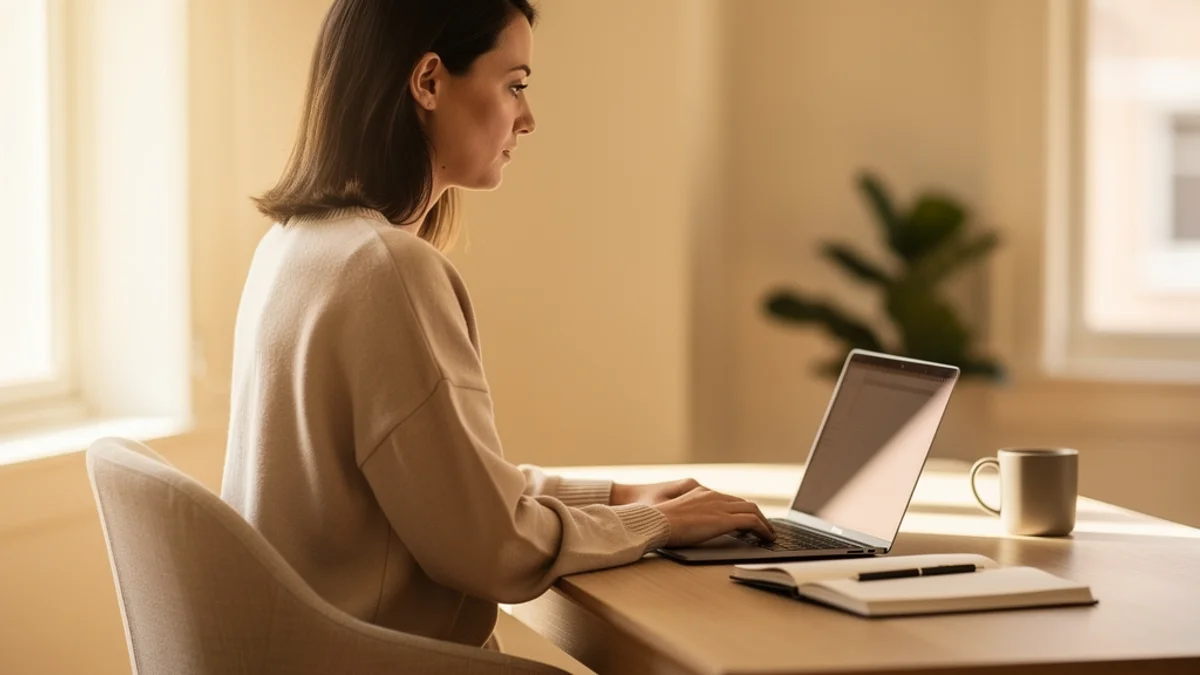
Most ergonomics articles skip this: a perfect chair doesn’t fix hips if you don’t actually move out of it.
You can dial in seat height, buy the sit-stand desk, learn all four stretches - and then twenty minutes into a deep focus block, you’ll be folded into the chair, one leg tucked under you, hips jammed shut, completely unaware. Focused attention hijacks every spare bit of bandwidth, including the bit that’s supposed to notice you haven’t stood up in two hours. That’s not a discipline problem. Good ergonomics sets up the conditions; awareness is the part that makes them matter.
A few things that genuinely help build that awareness:
Movement frequency over movement perfection. You don’t need a perfect posture. You need to not hold any single one for ninety minutes. The goal is variety - sit, stand, walk, repeat.
A trigger you already do constantly. Pick something you do dozens of times a day - sending a message, finishing a task, refilling water - and pair it with a one-second hip check: are my knees jammed above my hips? Have I stood up recently? Habits stick when they’re bolted onto existing ones.
Posture-aware software. This is part of why I built SitApp - an on-device monitor that uses your webcam and local AI to notice when your posture slips during deep work, then nudges you with a gentle reminder to reset and move. Quiet when you’re sitting well, helpful when you’ve been collapsing into the chair without noticing. No images or video ever leave your machine - everything runs locally, which is the only way webcam-based anything is worth installing. (For what to check before installing any webcam tool, our health app privacy guide walks through it.)
Fix the setup, run the five-minute routine once or twice a day, and use something - app, timer, or a sticky note on the monitor - to keep you moving during focus blocks. Any one of those alone is partial. All three together is what actually stops desk hip pain.
When to See a Professional
Most hip pain from sitting is mechanical and eases within a few weeks once you change the inputs. But not all hip pain is from your chair. Per the NHS hip pain guidance, see a GP or physio if self-care hasn’t helped after a couple of weeks, or sooner if you notice any of:
- Pain that’s severe, or stops you doing normal daily activities
- The hip giving way, locking, or feeling unstable
- Numbness, pins and needles, or pain shooting down the leg
- Pain that wakes you repeatedly at night
- Hip pain after a fall or sudden injury, or any visible swelling or deformity
- A high temperature alongside the hip pain (which can signal infection)
A physio can pin down which specific part of the pattern is driving your pain - a sticky joint capsule, a genuinely weak glute medius, an impingement - in a way that’s hard to self-diagnose, and rule out the smaller number of cases where the hip pain isn’t coming from the desk at all.
Frequently Asked Questions
Why do my hips hurt so much when I stand up after sitting? Your hip flexors shorten while you sit, and your joint capsule stiffens in the folded position. Standing asks the hip to suddenly extend through a range it’s been denied for hours, and the tightened tissues resist - that’s the stiff, hobbled feeling. It eases within seconds of walking because movement restores the range. Frequent breaks stop it building up in the first place.
Is hip pain from sitting serious? Usually not. The large majority is mechanical - tight flexors, dormant glutes, an overloaded joint from a poor sitting position - and it responds to movement, setup changes, and stretching. It’s worth getting checked if pain is severe, comes with numbness down the leg, wakes you at night, or follows an injury.
What’s the best stretch for tight hips from sitting? The kneeling hip flexor stretch, held for around 60 seconds per side, targets the iliopsoas - the muscle most directly shortened by sitting. Pair it with glute bridges to wake up the muscles on the other side. Stretching the front without strengthening the back only fixes half the imbalance.
Does a standing desk fix hip pain? It helps, but not because standing is magic - it’s because it makes it easy to alternate. Standing all day creates its own problems. The benefit is breaking up long sitting blocks and varying your hip position, which a sit-stand desk makes effortless.
Can sitting cause permanent hip damage? Prolonged sitting reliably reduces hip mobility and can contribute to conditions like impingement or bursitis, but the mobility loss is largely reversible with movement and stretching. The earlier you change the inputs, the easier it reverses. The hip is adapting to what you do to it most - and that adaptation runs both directions.
The Bottom Line
Hip pain from sitting all day is the predictable result of holding your hips bent at 90 degrees for eight hours. The flexors shorten and tighten, the glutes switch off, and the joint stiffens into whatever position it’s held in most. The 90-minute mark where discomfort becomes meaningful isn’t random - it’s just how long the body tolerates being still.
Five changes make the difference:
- Sort the chair. Hips level with or above knees, sit all the way back, feet flat, skip the low soft chairs.
- Break up the sitting. Move every 30 minutes. Alternate sit and stand. Ninety unbroken minutes is the enemy.
- Lengthen the front, wake up the back. Kneeling flexor stretch plus glute bridges - half the routine each.
- Add the deep-glute and rotation work. Figure-four stretch and hip circles for the buttock and joint patterns.
- Keep moving during focus blocks. A timer, a habit, or a posture-aware tool - whatever keeps you from disappearing into the chair for two hours.
Most desk-induced hip pain resolves once you stop re-creating it every half hour.
If you want a quiet, on-device way to keep that awareness alive during deep work, SitApp’s free tier gives you an hour of AI-powered posture monitoring a day, entirely local to your machine - the kind of nudge that catches you two hours into a focus block before the hip stiffness sets in.
