
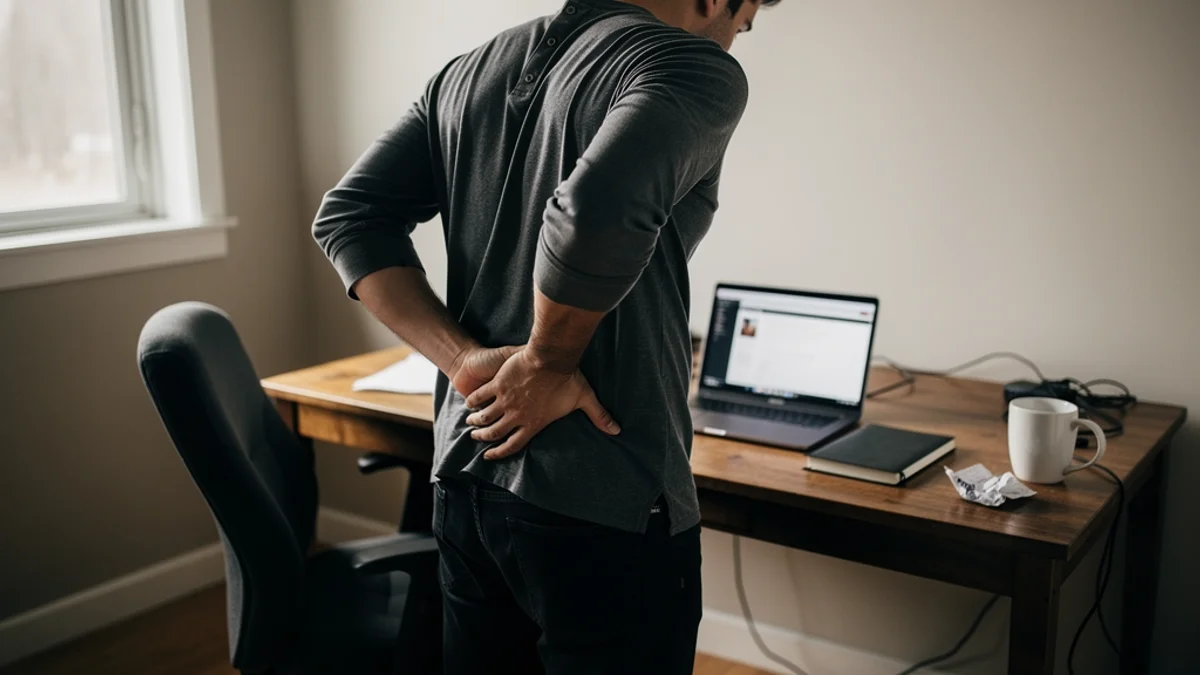
There is a particular version of this that desk workers know well. You’re fine walking to the kitchen. You’re fine standing at the counter. Then you sit down to work, and somewhere between ten minutes and an hour a deep ache starts in one buttock and begins creeping down the back of the leg. Stand up, walk about, and within a minute or two it fades. Sit back down and the clock starts again.
That on-off pattern is the signature of sciatica from sitting, and it’s one of the more frustrating things a desk job can do to a body, partly because the thing that sets it off is the thing you’re paid to do for eight hours a day.
The internet’s answer is usually a chair recommendation and a hamstring stretch. Both can help a bit. Neither explains why sitting is the position that provokes it, which is the part worth understanding, because once you know what the chair is doing to the nerve you can be a lot smarter about how you get through a working day.
Below: what sciatica actually is, what the evidence really says about sitting as a cause versus a trigger, a sitting-specific mechanism most desk workers have never heard of, two rough self-checks, the symptoms that mean stop reading and see a doctor, and the things that genuinely help between nine and five.
What Sciatica Actually Is
Sciatica describes a symptom, not a diagnosis. The NHS puts it simply: it “happens when the sciatic nerve, which runs from your lower back to your feet, is irritated or compressed.” The nerve is the thickest in the body, formed from roots in the lower spine, running through the buttock and down the back of the thigh before branching below the knee.
When something irritates it, the pain follows the nerve’s territory instead of staying put. That’s the tell. Symptoms include “a sharp, burning pain down the back of the leg” plus tingling, numbness and weakness, typically in “your bottom and the back of one leg.” One leg, usually. Pain that radiates below the knee is more convincing than pain that stops at the buttock.
It’s common. StatPearls puts the lifetime incidence between 10% and 40%, with an annual incidence of 1% to 5%, and notes that “peak incidence occurs in patients in their fourth decade” with “no gender predominance.” Thirties and forties is squarely the desk-career window, which is part of why the two get associated.
The reassuring bit comes from the same source: “Most cases of sciatica resolve in less than 4 to 6 weeks with no long-term complications, even if no medical therapy is sought.” The Cleveland Clinic agrees that many cases improve within four to six weeks without treatment, while noting some run longer.
Worth separating this from its neighbours. Lower back pain from sitting at a desk stays in the back. Hip pain from sitting stays around the hip and groin. Sciatica travels down the leg. People use the word loosely for any ache in that general region, which muddies things when they go looking for answers.
Why Sitting Flares It: The Honest Version
Most articles on this tell you flatly that sitting causes sciatica. The research is more careful, and the difference changes what you should do about it.
A systematic review of 25 studies by Lis and colleagues in the European Spine Journal looked at occupational sitting and back pain, and reached a conclusion that surprises people: “Sitting alone was not associated with the risk of developing LBP.” Sitting became a real risk factor when it combined with other exposures. Add whole-body vibration or awkward postures and “the risk of LBP increased fourfold,” with helicopter pilots showing the strongest association at an odds ratio of 9.0. Vibration was independently linked to sciatica specifically.
So an office chair on a carpeted floor is not a lorry cab, and the honest reading is that sitting is a weaker independent cause than the wellness industry suggests.
What sitting does do, very reliably, is provoke symptoms in a nerve that’s already unhappy. Load and tension, working together.
Start with load. A 2022 meta-analysis in Life pooled seven in-vivo studies of pressure inside the lumbar discs and found sitting produced higher pressure than standing, with a standardised mean difference of 0.87 (95% CI 0.33 to 1.41). The authors then hedge it properly, and the hedge matters. Studies published before 1990 supported the sitting-is-worse finding, studies after 1990 mostly didn’t, and in people with already-degenerated discs there was no meaningful difference between the two positions. Their own summary line is the one to remember: “Any prolonged posture should be prohibited.” Not sitting specifically. Prolonged anything.
Then there’s tension. Sitting flexes the hip, and hip flexion puts the sciatic nerve on stretch through the buttock and thigh. Slump forward over a keyboard and the lower back rounds out of its natural curve, which adds a little more. A healthy nerve tolerates that all day without complaint. An inflamed one has lost its tolerance, so a position that used to be neutral now reads as provocation, and the longer you hold it the louder it gets.
Put the two together and you get the on-off pattern. The chair squeezes and stretches a nerve that has already used up its margin, and standing takes both off at once, which is the whole reason relief arrives inside a minute. An afternoon at a desk provokes the nerve without wrecking it.
The Sitting-Specific Cause Most Desk Workers Miss
Ask most people what causes sciatica and they’ll say slipped disc. Discs are the most common cause, but there’s a whole category of causes that sits below the spine entirely, in the buttock, and it has a very particular relationship with chairs.
Deep gluteal syndrome is the modern name for what used to be called piriformis syndrome. The sciatic nerve passes through a crowded space deep in the buttock, and it can get irritated there by muscle, by fibrous bands, by blood vessels, without anything being wrong with the spine at all. A 2025 study in Quantitative Imaging in Medicine and Surgery describes it as “extrapelvic entrapment or irritation of the sciatic nerve (SN) within the deep gluteal space.”
Two things in that paper are worth knowing.
One is about sitting specifically. Patients presented with “unilateral gluteal pain radiating in at least part of the S1 dermatome lasting at least three months, aggravated by sitting,” and the researchers recorded how long people could sit before symptoms started. The range ran from under five minutes to over twenty, varying a lot between individuals. If you’ve ever timed your own chair tolerance, that will sound familiar.
The other explains a lot of frustrating scan results. Standard MRI found lumbar spine pathology in 42% of these patients, but only 21% had anything at the L5-S1 level actually touching a nerve root. So a scan can show a bulge in your back while the real trouble sits in your backside. Deep gluteal syndrome “often mimics S1 radicular syndrome,” the authors note, and telling the two apart takes clinical testing, not imaging alone.
None of this is something to self-diagnose. It’s useful context for two situations though. If your pain is buttock-dominant, sitting-dependent, and your back itself feels basically fine, the buttock is worth mentioning to whoever assesses you. And if a scan found something in your back but treatment aimed at your back hasn’t shifted anything, that gap between 42% and 21% is a real phenomenon and not bad luck.
Two Rough Self-Checks
Neither of these diagnoses anything. They’re for working out whether what you have looks nerve-shaped at all, which is useful to know before you spend six weeks stretching a hamstring that was never the problem.
The seated leg extension. Sit on the front edge of your chair, hands on the seat, both feet on the floor. Slowly straighten one knee until the leg is out in front of you, and pay attention to what you feel. Then, holding the leg out, pull your toes back toward your shin. Nerve-related pain tends to be sharp, electrical, or burning, and it tends to spread further down the leg when you add the ankle movement. Muscle tightness feels like a broad pull in the belly of the hamstring and barely changes when you flex the ankle.
The lying leg raise. Lie flat on your back and have someone slowly lift one straight leg, or lift it yourself with a belt around the foot. StatPearls describes a positive result as “radicular leg pain…radiating below the knee” appearing “when the leg is between 30° and 60° or 70° from horizontal.” Pain arriving before 30 degrees or after 70 doesn’t count, and the second one is usually just tight hamstrings.
Take the numbers loosely. The same source gives the test a sensitivity of 72% to 97% but a specificity of only 11% to 66%, which in plain terms means it rarely misses genuine nerve irritation but flags plenty of people who don’t have it. A positive result means get assessed.
Red Flags: Stop and Get Seen
Most sciatica is unpleasant and self-limiting. A small fraction is an emergency, and the difference is worth knowing cold instead of looking up at 11pm.
The NHS says to call 999 or go to A&E if you have sciatica on both sides, “weakness or numbness in both legs that’s severe or getting worse,” numbness around your genitals or anus, or loss of bladder or bowel control that is unusual for you. Those can indicate cauda equina syndrome, where the bundle of nerves at the base of the spine is compressed, and it needs treating within hours.
Short of that, see a GP if the pain hasn’t improved after a few weeks of home treatment, if it’s getting worse, or if it’s stopping you doing normal things. Progressive weakness in one leg, such as a foot that starts catching on steps, is also a reason to be seen sooner rather than later.
What Actually Helps at a Desk
Every source above converges on the same lever, and it’s duration. The NHS advice list is short and its one prohibition is “do not sit or lie down for long periods.” The Life meta-analysis lands in the same place from the mechanical side. Prolonged anything is the problem.
Get up before the ache starts. This is the big one. If you know you get about twenty-five minutes before symptoms arrive, get up at fifteen. Waiting for pain means you’re letting the nerve wind up and then asking it to calm down, which takes far longer than never letting it wind up at all. Cheap way to run this: pick an interval, set something to nag you, and treat it as non-negotiable. The 20-8-2 rule gives you a ready-made structure if you’d rather not invent one.
Rotate through positions. People go looking for the one correct way to sit. Given what the pressure research actually shows, the more useful goal is a rotation: sit for a while, stand for a while, walk for a bit, sit differently. Standing desks aren’t a cure on their own, and standing all day produces its own problems, but a desk that lets you alternate is genuinely useful when your symptoms are position-dependent.
Open the hip angle. Since hip flexion is part of what tensions the nerve, sitting with the knees below hip level often buys tolerance. Raise the seat a couple of centimetres, or tilt the seat pan slightly forward if your chair allows it. You may need a footrest afterwards. It’s a small change that some people notice immediately.
Keep the lower back supported. Losing the natural curve of the lower back is what turns sitting into slumping, and slumping adds the extra bit of tension the nerve doesn’t need. A lumbar support or a rolled towel at belt height does the job. This is worth more than the price of the chair, which is a longer conversation in our guide to ergonomic chairs for posture.
Take the wallet out of your back pocket. It sounds trivial and it costs nothing, and for some people it’s most of the fix. Sitting on a wallet tilts the pelvis and presses directly into the deep gluteal space where, as above, the nerve can already be having a hard time.
Try nerve glides. These are gentle movements that slide the nerve through its tunnel instead of yanking on it, and the evidence for them is better than most desk-pain advice gets. A 2023 meta-analysis in Life pooled 19 randomised controlled trials of neural mobilisation for lumbar radiculopathy and found a large effect on pain (Hedges’ g = -1.097, 95% CI -1.482 to -0.712, p < 0.001) and on disability across 14 trials (Hedges’ g = -0.964, 95% CI -1.475 to -0.453, p < 0.001). Effects held whether the technique was used alone or alongside other treatment, and more sessions produced more improvement. The seated leg extension described earlier is a mild version of one: straighten the knee, flex the ankle, release, repeated slowly, well short of provoking real pain. Get the technique checked by a physio if you can, because doing these too aggressively is a good way to feel worse.
Keep moving generally. The NHS advice is to “carry on with your normal activities as much as possible.” Bed rest was standard advice decades ago and hasn’t held up. Walking is usually well tolerated when sitting isn’t, which makes it a reasonable default. Our desk stretches and posture exercises for desk workers both work as break structure rather than treatment.
What Helps Less Than You Think
A better chair, on its own. A good chair makes a bad position more tolerable. It doesn’t change the fact that you held one position for three hours. Chairs get bought as a way to skip the movement conversation, and moving is what actually shifts symptoms.
Hard hamstring stretching. If your problem is nerve tension, hauling on a stretch that already tensions the nerve is more likely to aggravate than settle it. A stretch that reproduces the electrical pain is telling you something. Nerve glides slide the nerve through its range. A static stretch pins it at end range and holds it there, which is a different job entirely.
Sitting perfectly upright and rigid. Holding an idealised posture is still a held posture, and the research keeps landing on duration over shape. Ramrod stillness fatigues quickly and tends to collapse into a worse slump than you started with.
Waiting for it to just go away while carrying on exactly as before. Most sciatica does settle within four to six weeks. That statistic assumes you’re not spending eight hours a day in the position that provokes it.
Knowing when you’ve been sitting too long is the hard part, since attention goes to the work and not to the body. That’s the specific job SitApp does: the Droid watches your posture through your webcam, on your machine, and nudges you when you’ve been slumped or static for too long. No images ever leave your computer. If your sciatica is position-dependent and time-dependent, something external tracking the time beats intending to remember.
Frequently Asked Questions
Can sitting at a desk cause sciatica? Sitting is a much better trigger than it is a cause. The occupational evidence found that sitting alone was not associated with developing back pain, and risk climbed fourfold only when vibration or awkward postures were added. Sitting reliably provokes symptoms in a nerve that is already irritated, which is why the pain switches on in the chair and eases when you stand.
Why does my sciatica hurt more sitting than standing? Two reasons combine. Sitting loads the lumbar discs, and it flexes the hip, which puts the sciatic nerve on stretch through the buttock and thigh. A healthy nerve copes with both. An inflamed one has less margin, so a position that used to be neutral now provokes symptoms after ten or twenty minutes.
How long should I sit with sciatica before getting up? Shorter than the interval that provokes your symptoms. If the ache reliably starts at twenty-five minutes, move at fifteen. Research into deep gluteal syndrome found sitting tolerance ranging from under five minutes to over twenty, so the honest answer is that you have to find your own number and then stay under it.
Is my sciatica coming from my back or my buttock? Both are possible and only a clinician can tell you. As a rough steer, buttock-dominant pain that starts within minutes of sitting and eases quickly on standing raises the question of deep gluteal syndrome, where the nerve is irritated in the buttock instead of at the spine. It matters because scans of the spine can look abnormal while the actual problem sits lower down.
How long does sciatica from sitting take to settle? Most cases resolve in under four to six weeks even without treatment, and the NHS puts the usual range at a few weeks to a few months. Recovery is slower if you keep spending full days in the position that provokes it, which is the main thing within your control at a desk.
Should I get a standing desk for sciatica? It helps if you use it to alternate rather than to swap one static position for another. Standing all day creates its own problems. The value of a sit-stand desk with position-dependent pain is that it lets you change position the moment symptoms start, without leaving your work.
The Short Version
Sciatica is nerve pain following the path of the sciatic nerve, it affects somewhere between 10% and 40% of people at some point, and it peaks in exactly the decade most people are deepest into a desk career. The evidence for sitting as a clean cause is weaker than the internet suggests. As a way to provoke an already-irritated nerve it works extremely well, loading the discs and putting the nerve on stretch at the same time, and how long you hold the position matters more than the shape you hold.
This week, three things. Find your sitting tolerance, the number of minutes before symptoms start, then set a reminder for well under it. Raise your seat so your knees sit below your hips, and put something behind your lower back. Take the wallet out of your back pocket.
Then learn the red flags once so you know them cold: both legs affected, numbness around the genitals or anus, or any change in bladder or bowel control means A&E that day. Anything getting worse instead of better after a few weeks is worth a GP appointment.
Everything else comes down to how long you stay put. A better chair helps at the margins, but the number that moves your symptoms is the one on your break timer.
This article is general information, not medical advice. Sciatica has a range of causes and some of them need proper assessment. If your symptoms are severe, persistent, or getting worse, see a doctor or physiotherapist.
