
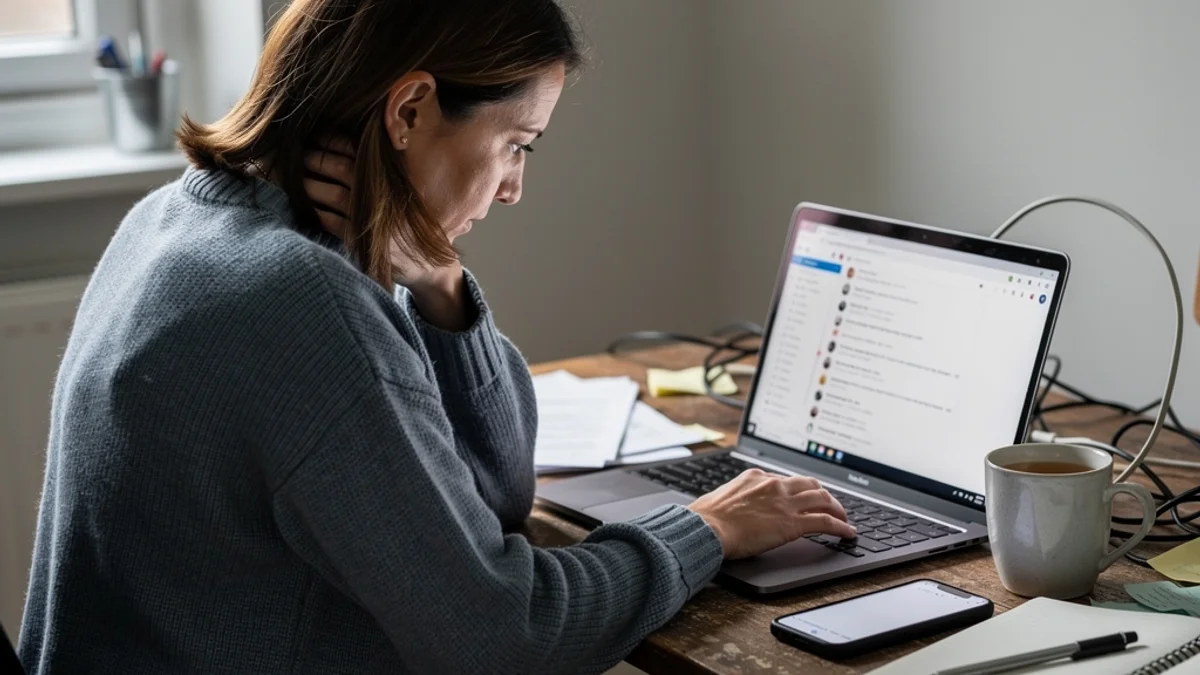
Posture and stress affect each other in both directions. Under stress, the muscles across the top of your shoulders tighten, and concentrating on a screen pulls your head forward. Sitting slumped then makes a stressful task feel worse and slows how quickly a bad mood lifts. Both directions have been measured in controlled studies. The claim that sitting up straight changes stress hormones has not held up.
How Stress Changes Your Posture
The clearest study for desk workers comes from the University of Colorado. Shahidi and colleagues put 60 healthy office workers through a demanding computer task twice: once as unmonitored practice with a familiar, encouraging tester, and once told that speed and accuracy mattered, with a cash reward for high scores and an unfamiliar tester who gave no encouragement. They tracked head position and the activity of the neck and shoulder muscles.
The two things moved separately. Forward head posture increased as soon as people started concentrating, compared with sitting at rest, but adding stress didn’t push the head any further forward. Stress instead raised activity in the upper trapezius, the muscle running from your neck to the top of each shoulder. It went up on both sides between the low-stress and high-stress runs. The deeper neck muscles didn’t change. The authors concluded the upper trapezius is “selectively activated by psychosocial stress independent of changes in concentration or posture.”
That fits older work. In 1994 a Swedish group led by Ulf Lundberg measured trapezius activity in 62 women during mental arithmetic and a Stroop colour-word test. Both mental tasks raised muscle activity, and doing the Stroop test while holding a physical contraction raised it more than either alone. Blood pressure and self-reported stress followed the same pattern as the muscle readings.
Low mood shows up in posture too. A Brazilian study photographed 34 people with major depression during an episode and again after treatment, over ten weeks, alongside 37 healthy volunteers. During the episode, patients showed more head flexion and more rounding of the upper back (both p < 0.001). After treatment their posture looked like the controls’ apart from shoulder position. These were people with clinical depression, so it says little about an ordinary bad week, but it does show posture following mood.
How Slouching Changes the Way Stress Feels
The best-known test of the other direction is from the University of Auckland. Nair and colleagues randomly assigned 74 people to sit either slumped or upright, and held them there with physiotherapy tape on their backs. To stop expectations skewing the results, participants were given a cover story about what the study was for. Then everyone did the Trier Social Stress Test speech task, which is a standard way to stress people in a lab.
The upright group reported higher self-esteem, better mood and lower fear than the slumped group. When the researchers analysed the speeches, the slumped group used more negative-emotion words, more sadness words, more “I” and “me”, and fewer words overall. Blood pressure and heart rate were measured throughout, and the only cardiovascular difference reported was higher pulse pressure in the upright group. The study didn’t measure cortisol.
The same team repeated the design with 61 people who screened positive for mild to moderate depression. Everyone started out more slumped than published norms. Taping them upright increased high-arousal positive mood, and they spoke more and said “I” less. Across both groups, a more upright shoulder angle went with less negative mood and less anxiety. The authors call it a preliminary study.
Slumping also seems to make a bad mood last longer. In a Dutch experiment with 229 participants, people were put into a negative or neutral mood and then asked to sit stooped, straight or as normal while writing down their thoughts. The stooped group recovered less from the negative mood, ended up in a worse mood after the neutral one, and wrote more negative thoughts. A second experiment with 122 people found the same slower recovery, whether or not they’d been taught to reframe their thinking.
Two more results point the same way. In 30 depressed inpatients, those who sat slumped while learning a word list later recalled more negative words, while those sitting upright recalled positive and negative words equally. And when 125 students did 30 seconds of mental subtraction in both positions, they rated it harder slouched (6.2 out of 10) than upright (4.9). The gap was widest among the students with the most test anxiety (7.0 against 4.8), and among the least anxious 30% it wasn’t significant. That was a class exercise with self-rated difficulty, so treat it as suggestive.
Posture and Stress Hormones: What Happened to Power Posing
In 2010, Carney, Cuddy and Yap reported that holding two expansive “high-power” poses for one minute each raised testosterone, lowered cortisol and made people more willing to take risks, in a sample of 42. The hormone figures from that study are still widely quoted.
In 2015 Ranehill and colleagues ran a similar study with 200 people and an experimenter who didn’t know which pose each person had held. People who power posed did say they felt more powerful, but there was no effect on hormones and none on the behavioural tasks. Dana Carney, the original lead author, later published a statement saying “I do not believe that ‘power pose’ effects are real.”
A 2022 meta-analysis in Perspectives on Psychological Science pooled 73 studies comparing expansive and contracted postures, and looked separately at comparisons with a neutral posture. The difference between expansive and contracted postures was real for mood and behaviour. But almost all of it came from the contracted side: slumped versus neutral posture gave an effect size of g = 0.45, while expansive versus neutral was g = 0.06, close to nothing. In the authors’ words, it’s “the absence of contractive displays rather than the presence of expansive displays” that changes how people feel and act. For desk work, that means the goal is to avoid slumping, and a big expansive pose adds little beyond that.
Does Slouching Affect Your Breathing?
Yes, a little. In a Northwestern University study of 70 volunteers, slumped sitting significantly lowered lung capacity and expiratory flow compared with normal sitting. In 35 healthy young men, the strength of a sharp sniff in was 8.7 cmH₂O lower slouched than upright.
It’s often said that slouching makes your breathing shallow and that this makes you anxious. Neither study measured stress or anxiety, so the second half of that is a guess. Our article on posture and breathing has the full numbers.
Does Stress Cause Neck and Shoulder Pain?
The reviews disagree.
A 2013 review of 18 long-term studies found strong overall evidence that high job demands, low control over your work, poor support and job strain add to the risk of neck and shoulder problems on top of physical factors. The authors said the results were too varied to pool and should be read carefully.
A 2012 review that looked only at office workers found the opposite for stress. Across seven cohort studies, the only factors that predicted new neck pain were being female and having had neck pain before. High psychosocial stress had no predictive value.
A 2018 review of 27 studies of computer users may explain the gap. Job demands and low control weren’t linked to neck pain on their own, but they were once they came with long hours at a computer or poor ergonomics. Support from a supervisor was the one factor that cancelled the effect out, in female office workers.
If your neck is already sore, see neck pain from desk work and shoulder pain from sitting.
How to Break the Loop at Your Desk
- Drop your shoulders when you notice them. The Shahidi study suggests the upper traps are the part that responds to pressure. Shrug them up towards your ears, hold for a second and let them fall. A few slow shoulder rolls do the same job.
- Raise your screen. Concentration pulled heads forward before any stress was added, and a low screen makes that worse. The top of the screen should sit roughly at eye level. Monitor height and neck pain has the measurements.
- Get out of the slump. You don’t need to sit bolt upright. The meta-analysis found the benefit comes from getting out of the collapsed position. Sit back on your sit bones with your ribs over your hips. Proper desk posture covers the setup.
- Check your posture before a stressful call or a hard email. The Auckland studies tested posture during a stressful task, and that’s where it made a difference.
- Break up long sessions. The 2018 review found stress mattered most when it came with long stretches at a computer. Getting up regularly shortens those stretches, and the 20-8-2 rule is one easy pattern.
Your head drifts forward while you’re concentrating on something else, so it’s easy to miss. That’s why we built SitApp. The Droid watches your posture through your webcam, on your own computer, and nudges you when you start to slump. No images leave your device.
Claims About Posture and Stress We Couldn’t Verify
Three claims about posture and stress are widely repeated, and we couldn’t support any of them:
- “Upright posture lowered perceived stress by 23% over six months (Journal of Behavioral Medicine, 2024).” We searched PubMed and Crossref and found no such study.
- “Power poses raise testosterone 20% and cut cortisol 25%.” These come from the 2010 study above, and the hormone effects didn’t replicate.
- “Slouching raises cortisol.” None of the sitting-posture studies we found showed this, and the Auckland study didn’t measure cortisol.
Frequently Asked Questions
Does bad posture cause stress, or does stress cause bad posture? Both. Stress raises upper-shoulder muscle tension and concentration pulls your head forward. Sitting slumped makes a stressful task feel worse and slows recovery from a low mood.
Can sitting up straight lower cortisol? There’s no good evidence that it does. The original power-posing hormone results failed to replicate, and the main sitting-posture stress study didn’t measure cortisol.
Can bad posture cause anxiety? No study shows it causes an anxiety disorder. In the lab, slumping made stressful tasks feel harder, and the effect was biggest in the students with the most test anxiety.
Is power posing real? People who power pose say they feel more powerful. The hormone and behaviour effects didn’t replicate, and the original lead author has said she doesn’t believe the effects are real.
Why do my shoulders tense up when I’m stressed? Mental stress raises activity in the upper trapezius, even when you aren’t moving. Two lab studies above measured it directly.
Can better posture help with depression? Small, short studies in people with depressive symptoms found upright sitting improved mood and reduced negative recall. They don’t show posture as a treatment, so speak to a GP if low mood is lasting.
