
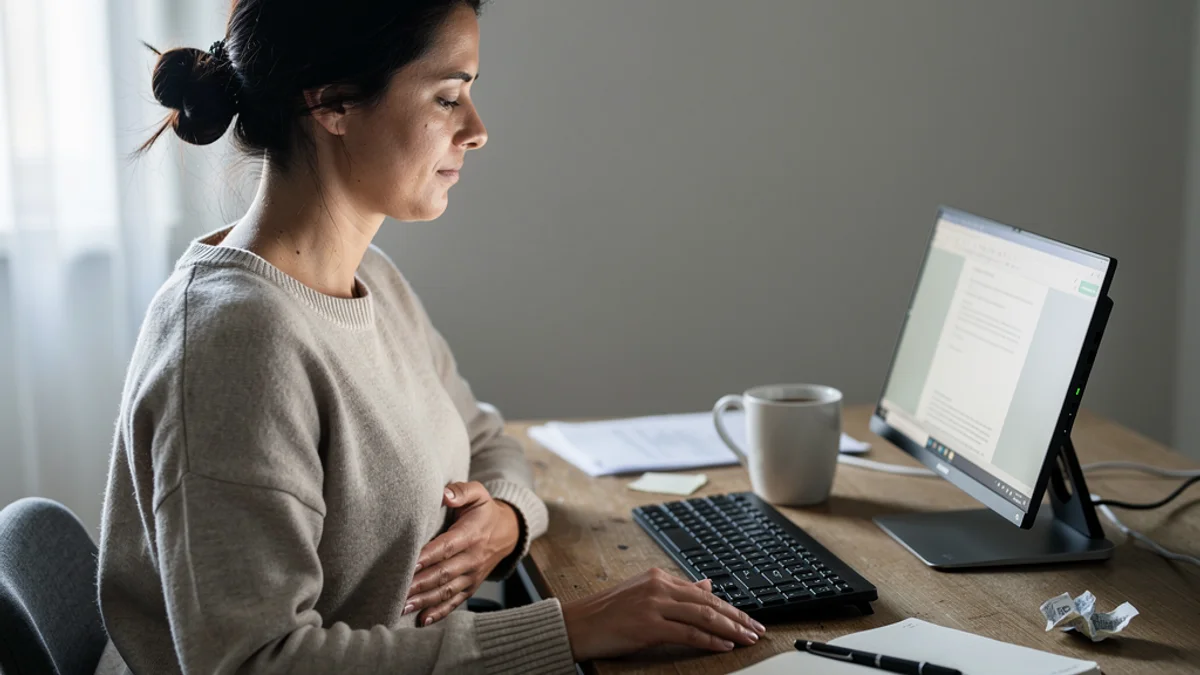
Yes. When you slump, you can’t move as much air, and this has been measured on spirometers rather than just asserted. In the studies below the drop is somewhere around 10%, it shows up within an hour of sitting down, and the same people score better again when they sit up or stand.
That’s a smaller effect than a lot of posture content implies. There’s also one reasonably sized study of office workers that found the opposite of what you’d expect, which I’ll come to.
What the Studies Measured
The most useful single study is from Northwestern University, published in Archives of Physical Medicine and Rehabilitation in 2006. Lin and colleagues put 70 volunteers through four postures in random order and ran spirometry in each: normal sitting, slumped sitting (pelvis slid forward, back rounded against the backrest), a modified seat that tipped the pelvis forward, and standing.
Slumping made things worse. In their words, “in slumped sitting, LC-EF significantly decreased from that in normal sitting,” where LC-EF means forced vital capacity, forced expiratory volume in one second, peak expiratory flow and maximum forced expiratory flow. Standing came out ahead of both normal and slumped sitting on every one of those.
Two smaller studies measured it differently.
Albarrati and colleagues tested 35 healthy men aged 18 to 35 on sniff nasal inspiratory pressure, which is how hard you can sniff in and a standard stand-in for the strength of your breathing-in muscles. Sitting upright they averaged 93.5 cmH₂O. Slouched, 84.8. The paper puts the mean difference at 8.7 cmH₂O (p = 0.04), so a bit over 9%.
A 2016 Korean study recruited 50 volunteers and analysed 46. Half spent an hour sitting on a smartphone and half spent the hour however they liked. Forced vital capacity in the phone group went from 3.2 to 3.0 litres, while the controls went from 2.4 to 2.5. The authors concluded that “the posture assumed while using a smartphone leads to reduced respiratory function.”
A 2017 systematic review of sitting posture came to the same general view, saying posture “also determines the work of the respiratory system.”
Most of the Drop Happens in the First Hour
This result gets less attention than it should. Researchers publishing in Osong Public Health and Research Perspectives in 2016 sat 21 young volunteers down (mean age 23, 16 of them women) and tested them at the start, after one hour and after two. The results:
| Measure | Start | 1 hour | 2 hours |
|---|---|---|---|
| FVC | 2.58 L | 2.33 L | 2.22 L |
| FEV1 | 2.39 L | 2.11 L | 2.00 L |
| PEF | 4.49 L/s | 3.72 L/s | 3.53 L/s |
Forced vital capacity fell about 10% in the first hour and peak flow about 17%. After that it more or less stopped. The authors write that “all the changes we found took place within the 1st hour of sitting,” and the one-hour and two-hour readings weren’t significantly different.
It’s a small study, so I wouldn’t lean on the exact figures. The pattern is still useful, though. If the loss comes early and then levels off, getting up briefly every hour should do more than one long lunch break, which is roughly the idea behind the 20-8-2 rule.
Why Slumping Gets in the Way
The diaphragm does most of the work of breathing in. Cleveland Clinic describes it as “the most efficient muscle for breathing.” It’s a dome of muscle under your ribs, and when it contracts it pulls down and draws air into the lungs.
When you slump, the gap between your lower ribs and your pelvis gets smaller. Your stomach and the rest of your abdomen get pushed up into the space the diaphragm needs to move into, and a rounded upper back holds the ribs down so they don’t lift as easily. So the diaphragm has less room and the ribs move less.
A 2010 study from the University of Queensland showed where the movement goes instead. Lee and colleagues tracked the chest wall in 3D in seven volunteers across seven seated postures, and kept the size of each breath constant so posture was the only thing changing. In the slumped posture, “movement at the AP diameters at T1 and axilla increased.” That’s front-to-back movement at the very top of the chest, around the first rib and the armpits. Put simply, breathing moved up into the upper chest.
Upper-chest breathing leans on the scalenes and sternocleidomastoid, neck muscles that attach to the top ribs and collarbone and can lift the ribcage. They’re built for occasional hard breathing, like running or coughing. Using them for hours of quiet breathing tends to leave the neck tight and sore.
Two studies from Greece fit with this. A 2009 pilot study in Cephalalgia compared 12 people with chronic neck pain to 12 matched controls. The neck pain group had “a statistically significant decreased maximal voluntary ventilation (P = 0.042) and respiratory muscle strength (Pimax and Pemax), (P = 0.001 and P = 0.002, respectively),” and the authors reported “a strong association between an increased forward head posture and decreased respiratory muscle strength.” A 2013 follow-up in Manual Therapy with 45 patients and 45 controls also found weaker breathing muscles in the neck pain group, with neck muscle strength “the only predictor that remained as significant into the prediction models.”
Neither study can show which came first. They do suggest that neck pain from desk work and breathing problems often turn up together. If your head tends to drift toward the screen, our guide to forward head posture goes into that in more detail.
Screen Apnea
This one has nothing to do with posture, but it’s probably what a lot of people notice first.
In 2007 Linda Stone noticed she kept holding her breath while going through email. She spent seven months looking into it, including testing friends “at my dining room table, using a simple device that tracked pulse and heart rate variability,” and wrote that “only about 80% of the people I observed and tested had email apnea.” She called it “email apnea or screen apnea, which means, temporary cessation of breath or shallow breathing while working (or playing!) in front of screens.”
That 80% comes from watching her friends, not from a controlled study, and she doesn’t claim otherwise. The term probably caught on because most people recognise it in themselves once they hear it. You can have a perfectly good chair and still hold your breath every time a message comes in. A better chair won’t change that. Noticing when you do it will.
The Evidence That Cuts the Other Way
Three things to keep in mind before reading too much into all this.
First, a 2024 study in Physical Activity and Nutrition tested 180 office workers and grouped them by how many hours a day they sat. You’d expect the people sitting longest to do worst. They did best. Average FVC was 2.91 L in the 2-4 hour group, 3.19 L in the 4-6 hour group and 4.11 L in the group sitting more than six hours, and FEV1 followed the same pattern (p < 0.001). The groups weren’t matched for age, sex, height or fitness, and each of those affects spirometry more than posture does, so I wouldn’t read it as sitting being good for your lungs. It does undercut the idea that desk work is doing lasting damage. The lab studies above measure a short-term effect of position, and that’s a much smaller claim.
Second, in the Queensland study, once breath size was held constant, respiratory function didn’t differ between postures. Slumping changed where the movement happened.
Third, I couldn’t find any evidence that slouching lowers blood oxygen in healthy people. You have a lot of spare capacity. If you’re actually short of breath at rest, posture probably isn’t the reason, and you should see a GP.
Does Improving Your Posture Improve Your Breathing?
Some evidence says yes. A randomised controlled trial published in BMC Complementary Medicine and Therapies in 2025 took 74 college students with upper crossed syndrome (rounded shoulders plus a forward head) and gave half of them neck and upper-back training for eight weeks, five days a week, 45 minutes a session. The other half carried on as normal.
Forward head angle improved a lot (effect size 1.113). Lung function improved moderately: FEV1/FVC at d = 0.516 (p = 0.002) and maximal voluntary ventilation at d = 0.504 (p = 0.033).
That’s nearly four hours of exercise a week for two months, compared with a group that did nothing. Sitting up changes your lung volumes straight away, and you don’t need a training programme for that part.
What Helps at a Desk
- Raise your screen. Most slumping starts with your head moving toward a screen that’s too low. Get the top of it roughly level with your eyes. Monitor height and neck pain has the measurements.
- Stand up once an hour. Standing scored best in the Lin study, and the time-course study suggests the loss happens early. A minute on your feet each hour is enough.
- Sit on your sit bones. The slumped posture in the Lin study had the pelvis slid forward. Sit back in the chair so your ribs are stacked over your hips. Proper desk posture covers the rest of the setup.
- Try a couple of minutes of belly breathing. From Cleveland Clinic: “Place one hand on your upper chest and the other just below your rib cage… Breathe in slowly through your nose so that your stomach moves out against your hand. The hand on your chest should remain as still as possible.” If the top hand is the one moving, you’re breathing mostly from your upper chest.
- Watch for breath-holding. Next time a notification lands, notice whether you stop breathing for a second.
- Stretch the front of your chest. Rounded shoulders pull the ribcage closed. A doorway chest stretch and a few shoulder rolls help. See desk stretches and how to fix rounded shoulders.
None of this is complicated. The hard part is remembering it while you’re concentrating, which is why we built SitApp. The Droid watches your posture through your webcam, on your own computer, and nudges you when you start to slump. No images leave your device.
Frequently Asked Questions
Can bad posture cause shortness of breath? It can make breathing feel shallow or restricted, and it lowers the maximum amount of air you can move. It’s unlikely to make a healthy person actually short of breath, because normal breathing uses only a small part of your capacity. Breathlessness at rest, at night or with chest pain needs a doctor.
How much lung capacity do you lose from slouching? In the studies above, about 10% of forced vital capacity after an hour of sitting, about 17% of peak flow, and about 9% of inspiratory muscle strength when slouched compared with upright. The posture studies tested the same people in different positions, so this is about how you’re sitting at the time, not lasting damage.
Why do I sigh or yawn so much at my desk? Two likely reasons, and you can have both. Upper-chest breathing takes smaller breaths, so every so often you take a big one to catch up. Holding your breath while you concentrate has the same result.
Does a standing desk help? Standing scored best in the Lin study, so yes, as long as you switch between sitting and standing and don’t just slump on your feet instead. More in do standing desks fix posture.
