

You stand up at six o’clock and your neck tells you what your day looked like. Stiff across the top of the shoulders. A dull ache at the base of the skull. That specific tightness on one side that shows up whenever you turn your head to reverse the car.
Search for text neck exercises and you get lists. Ten moves, twelve moves, a yoga pose or two padded in to reach a round number, and a closing line about doing them “several times a day”. Almost none of them tell you which moves matter most, how many minutes actually buys you anything, or how long you should expect to wait before your neck feels different.
So here are six, chosen for what they do to the specific muscle pattern a day of looking down leaves behind, with the dose and the timeline from the trials that measured it.
What a Day of Looking Down Actually Leaves Behind
A day of screen work leaves a pattern across four or five muscle groups. The routine has to reverse all of it, and the bit that hurts is rarely where the problem started.
Hold your head forward of your shoulders for hours and two things happen at once. The deep muscles at the front of your neck, the ones that tuck your chin and hold your head balanced on the spine, stop pulling their weight. The bigger surface muscles take over the job badly. A 2018 systematic review in BMC Musculoskeletal Disorders by Blomgren and colleagues, Effects of deep cervical flexor training on impaired physiological functions associated with chronic neck pain, pooled twelve randomised controlled trials covering 502 people with persistent neck pain and described the signature plainly. “The changed muscle behaviour in patients with neck pain presents as impaired (reduced) deep flexor muscle activity associated with increased activity in SCM and AS.” Sternocleidomastoid and anterior scalene, the two big surface muscles at the front and side of your neck, doing a job they are not shaped for.
Meanwhile the back of the picture shortens. Your upper trapezius and levator scapulae spend the day holding your head up against gravity from a bad angle. Your chest muscles shorten because your arms are out in front of you on a keyboard for eight hours.
So a text neck routine has three jobs. Wake up the deep flexors, lengthen the muscles that shortened, and strengthen the ones across the upper back and shoulders that gave up, with anything else in the list counting as padding. If you want the fuller version of how the condition develops, our guide to what tech neck actually is covers the mechanics, and forward head posture covers the alignment side.

The Six Text Neck Exercises Worth Doing
None of these need equipment beyond an elastic band for the last one. All of them can be done in a normal work shirt without anyone noticing much.
1. The Seated Chin Tuck
Sit tall. Without tipping your head down, draw your chin straight back toward your throat, as though someone is pressing gently on your forehead. Your eyes stay level. You should feel a stretch at the base of your skull and get a mild double chin, and the double chin is how you know you have it right.
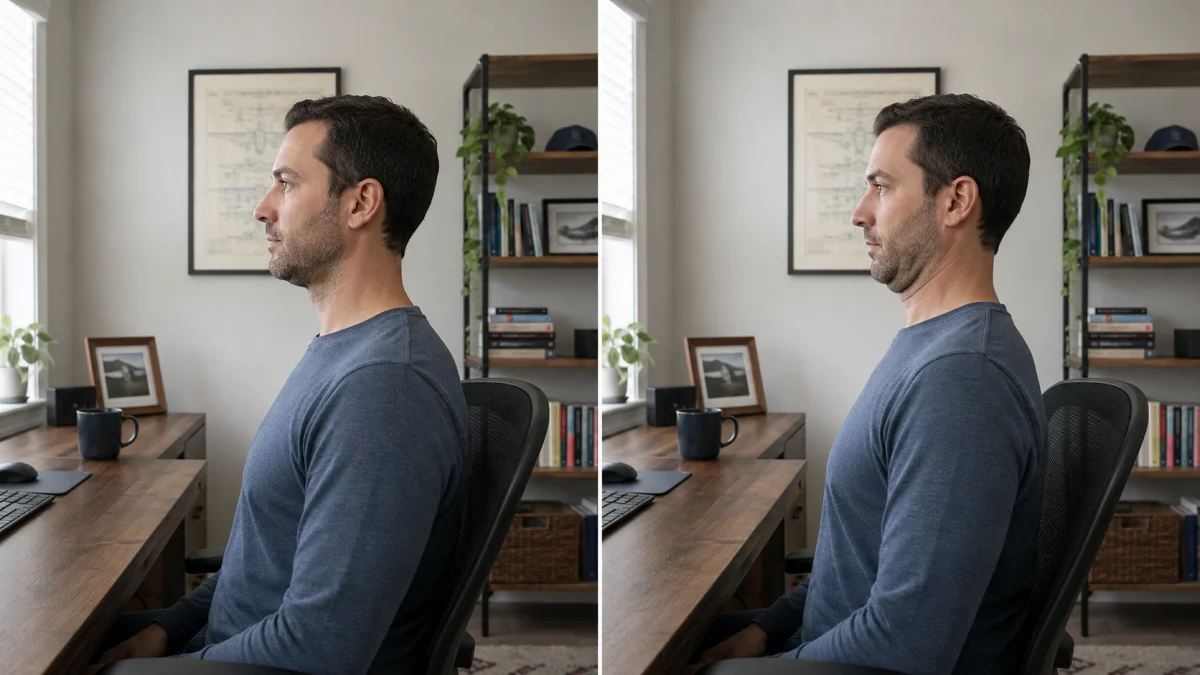
Hold five seconds. Release. Ten repetitions.
This is the anchor of the whole routine. It is the movement the Blomgren review was measuring, and the one that trains the deep flexors directly rather than letting the surface muscles do the work. Go slowly. If you feel your throat straining or the front of your neck bulging, you are pulling too hard and the big muscles have taken over.
2. The Lying Chin Tuck
Same movement, lying on your back with your head on the floor and knees bent. A thin folded towel under your head is fine if the floor feels harsh. Draw the chin back so the back of your neck lengthens toward the floor. Hold five seconds, then release. Ten repetitions.
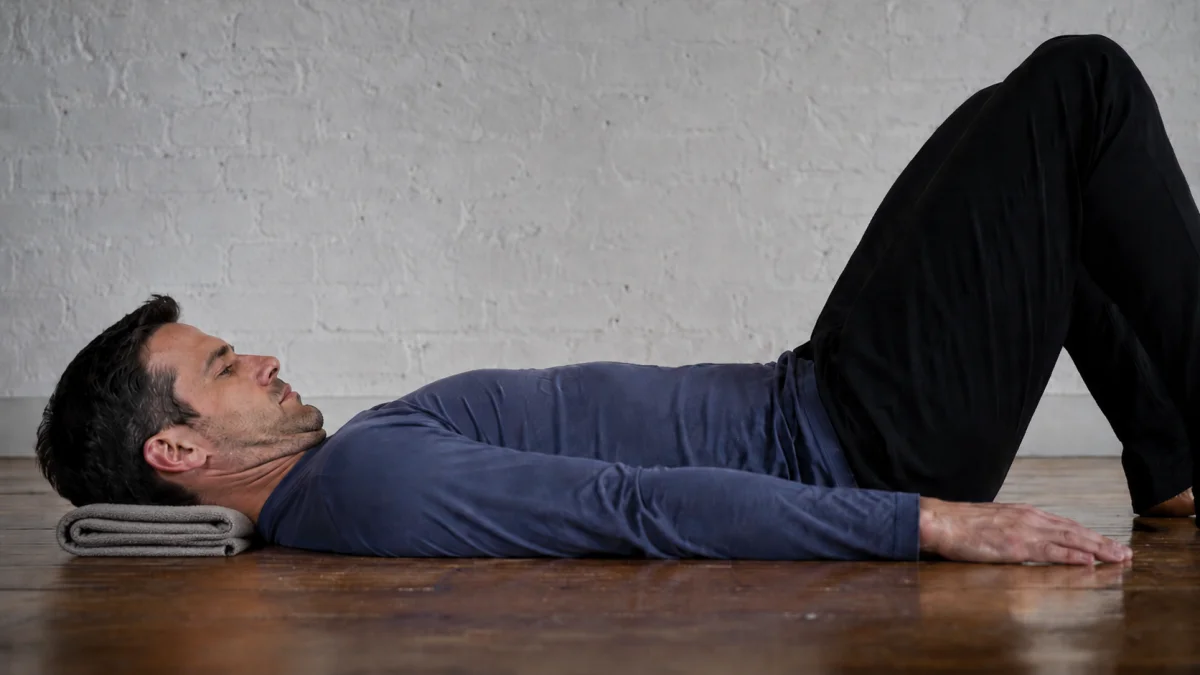
Gravity resists you here, which makes it considerably harder than the seated version. Treat it as a progression rather than an alternative, and spend two or three weeks on seated chin tucks before you add it. If your head lifts off the floor, you have turned it into a crunch and switched muscles again.
3. The Upper Trapezius Stretch
Sit tall with one hand tucked under your thigh to anchor that shoulder down. Tip the opposite ear toward your shoulder. Use your free hand on the side of your head for a little extra pull, gently. Hold thirty seconds, then swap.
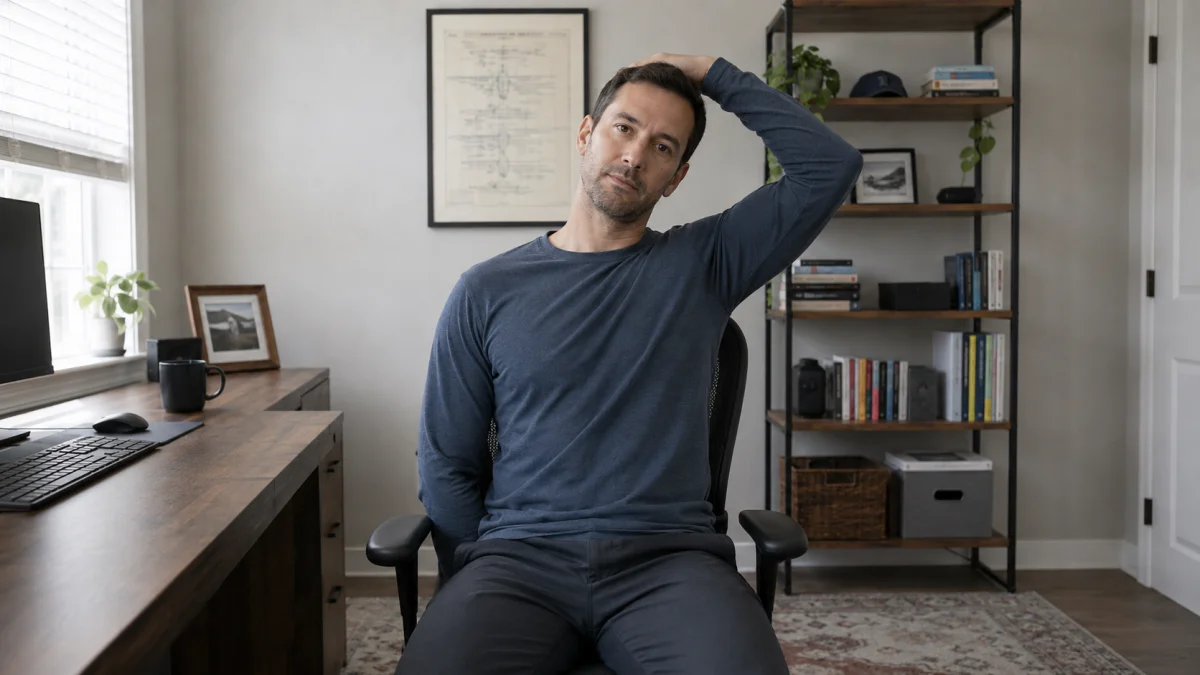
People skip the anchoring. Without it your shoulder rides up to meet your ear and you stretch almost nothing.
4. The Levator Scapulae Stretch
Turn your head about forty-five degrees, as though you are looking toward your armpit, then drop your nose toward that armpit. Same anchoring rule, hand under the thigh. Hold thirty seconds each side.
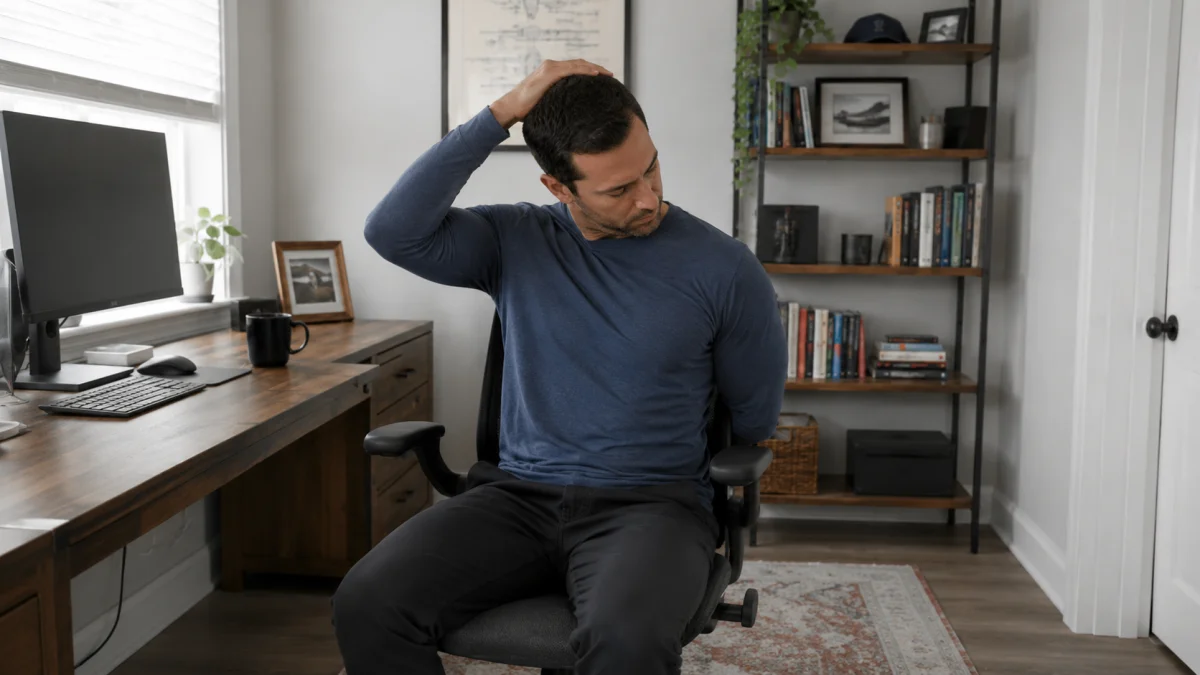
Most text neck lists give this one a single line, if they mention it at all, which is odd given the anatomy. The levator scapulae runs from your upper neck to your shoulder blade, and it does the most work when your head hangs forward of your body for hours. If your neck pain has a specific sore spot where the neck meets the shoulder, this is usually the muscle.
5. Wall Angels
Stand with your back against a wall, feet six inches out, and press your lower back, upper back and the back of your head into the wall. Bring your arms up into a goalpost shape, upper arms and forearms touching the wall. Slide them up overhead as far as you can while keeping contact, then back down. Ten slow repetitions.
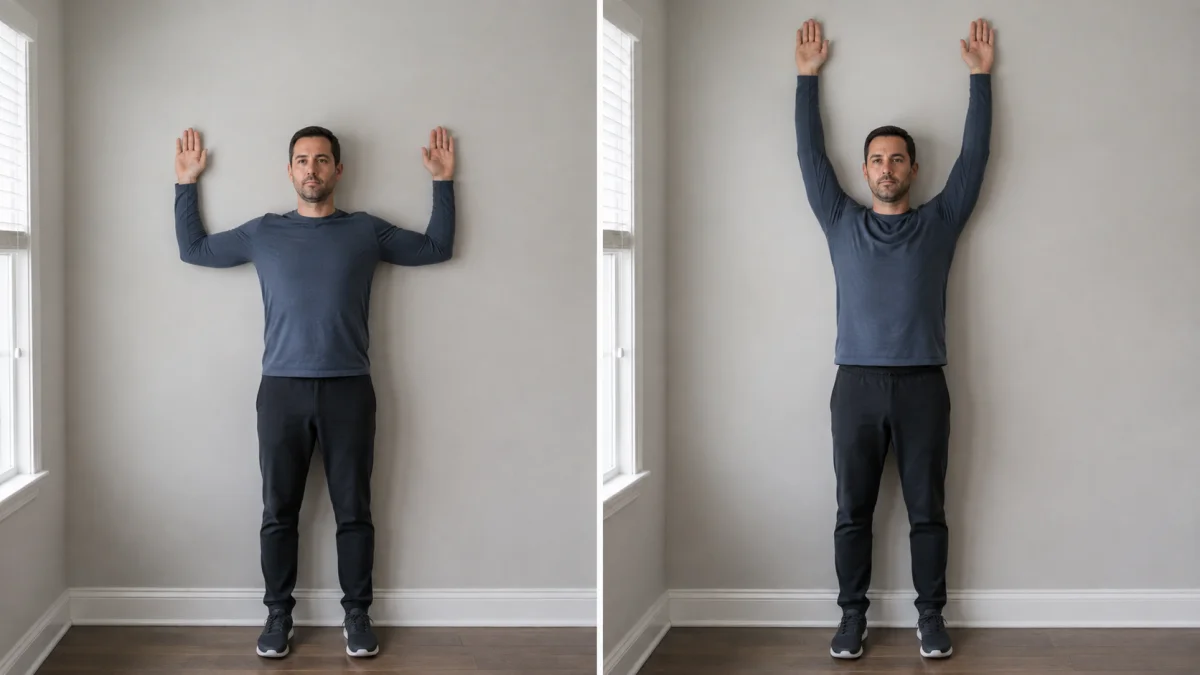
Most people cannot keep their wrists on the wall the first time. That gap is the measurement, and it closes over a few weeks. Wall angels handle the rounded-shoulder half of the pattern, which sits underneath the neck half more often than people expect. Our guide on how to fix rounded shoulders goes further if the shoulders are your main complaint.
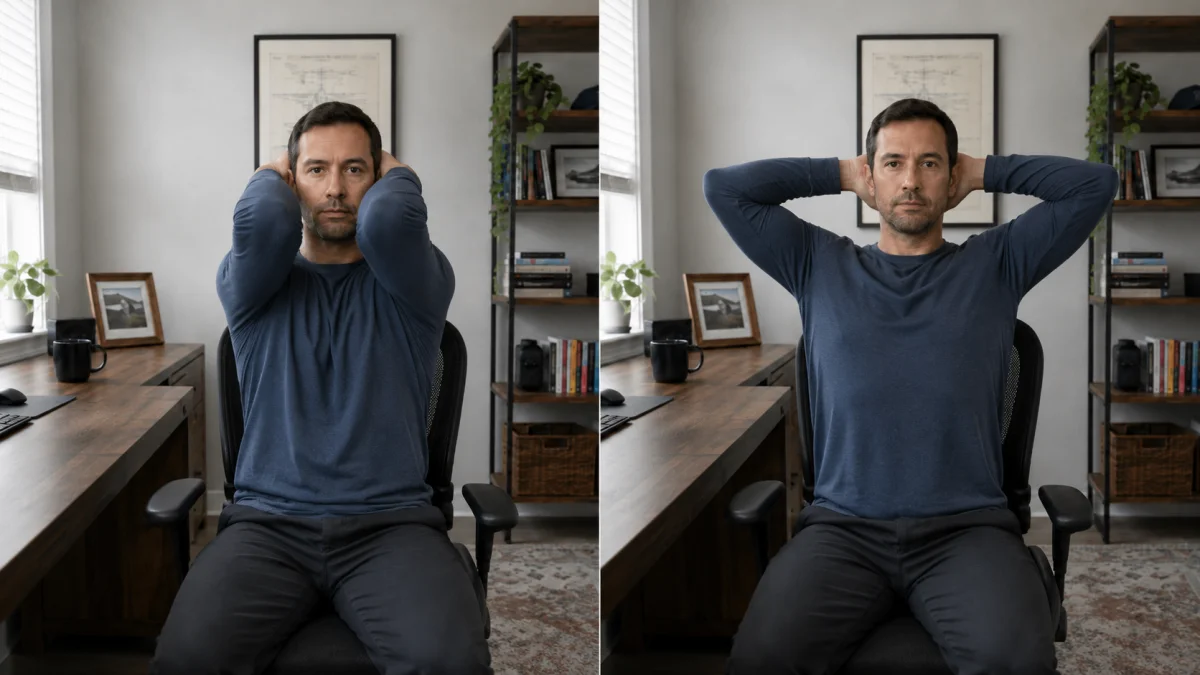
If there is no free wall in your office, the seated chest opener does a smaller version of the same job from your chair.
6. Banded Shoulder Raises
Stand on the middle of an elastic band or resistance tube, one end in each hand. Raise your arms out and slightly forward, to about shoulder height, then lower slowly. Keep going until the muscle genuinely fatigues.
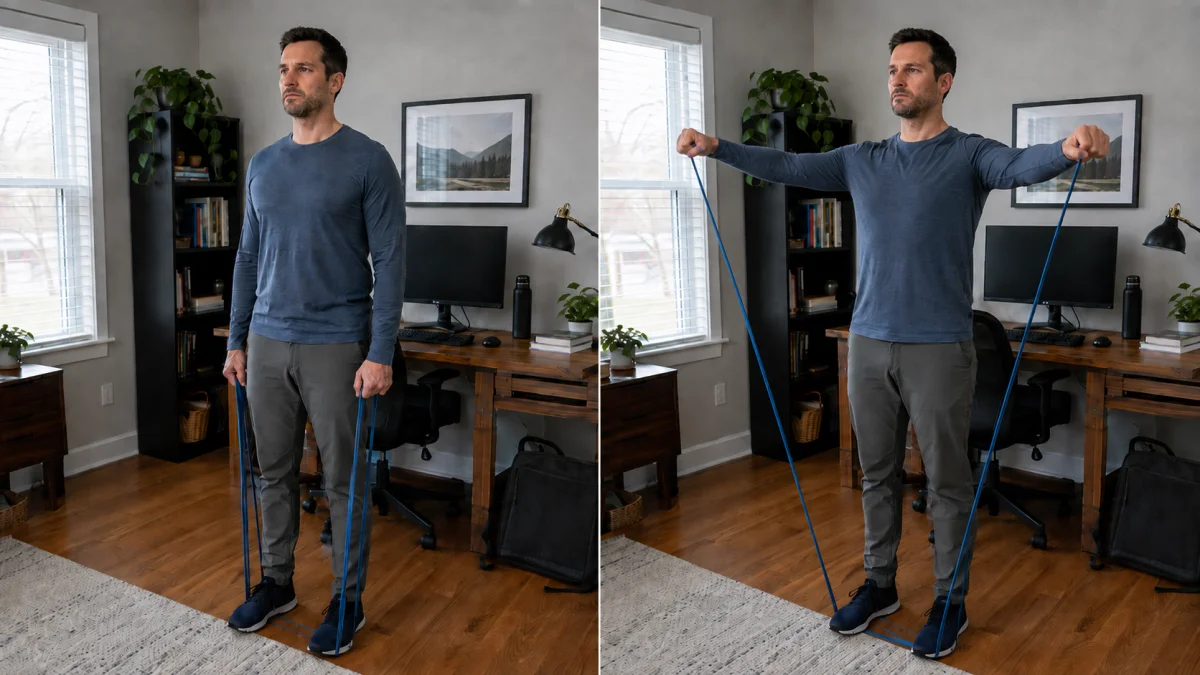
This is close to the exercise used in a 2013 randomised controlled trial by Lidegaard and colleagues in BioMed Research International, Effect of Brief Daily Resistance Training on Occupational Neck/Shoulder Muscle Activity in Office Workers with Chronic Pain. Thirty female office workers with chronic neck and shoulder pain did a single set of shoulder abductions with elastic tubing, to fatigue, for two minutes a day on workdays. Ten weeks later the training group’s neck and shoulder pain intensity had dropped 40% against the control group, and isometric strength was up 6%. One exercise, two minutes, done on workdays only.
How Much, and How Often: The Dose Nobody Cites
Most exercise lists tell you to do all of them “several times a day” and stop there. Two trials put numbers on it.
The Lidegaard result sets a floor. Two minutes a day of one properly fatiguing exercise produced a 40% drop in pain over ten weeks, which is a small enough commitment that “I did not have time” stops being credible.
Whether piling on more buys you anything is a separate question, and a 2020 workplace study answers it directly. Saeterbakken and colleagues, writing in BMC Sports Science, Medicine and Rehabilitation, ran a dose-response comparison over eight weeks of resistance training five days a week: ten minutes a day against ten minutes twice a day. The group doing double the volume got nothing extra for it. “There were no differences between the TG10 and TG20 in pain (general and worst)”, the authors report, at p values between 0.37 and 0.68. Merging both groups, mean pain fell 25% and worst pain 43%, and their read on it was that “10 min bouts were equally effective as 2 x 10 min bouts per day.”
Run the full six-exercise routine once a day, most days. It takes about five minutes. Doing it three times a day will not make your neck three times better, and the belief that it will is why most people quit in week two.
Stretches are the exception. Holds are cheap and you can scatter them across the day without any of this mattering. Our 90-second hourly desk stretch routine exists for exactly that, and it runs alongside this programme.
When in the Day to Do Them
Most people default to the end of the day. By six o’clock the position has already been held for eight hours, so that timing only ever catches the damage after the fact.
Pick two moments instead of one. Put the strength work wherever it reliably happens, which for most people means either first thing or right after logging off. Then break the stretches up across the afternoon, when the forward drift has usually set in. If you have ever noticed your posture is fine at ten and wrecked by three, that pattern is real and we have written about when people slouch most.

What Text Neck Exercises Cannot Do
The deep flexor work has a narrower effect than the enthusiasm around it suggests. The Blomgren review found strong evidence that it improves neuromuscular coordination, and reported that “DCF training improved head and cervical posture, while evidence was limited or contradictory for other measures”. It also had “no or small effects on strength and endurance at higher loads”. Their conclusion was that “a multimodal training regime is proposed when the aim is to specifically address various impaired physiological functions associated with neck pain”. Chin tucks retrain the pattern, which is why the other five exercises are in this list.
The evidence base is thinner than the confident tone of most posture content implies, too. A 2025 systematic review in PLOS One by Norasteh and colleagues, Exercise therapy to improve cervical proprioception in individuals with asymptomatic forward head posture, pooled nine randomised controlled trials with 367 participants and found that cervical stabilisation exercises may improve cervical proprioception, while noting that “methodological heterogeneity and diagnostic inconsistencies, such as variations in craniovertebral angle thresholds used to define FHP, limit the ability to draw definitive conclusions”. Odds like that are worth acting on, as long as you go in expecting a decent bet rather than a settled result.
You also cannot out-exercise your desk. If your screen sits below your eye line, you will spend eight hours pulling your head forward and five minutes pulling it back, and the eight hours wins.
The OSHA computer workstation guidance is specific about this. “The top of the monitor should be at or slightly below eye level. The center of the computer monitor should normally be located 15 to 20 degrees below horizontal eye level.” Viewing distance should sit somewhere between 20 and 40 inches. If you work on a bare laptop, that geometry is impossible without a stand and a separate keyboard, and no amount of chin tucks will substitute. We go through the measurement properly in our guide to monitor height and neck pain.
There is a third thing the exercises cannot do, which is notice. Text neck is stubborn because the posture is invisible while you are in it. You do not feel your head drifting forward at 2pm during a difficult debugging session. You feel it at six. We built SitApp around that gap. The Droid sits in your menu bar, watches the same posture markers a physiotherapist would look for, and nudges you before the position turns into hours. Detection runs on your machine and no images ever leave it. Any cue that reliably catches the drift does the same job, whether it is an app, a timer or a colleague who keeps telling you to sit up.
How Long Before It Feels Different
The stretches relieve stiffness in the minute you do them, which is pleasant and tells you nothing about whether the pattern underneath is changing. That part takes weeks.
The 2025 scoping review in the Journal of Clinical Medicine by Piruta and Kułak, Physiotherapy in Text Neck Syndrome, looked at fifteen studies whose protocols ran from a single thirty-minute session up to eight weeks. Six weeks was the most common by a distance, used in seven of the fifteen, and where a frequency was specified it sat between three and five sessions a week. Their finding was that “all studies suggest that appropriate physiotherapeutic interventions can provide significant benefits, including pain reduction, posture correction, and improved range of motion in the cervical spine”, with the best outcomes coming from combining techniques rather than relying on one. They were careful to add that “further high-quality research is needed to strengthen the evidence and offer reliable recommendations for clinical practice”.
Six weeks is a fair expectation, then. The Lidegaard pain result came at ten weeks and Saeterbakken measured at eight. If you are two weeks in and nothing has changed, that is normal rather than a sign the routine is wrong. Our piece on how long it takes to fix bad posture sets out the wider timeline.
When to Stop Exercising and See Someone
A few symptoms mean you should put the routine down and get assessed.
The NHS advises seeing a GP if neck pain or stiffness “does not go away after a few weeks”, if painkillers are not helping, or if you have “other symptoms, like pins and needles or a cold arm - this could be something more serious”. Numbness, tingling or weakness running into an arm or hand means nerve involvement, and that needs a proper assessment rather than a YouTube routine.
One more piece of NHS advice worth repeating, because it runs against instinct. “Do not wear a neck collar - it’s better to keep your neck moving (unless a doctor tells you not to).” The reflex to immobilise a sore neck makes things worse in most cases.
Frequently Asked Questions
Do text neck exercises actually reverse forward head posture? Partly. The Blomgren systematic review reported that deep cervical flexor training “improved head and cervical posture”, with the evidence limited or contradictory on other measures. The change is real but gradual, and it holds only if the workstation stops pulling your head forward for the other eight hours.
How many chin tucks should I do a day? Ten repetitions with a five-second hold, once or twice a day, is a sensible starting dose. Nothing in the research suggests grinding out hundreds works better. The dose-response work on neck and shoulder training found doubling the volume produced no extra benefit.
Should I do these if my neck already hurts? For mild stiffness and ache, yes, and the trial evidence comes from people who already had chronic pain. Sharp pain, pain that radiates into an arm, or any numbness and tingling means stop and get assessed first.
Can you do chin tucks wrong? Easily. The common error is tipping the head down instead of drawing it straight back, which turns a deep flexor exercise into a neck flexion stretch. Keep your eyes level and imagine sliding your head backwards along a rail.
Do posture correctors do the same thing? No. A brace holds a position for you rather than training the muscles that hold it themselves, and the moment it comes off you are back where you started. We looked at the evidence in do posture correctors work.
Where to Start This Week
The routine is five minutes. Seated chin tucks, upper trapezius stretch, levator scapulae stretch, wall angels, banded raises, and the lying chin tuck once the seated version feels easy. Once a day, most days, for six weeks.
Before any of it, spend ten minutes on the screen. Raise the monitor until the top edge sits at or just below your eye line, push it back to roughly arm’s length, and if you work on a laptop, get it on a stand with a separate keyboard. That change costs you one afternoon and removes more daily neck flexion than the exercises can add back.
Then the harder part, which is remembering. Chin tucks are easy. What people lose is the 3pm Thursday moment, deep in something, when the head goes forward and nothing tells them. If that is the piece you keep dropping, SitApp handles it quietly from the menu bar, free to try, with the detection running entirely on your own machine.
Raise the monitor tonight. Run the five minutes tomorrow morning, and put a note six weeks out to check whether six o’clock still feels the way it does today.
