
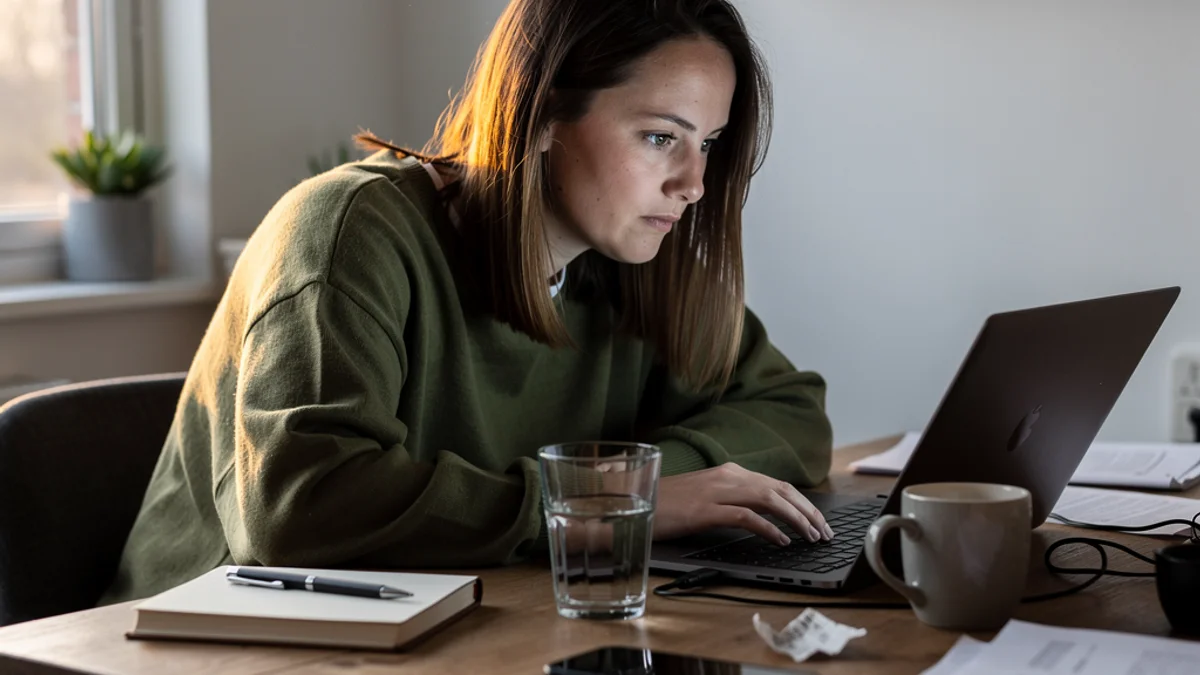
Slouching feels random - you catch yourself folded over the keyboard and have no idea how long you’ve been like that. But it isn’t random at all. Ask when do people slouch most, and the research gives a surprisingly consistent answer: posture doesn’t collapse all at once, it drifts in predictable windows. The longer you’ve been sitting, the time of day, and the device in your hands all push you the same direction.
None of this is willpower failing you. Slouching is what a tired body does when no one is watching - and most of the day, no one is, including you. Below are the three patterns that show up again and again in posture studies, why each happens, and how to spot your own slouch windows before they turn into a stiff neck by 5pm.
The Short Answer: When Slouching Peaks
If you want the pattern in one breath: you slouch most late in a long sitting stretch, during the mid-afternoon energy dip (roughly 2-4pm), and any time you’re hunched over a phone or laptop. Stack two or three of those together - a phone, at 3pm, ninety minutes into a meeting - and you’ve found the worst posture of your day.
The thread connecting all three is fatigue. Muscles tire, attention fades, and the slumped position is the one that costs nothing to hold.

Pattern 1: The Longer You Sit, the More You Slouch
The single most reliable predictor of slouching is simply how long you’ve been parked in the chair. You start upright, full of good intentions, and your posture erodes from there. Every time.
You can watch it happen at the muscle level. In a study of 30 office workers who sat for an hour in different positions, published on PubMed Central, the deep abdominal muscles that stabilise your spine (the internal oblique and transversus abdominis) showed measurable fatigue over the hour - but only in slumped sitting. The same muscles in upright and forward-leaning postures didn’t fatigue at all. Tellingly, the muscle signal during the first 10 minutes was significantly stronger than in every later block, meaning the support those muscles provide fades as the hour wears on.
It doesn’t even take an hour. A 2023 randomized crossover study of 25 healthy adults doing 15-minute typing tasks, published in Applied Ergonomics, found that all of the seated tasks produced a clinically meaningful rise in neck pain - and the slumped, unsupported posture caused both the most pain and the highest activity in the upper and lower trapezius (the muscles that ache across your neck and shoulders). Fifteen minutes of slumping was enough to register.
Part of this is mechanical. Hold your spine in a flexed, slumped shape and the soft tissues slowly stretch and give way - a process biomechanists call creep - so the same slouch deepens the longer you hold it. By the time you notice, you’re further forward than you were twenty minutes ago.
The clock matters more than your starting posture. Beginning a three-hour stretch sitting beautifully doesn’t help much if you never move again - the slump is coming once the support muscles tire, regardless. Interrupting the stretch before fatigue wins is what actually works. A short movement break every 30 minutes beats any single heroic posture correction, which is what our guide on how to stop slouching at your desk gets into.
Pattern 2: The Mid-Afternoon Dip
Layer time of day on top of sitting duration and a second window appears: the early-to-mid afternoon. That heavy, foggy feeling around 2-4pm has a name - the post-lunch dip - and it drags your posture down with your alertness.
It’s a genuine biological rhythm, not a food coma. A classic review of the post-lunch dip in performance notes that the dip shows up even when people eat no lunch at all and don’t know what time it is - it’s wired into the circadian system, though a heavy carb-loaded lunch can make it worse. Research places the window squarely in the 14:00-16:00 range, when sleepiness rises and sustained attention and working memory measurably decline.
That’s bad news for posture. Sitting upright is an active job - it takes muscles and, crucially, attention to keep doing it. When alertness bottoms out in the afternoon, the mental effort that had been holding you upright goes offline, and you fold into the path of least resistance. The same dip that makes you reread the same email three times also lets your shoulders round forward. There’s a real two-way street between how you sit and how you feel, which we dig into in posture and productivity.
Pattern 3: Phones and Laptops Pull You Down
The third pattern has nothing to do with time - it’s about what you’re looking at. Some devices are practically slouch machines, because they sit below eye level and pull your head forward and down.
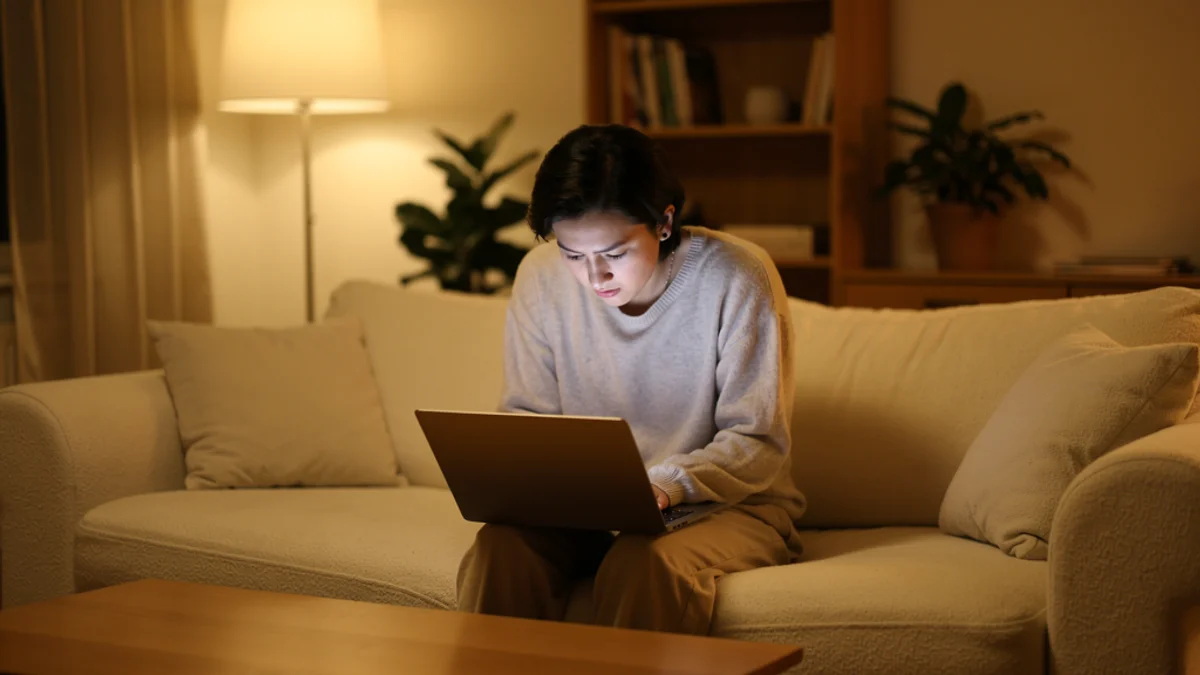
A laptop is the worst offender on a desk. Its screen and keyboard are fixed together, so to type comfortably you drop the screen low, and to see the screen you crane your neck forward over it - the trade-off that produces classic tech neck. Phones are worse still, because you almost always hold them at chest or lap height with your head tipped down toward them. Every centimetre your head juts forward of your shoulders multiplies the load your neck muscles have to hold, which is why phone-and-laptop time is where so much daily slouching hides.
This one is the most fixable, because it’s about geometry. Get the screen up to eye level and the reason to crane forward largely disappears - a laptop stand plus an external keyboard is the cheapest posture upgrade most desk workers can make. You can’t always fix a phone, but you can at least lift it toward your face instead of dropping your face toward it.
Watch for the stack, too. The device pattern is dangerous precisely because it overlaps with the other two. Scrolling your phone during the afternoon dip, or hunching over a laptop two hours into a session, doubles or triples the pull. The slouchiest moment of your day is rarely one cause - usually two or three of these windows landing at once.
Why You Don’t Notice Until It Hurts
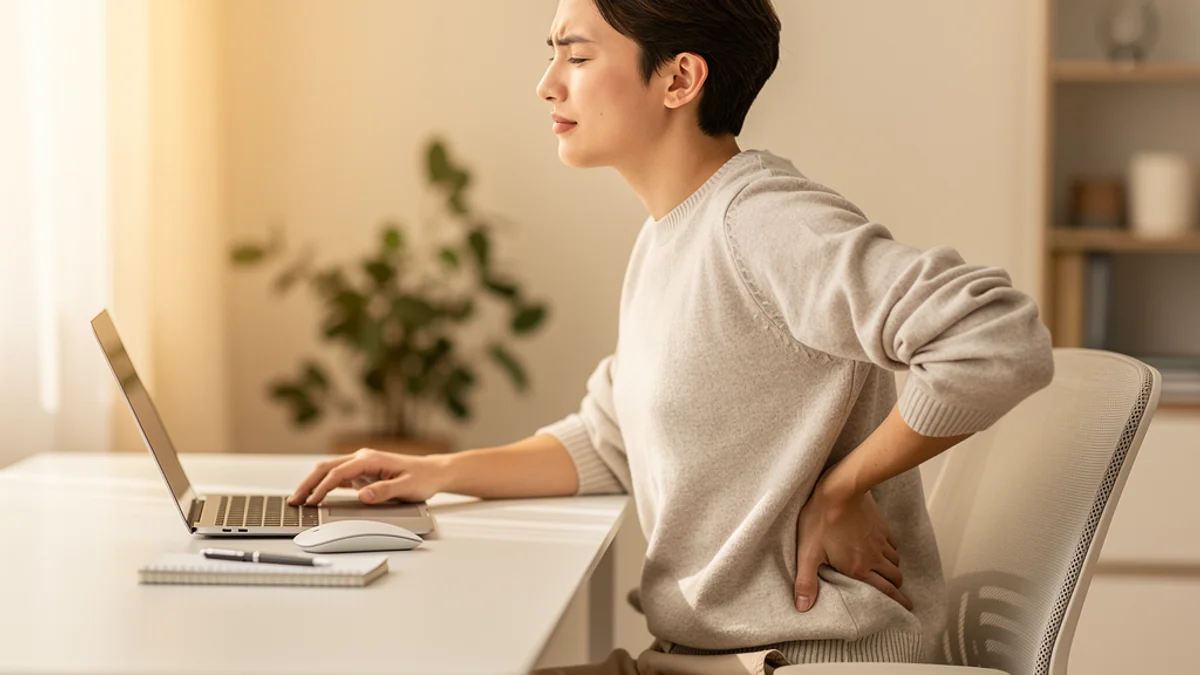
Notice what all three windows have in common: you’re never deciding to slouch. Your muscles tire late in a sitting stretch, your attention drops in the afternoon, and your head drifts toward a low screen - all without a single conscious thought.
That’s the real problem. Almost everyone knows they should sit up. The issue is awareness. The exact moments you slouch most - deep in a long session, mid-afternoon, absorbed in your phone - are the moments you’re least likely to be paying attention to your body.
Add deep focus to the mix and it gets worse. When you’re genuinely absorbed in a hard task - debugging, writing, a back-to-back run of calls - the part of your brain that might have flagged the slump is fully occupied with the work. The absorption that makes you productive is also what switches off the self-monitoring. You only find out hours later, when your neck files a complaint and you realise you haven’t shifted position since lunch.
So the most useful thing isn’t another reminder to “sit up straight” - it’s something that notices for you, in the windows where you can’t.
How to Find Your Own Slouch Pattern
The patterns above are averages from research. Your actual pattern will be more specific - maybe you’re fine until the 90-minute mark, maybe your dip hits at 4pm, maybe it’s only ever your phone. A study average won’t tell you that. Real data from your own day will.
That’s the job we built SitApp to do. The Droid watches your posture through your webcam and nudges you only when you actually slouch - so after a few days, you can see when the nudges cluster. Maybe it’s always after lunch. Maybe it’s every time you pick up your phone. Maybe it kicks in right around the time a long meeting runs over. That pattern is yours, and it’s more useful than any study average.
It’s privacy-first by design: the AI runs entirely on your device, nothing is uploaded, and no images are ever stored. It’s just a quiet second set of eyes for the hours when your own attention has clocked out. If you want the realistic timeline for turning those catches into a habit, how long it takes to fix bad posture lays out what the research actually shows.
FAQ
What time of day do people slouch most?
The early-to-mid afternoon, roughly 2-4pm, is the worst window for most desk workers. It lines up with the post-lunch dip, a circadian drop in alertness that occurs even if you skip lunch. As your attention fades, the muscular effort holding you upright fades with it, so you fold forward without noticing.
How long can I sit before I start slouching?
Sooner than you’d think. In one study, the deep core muscles that stabilise the spine began fatiguing within the first 10-20 minutes of slumped sitting, and another found measurable neck pain after just 15 minutes of typing in a slouched position. As a rule of thumb, posture starts drifting well before the 30-minute mark, which is why a short movement break twice an hour helps so much.
Why do I slouch more in the afternoon?
Because sitting upright takes attention, and your attention dips in the afternoon. The post-lunch dip is a built-in circadian rhythm that lowers alertness and sustained focus between about 2 and 4pm. When that focus drops, the muscles quietly holding you upright relax, and you sink into a slump.
Why is my posture worse on my phone or laptop?
Both devices sit below eye level, so you tip your head down and forward to use them - the position behind tech neck. A laptop locks the screen low to keep the keyboard reachable; a phone is usually held even lower. Raising the screen toward eye level with a laptop stand removes most of the reason to crane forward.
How do I stop slouching when I’m deep in focus?
You usually can’t catch it yourself, because the focus that makes you productive is the same focus that tunes out your body. The reliable fix is an external cue - a timed break, or a posture app that watches and nudges you only when you actually slump - so the noticing doesn’t depend on attention you don’t have to spare.
The Short Version
People slouch most late in a long sitting stretch, in the 2-4pm dip, and whenever a low screen pulls the head forward. Stack two or three of those and you’ve found the worst posture of your day. All three trace back to the same thing: a tired, unwatched body takes the path of least resistance.
Knowing the general windows is useful. Knowing your windows is what actually changes the habit. The time, the duration, the device - those details let you head off the slump before it becomes a 5pm headache.
If you’d rather not track all that by hand, SitApp’s free tier gives you an hour a day of on-device posture monitoring. The Droid watches through your webcam, everything runs locally - no images stored, nothing uploaded - and it only speaks up when you actually slouch. Within a day or two the pattern gets obvious.
