

It’s 3pm. You’ve been at your desk since morning, and something feels off. Your neck aches. Your lower back has that familiar dull throb. You’re reading the same paragraph for the third time because your brain just won’t cooperate. So you reach for another coffee, blaming the afternoon slump on a bad night’s sleep or a heavy lunch.
But the real culprit might be sitting right behind you. Literally.
The link between posture and productivity is stronger than most people realise. How posture affects productivity goes well beyond your back - it shapes your breathing, your mood, your confidence, and your ability to focus. And if you spend most of your day at a desk, that’s a lot of hours for bad posture to quietly chip away at your output.
The good news? Small posture changes make a measurable difference. Here’s what that looks like in practice - and what you can do about it starting today.
How Posture Affects Productivity: The Brain and Body Science
Most people think of posture as a back problem. Sit badly, get a sore back. Simple. But the effects of poor posture at your desk run far deeper than muscle pain. Your posture shapes how your brain functions, how you feel emotionally, and how effectively you think.
Breathing and Oxygen Flow
When you slouch at your desk, your chest cavity compresses. Your lungs can’t fully expand. Research shows this measurably reduces your breathing capacity - your brain receives significantly less oxygen with every breath.
That matters because your brain is an oxygen hog. It uses roughly 20% of your total oxygen intake despite being only 2% of your body weight. Cut the supply, and cognitive performance drops. You’ll notice it as brain fog, difficulty concentrating, and that frustrating feeling of reading words without absorbing them.
Sit upright, and your lungs open up. More oxygen reaches your brain. Thinking gets clearer. Basic physiology.
Pain and Distraction
Chronic pain is a productivity killer, and bad posture is one of its most common sources among desk workers. When your neck, shoulders, or lower back hurt, your brain diverts processing power to managing that discomfort. You’re not giving your work 100% of your attention - part of your mental energy is constantly occupied by pain signals.
Back pain alone costs US employers an estimated $19.8 billion annually in lost productive time. And the damage isn’t primarily from sick days. Most of the productivity loss comes from presenteeism - showing up to work but performing below your capability because you’re uncomfortable.
Mood, Confidence, and Focus
Posture doesn’t just affect you physically. It changes your psychology too.
Researchers at Ohio State University found that people who sat upright were more likely to believe their own positive thoughts. When participants wrote down their qualifications for a job while sitting straight, they rated themselves more favourably than those who slouched. Posture literally affected their confidence in their own thinking.
A separate study from the University of Auckland found that sitting upright reduced negative mood and increased positive mood in participants under stress. People who sat up straight maintained their self-esteem even during stressful tasks, while those who slumped showed increased anxiety and worse performance.
And a 2024 study published in Psychophysiology confirmed that alternating between sitting and standing positions reduced facial muscle tension - a physiological marker of stress - and improved cognitive arousal. Your body position is constantly sending signals to your brain about how alert and capable you should feel.

What the Research Says: Posture and Productivity by the Numbers
The connection between posture and productivity isn’t just theoretical. Recent studies have put numbers on it.
A 2023 study published in BMC Public Health tracked office workers using sit-stand desks over six weeks. When workers could freely switch between sitting and standing, their measured productivity improved by 6.5% compared to sitting-only periods. The researchers used keystroke and mouse interaction data - not self-reporting - making this one of the more rigorous measurements available.
The study also revealed something interesting about timing. Workers naturally gravitated toward standing between 2:30pm and 4:00pm - precisely when the afternoon slump hits hardest. Their bodies were instinctively fighting the energy dip with a posture change.
In a separate corporate wellness initiative studied by Ernst & Young, 75% of office workers who received posture coaching reported improved posture, decreased back pain, and feeling more productive. The improvement was rapid, too - 50% of participants reported meaningful changes within their first one to six sessions.
These posture and productivity gains aren’t massive, overnight transformations. A 6.5% improvement doesn’t sound dramatic. But compounded across an entire workday, five days a week, it adds up. That’s roughly 30 extra minutes of productive output every day - just from sitting better.
Why Posture and Productivity Is a Bigger Problem for Remote Workers
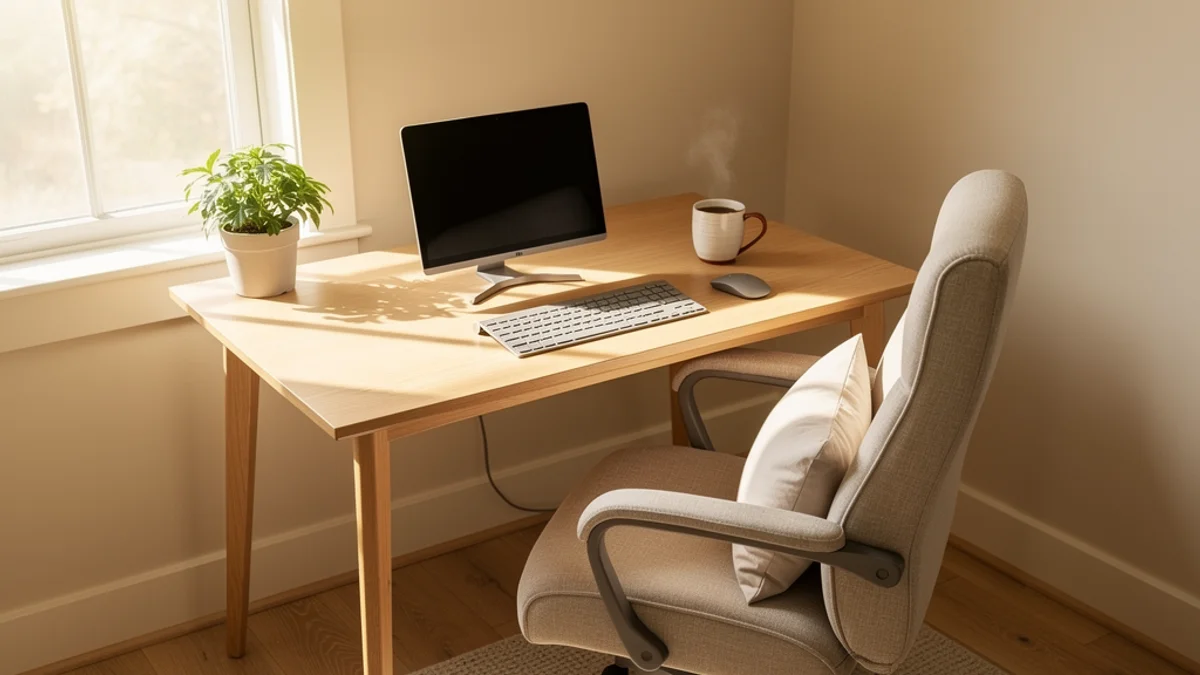
If you work from home, the posture and productivity problem is amplified. Trying to improve posture working from home is harder than in an office, for reasons that go beyond furniture.
In a traditional office, you’ve got an ergonomic chair (probably), a proper desk (hopefully), and at minimum, the social pressure of colleagues seeing you slumped over like a prawn. At home, those guardrails disappear.
Remote workers regularly work from kitchen tables, couches, beds, and dining chairs never designed for eight-hour sessions. Laptop screens sit below eye level, forcing your neck into a forward crane. There’s no facilities team adjusting your chair height. No occupational health assessment. Just you and whatever flat surface was available when you opened your laptop.
The result is that remote workers often develop worse posture habits than their office counterparts - without anyone around to notice. The deterioration is gradual - you won’t notice it until the headaches start, the back pain becomes persistent, or the afternoon crashes become a daily pattern.
This doesn’t mean you need to buy expensive office furniture. It means you need to be more intentional about your setup and more aware of how you’re sitting throughout the day - because nobody else is watching.
Well, unless you set up something to watch for you.
How to Improve Your Posture at Your Desk for Better Productivity
Four approaches that work, ordered from simplest to most effective.
1. Audit Your Desk Setup (5 Minutes)
Before changing any habits, make sure your workspace isn’t actively working against you. Run through this quick checklist:
- Monitor: Top of screen at eye level, roughly arm’s length away. If you’re using a laptop, get a separate keyboard and raise the screen. (Mayo Clinic’s ergonomic guide covers this in detail.)
- Chair: Feet flat on the floor, thighs parallel to the ground. If your chair doesn’t support your lower back, a rolled towel works surprisingly well.
- Keyboard and mouse: At elbow height, so your arms hang naturally at your sides with elbows at roughly 90 degrees.
- Phone: Stop cradling it between your ear and shoulder. Use headphones or speaker.
Most desk posture problems can be traced back to a screen that’s too low or a chair that’s too high. Fix those two things and you’ve eliminated the most common triggers.
2. Build Movement Into Your Day
The best posture advice might surprise you: there is no single perfect sitting position. The problem isn’t how you sit - it’s that you sit the same way for too long.
Try the 20-8-2 rule: spend 20 minutes sitting, 8 minutes standing, and 2 minutes moving. This doesn’t require a standing desk - you can stand during a phone call, walk to the kitchen for water, or simply stretch beside your desk.
The 2023 BMC study found that workers naturally stood most during the afternoon energy dip (2:30pm-4:00pm). If you can only manage one standing session per day, that’s the window where it’ll make the biggest difference.
3. Strengthen Your Postural Muscles
Slouching isn’t purely a discipline problem. Your back and core muscles fatigue after hours at a desk, and gravity wins. Willpower doesn’t fix weak muscles.
One Reddit user documented their experience fixing their posture using a fitness subreddit spreadsheet that identified weak muscles and targeted exercises. They reported “a dramatic change in my posture in less than a month” - not from willpower, but from strengthening the right muscles.
Three exercises that target desk-worker posture specifically:
- Wall angels (2 minutes): Stand with your back against a wall, arms in a “goal post” position. Slowly slide arms up and down. Targets upper back and shoulder muscles.
- Chin tucks (1 minute): Pull your chin straight back (making a double chin). Hold for 5 seconds. Strengthens deep neck flexors that fight forward head posture.
- Thoracic extensions (2 minutes): Sit in your chair, clasp hands behind your head, and gently arch your upper back over the chair back. Opens up the chest and mobilises the thoracic spine.
Five minutes a day. That’s all it takes to start building the muscular endurance that keeps you upright through a full workday.
4. Use Technology to Stay Aware
The bottleneck isn’t knowledge - it’s awareness. You sit up straight, get absorbed in work, and 20 minutes later you’re hunched over again. Knowing the right exercises doesn’t help if you forget to do them.
Technology solves a different part of the problem. SitApp uses your webcam and on-device AI to monitor your posture in real-time. When you start to slouch, it gives you a gentle nudge - like a friend tapping your shoulder. Your webcam feed never leaves your computer, so there’s no privacy trade-off.
The free tier gives you 1 hour of daily monitoring - enough to build awareness during your most productive hours. Over time, that awareness becomes habit, and the nudges become less frequent because your posture improves.
Setting a phone timer works too, but it interrupts whether you need it or not. AI-powered monitoring only nudges when you’re actually slouching - which is the difference between a helpful reminder and an annoying alarm.
How Long Until You See Results?
This is the question nobody else answers, so let’s be specific.
Week 1: If you fix your desk setup and start taking movement breaks, you’ll likely notice less afternoon fatigue and fewer end-of-day headaches. The ergonomic changes work immediately.
Weeks 2-4: With daily posture exercises (even just 5 minutes), you’ll start noticing your default sitting position shifting. The Reddit user who used targeted exercises reported “completely changed the shape of my back” in under a month.
Months 2-3: The research suggests this is when lasting habit change takes hold. In the Ernst & Young study, 50% of participants saw meaningful improvement within their first few sessions, with continued gains over the six-week programme.
You don’t need perfect posture. You need better awareness. Once you start noticing when you slouch - whether through muscle memory, a timer, or a posture monitoring app - the corrections become automatic.
Frequently Asked Questions
Can Bad Posture Cause Headaches and Brain Fog?
Yes. Forward head posture increases strain on your neck muscles and can trigger tension headaches. Slouching also compresses your lungs, reducing oxygen flow to your brain. This oxygen reduction directly causes the foggy, unfocused feeling many desk workers experience in the afternoon.
Does a Standing Desk Improve Productivity?
Research shows a 6.5% productivity improvement when workers can alternate between sitting and standing. However, standing all day is not the answer - the benefit comes from changing positions. If a standing desk isn’t an option, regular movement breaks provide similar benefits.
How Often Should I Take Breaks From Sitting?
The 20-8-2 rule is a practical guideline: 20 minutes sitting, 8 minutes standing, 2 minutes moving. At minimum, stand and move for 2 minutes every 30 minutes. Studies show this is enough to counteract the negative effects of prolonged sitting on both posture and cognitive performance.
What’s the Single Most Important Posture Fix for Desk Workers?
Raise your screen to eye level. Most posture problems cascade from looking down at a screen that’s too low, which forces your head forward, rounds your shoulders, and curves your upper back. Fix the screen height, and many other postural issues resolve naturally.
Your Posture Is a Productivity Tool
The research is consistent across the studies above. Sitting upright improves your breathing, sharpens your focus, boosts your confidence, and lifts productivity by a measurable 6.5%. Bad posture does the opposite - draining your energy, clouding your thinking, and costing you roughly 30 productive minutes every day.
Start with three things this week:
- Fix your screen height - get it to eye level, even if that means stacking books under your monitor
- Set a movement reminder for every 30 minutes - or try SitApp’s free posture monitoring to get nudged only when you’re actually slouching
- Do 5 minutes of wall angels and chin tucks before your first meeting each morning
Your back will feel the difference within days. After that, the connection between how you sit and how well you think tends to stick - you start noticing the slump before it sets in.
