
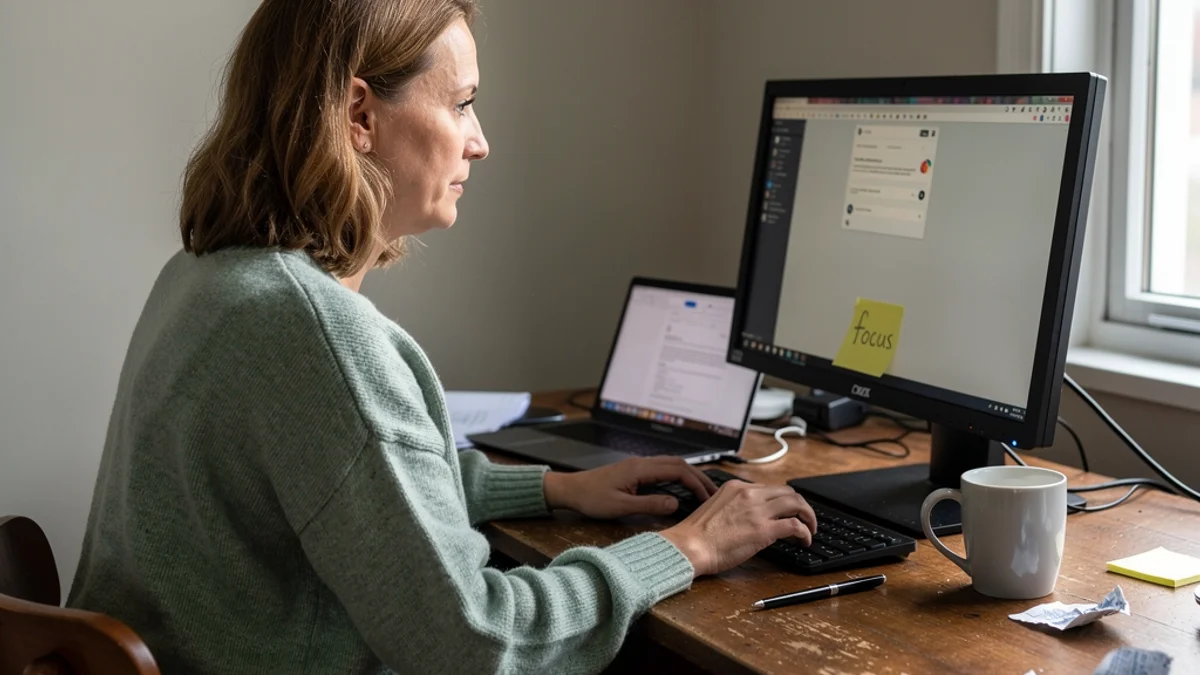
You catch yourself. Chin drifting forward, shoulders rolled in, spine curled into the back of the chair like a comma. So you straighten up, pull the shoulders back, feel briefly virtuous about it. Ninety seconds later the email gets complicated and you’re back in the comma.
Then it happens again after lunch. And at four. And tomorrow.
If you’ve searched for how to remember to sit up straight, you almost certainly already know what good posture looks like. Nobody needs a diagram. The gap is between knowing and doing, and it sits in a very specific place: the moment of remembering. That moment keeps not arriving.
The reason is more interesting than “you lack discipline,” and once you see it, the fix stops being about effort.
Remembering Is the Wrong Tool
Posture correction is a conscious act. It needs attention, and attention is a single pot you’re already spending on something else.
Think about what your day actually asks of you. A spreadsheet that won’t reconcile. A colleague’s message you need to read twice. A build that failed for reasons the log won’t explain. Each of those wins the competition for your attention, every time, because they’re supposed to. Your work is urgent and your spine is not. So the posture check loses, quietly, several hundred times a day.
Losing that competition is the correct allocation of a limited resource, which makes it a strange thing to feel guilty about. Any plan that depends on you winning the fight repeatedly is going to lose over a working week, no matter how motivated you were on Monday.
There’s a second problem stacked on top. Even when you do think about your back, you’re not a reliable judge of what it’s doing.
Researchers test this with repositioning accuracy. You move your spine to a target position, then try to reproduce it without looking, and the size of your error tells you how good your internal sense of the position is. Preuss, Grenier and McGill, publishing in the Journal of Orthopaedic & Sports Physical Therapy in 2003, tested this across three positions and found something worth knowing if you work at a desk. Repositioning errors “were significantly larger in sitting than in standing, under both eyes-open and blindfolded conditions.”
Sitting is the position where your sense of your own spine is at its worst. It’s also the position you spend eight hours in. So the instruction “notice when you’re slouching” is asking you to run a detection system that is measurably degraded exactly when you need it.

The Thing You’re Trying to Remember Is the Wrong Thing
“Sit up straight” implies there’s a correct position, that you should find it, and that holding it is the goal. That belief is a good deal older than the evidence for it. In 2019 a group of physiotherapists led by Diane Slater published a viewpoint in the Journal of Orthopaedic & Sports Physical Therapy titled, plainly enough, “‘Sit Up Straight’: Time to Re-evaluate”. Their summary of where the field stands: “A common belief is that spinal pain is caused by sitting, standing, or bending ‘incorrectly.’ Despite the absence of strong evidence to support these common beliefs, a large posture industry has flourished, with many interventions and products claiming to ‘correct’ posture and prevent pain.”
What does seem to protect people is moving between positions rather than finding one and defending it.
A three-arm cluster-randomised trial across six Bangkok organisations makes the point with numbers. Waongenngarm and colleagues, writing in the Scandinavian Journal of Work, Environment & Health in 2021, followed 193 high-risk office workers for six months. One group got prompts to take active breaks. A second got prompts to shift position in the chair. The third got a placebo seat pad and nothing else.
New neck pain over those six months: 17% in the active break group, 17% in the postural shift group, 44% in the control group. New low back pain: 9%, 7%, and 33%. A separate six-month trial of a dynamic air-filled seat cushion that nudges small position changes found the same shape of result across 133 office workers, with neck pain at 15% versus 65% and low back pain at 10% versus 59% against a placebo pad.
The workers who shifted more often did dramatically better than the ones sitting still, and nobody in those trials was maintaining a textbook posture through willpower. They were just moving.
Which changes the target. Instead of freezing in the right position, you want to stop staying in any single position for forty minutes at a stretch. Much easier to achieve, and easier still to hand off to something other than your memory.
Why the Phone Alarm Stops Working by Thursday
Most people arrive at the same solution first. Set a recurring reminder. Every 30 minutes, buzz, sit up.
It works for about three days.
The decay is so predictable that it has been studied directly. Katarzyna Stawarz, Anna Cox and Ann Blandford at UCL ran a four-week study on how different cue types affect habit formation, alongside a functionality review of 115 habit-forming apps, and presented the results at CHI 2015. Their finding: “relying on reminders supported repetition but hindered habit development, while the use of event-based cues led to increased automaticity.”
Read that twice, because it’s counterintuitive. Reminders made people do the behaviour. Reminders also stopped the behaviour from becoming automatic. The alarm did the remembering, so the brain never had to learn the association, and when the alarm went away so did the behaviour. Meanwhile the people whose trigger was an event they already encountered anyway got the automaticity the alarm group never developed.
There’s a practical failure mode on top of the theoretical one. A timer fires on the clock’s schedule, which has no relationship to yours. It goes off while you’re on a call, or mid-sentence, or two minutes after you already stood up to make tea. Interruptions that arrive at the wrong moment get dismissed, and once you’ve dismissed a few, dismissing becomes the habit you’re building. Plenty of people have taught themselves, with real diligence, to swipe away a posture notification without reading it.
Build the Cue Out of Something You Already Do
The alternative is to attach the posture check to an event that happens on its own, without you scheduling it.
This is the mechanism behind implementation intentions, one of the better-replicated findings in behaviour change. The US National Cancer Institute’s research constructs library defines them as “if-then plans that link situational cues (i.e., good opportunities to act, critical moments) with responses that are effective in attaining goals,” and reports that Gollwitzer and Sheeran’s meta-analysis found “a medium-to-large effect on rates of goal attainment across the 94 studies included in the review (d = .65).” Same page, two more numbers worth having: d = .61 for getting started at all, and d = .77 for not getting derailed once you’ve started.
The format is deliberately mechanical. If X happens, then I do Y. No motivation involved, no deciding in the moment.
For posture the useful X is something frequent, involuntary and already part of your day. Joining a video call. Sending a message. Picking up your cup. Saving a file. A browser tab going to a new page. Something you do twenty times before lunch and never once put in a calendar.
Then Y has to be small enough to survive being done twenty times. Feet flat, sit tall for one breath, back to work. Two seconds. Anything longer than that and you’ll start skipping it by Wednesday.
Pick one trigger, not five. This matters more than people expect. Marco Stojanovic and colleagues at Bielefeld tested it directly in Frontiers in Psychology in 2022, splitting 95 students into a group told to keep the context of a new habit stable and a group told to constantly vary it by changing rooms and times. Across 2,482 habit repetitions, “context stability predicted more automaticity and higher habit repetition goal attainment,” and the same pattern showed up in a second dataset of 308 habits from real users of a habit-building app. Same trigger, same place, same response. Variety is the enemy here.
A few that work well for desk workers, if you want somewhere to start. Every time a call connects, before you speak. Every time you pick up your drink. Every time you send a message to your manager. Choose the one that happens most often in your actual day, which for most people is not the one that sounds most sensible in the abstract.
Change the Desk So There’s Less to Remember
Every cue-based system is fighting against the shape of your workspace, and a badly shaped workspace generates slouching faster than any habit can absorb it.
The single biggest offender is screen height. A laptop on a desk puts the display roughly a foot below eye level, so your neck flexes forward to read it, and no amount of noticing will hold your head up against a screen that’s asking it to come down. Fixing this is a one-off purchase and a five-minute change: a laptop stand plus an external keyboard, or a monitor raised until the top of the screen sits at about eye level. Our guide to the best desk setup for posture covers the measurements, and the laptop stand comparison has the specific options.
Chair depth matters nearly as much. If the seat is too deep, you can’t get your back against the backrest without your feet leaving the floor, so you end up perching or sliding into a slump. Adjust the seat pan or put a cushion behind you.
Then there’s the reach distance to your keyboard and mouse. Anything you stretch for pulls one shoulder forward, and holding that all day is how rounded shoulders and forward head posture get built. Bring the mouse in closer than feels natural.
None of this requires memory. That’s the point of doing it. Every hour of good positioning you get from furniture is an hour you don’t have to buy with attention, and attention is the resource you’re short of.
When You Want Something Else Doing the Watching
Even with a decent desk and a decent trigger, there’s a category of slouching that no cue will catch: the slow kind. You start upright, and over twenty minutes of concentration you sink, a millimetre at a time, without any single moment where you notice a change. Deep work is when this happens most, which is exactly when interrupting yourself is least welcome. We looked at the daily pattern of this in when people slouch most.
This is the gap a posture app is actually for, and it’s worth being picky about which kind.
A timer-based app fires on a schedule whether you need it or not, which puts you straight back in the Stawarz problem. A posture app that watches your actual position only speaks up when your position has genuinely changed, which means far fewer interruptions and each one carrying real information. SitApp works this way. It uses your webcam to check how you’re sitting, all the processing runs on your own machine, and no visual or image data ever leaves your computer. When you drift, the Droid nudges you. When you’re fine, it stays quiet.
The honest framing is that an app like this buys you time while the cue-based habit builds underneath it. Scaffolding, in other words, and scaffolding comes down eventually. If you’d rather start without installing anything, the free posture reminder app roundup covers the options, and how to stop slouching at a desk has the manual version.
How Long This Takes
Longer than you want, and the honest number is worth knowing before you start.
The most-cited study on this is Phillippa Lally’s 2010 work, in which 96 volunteers picked a daily behaviour and reported on it for twelve weeks while researchers modelled how automatic it became. As the International Association for the Study of Pain summarises the findings, “it took between 18 and 254 days - average was more than two months.”
Two months. And that range is enormous, which means your own timeline is close to unpredictable in advance.
Three weeks is the number most people have in their heads. It comes from a 1960 self-help book, not a study: as the American Council on Science and Health puts it, the 21-day figure was “a notion popularized by surgeon and writer Maxwell Maltz” in Psycho-Cybernetics, based on how long his surgical patients took to adjust to a new face. Expecting three weeks and getting eight is how people conclude they’ve failed at something that was working fine.
If you want the fuller picture on timelines for the physical side, how long it takes to fix bad posture covers what changes and when.
What to Do This Week
Skip the ambitious version. Pick one trigger that fires at least ten times a day, and use only that one for a fortnight.
Write the if-then sentence down somewhere you’ll see it on Monday. “When a call connects, I put both feet flat and sit tall for one breath.” Specific event, specific response, nothing else attached to it.
Raise your screen before you do anything else, because that removes more slouching per unit of effort than any habit will. Then let the first two weeks be about the trigger firing, not about how good your posture is when it does. You’re building an association, and the association is the part that has to become automatic before the posture can.
Expect to forget. Given that the range in Lally’s data ran all the way out to 254 days, a bad Wednesday in week two tells you nothing much about how this ends.
Somewhere around the sixth or eighth week, if it’s working, you’ll catch yourself already sitting up as the call connects, a second before any thought about posture arrives. It’s an odd feeling the first time, a bit like finding your hand already on the light switch in a dark room. After that you can stop paying attention to it, which was the point of the whole exercise.
